

Sourcing cheap moving supplies is one of the fastest ways to slash your moving costs, whether you're heading to a new apartment in Raleigh or settling into a home in Orlando. It just takes a little bit of planning and some local know-how to find free or low-cost boxes, tape, and packing materials. As local logistics experts, our Family Movers Express team knows that if you look beyond the obvious retail stores, you can make a serious dent in your moving budget right here in your community.
Your Local Guide to Sourcing Cheap Moving Supplies
Moving in Raleigh, Orlando, or South Florida comes with its own set of local quirks. You might be navigating rush hour on I-95 in Miami or dealing with strict HOA rules in a Lake Nona community. The last thing you need on your plate is the stress of overspending on moving supplies.
Our Family Movers Express teams see it all the time—savvy clients who have figured out how to save a bundle. The secret isn't just about finding the cheapest tape; it's about knowing where to look and who to ask right in your own backyard. Whether you're in a North Hills estate in Raleigh or a high-rise in Brickell, the best resources are often closer than you think.
Smart Sourcing in Your City
You can stretch your moving budget a lot further by tapping into the natural rhythm of your local economy. Think about it: retailers are constantly getting shipments and breaking down sturdy boxes that are perfect for your move.
- Grocery and Liquor Stores: These places get deliveries almost daily and usually have a surplus of clean, durable boxes. Your best bet is to ask the manager at your local Publix in Winter Park or Wegmans in Cary what their "truck day" schedule is. You’ll get the first pick.
- Big-Box Retailers: Stores like Home Depot or Lowe's near the Research Triangle Park can be a goldmine for larger boxes. Just find an employee in the stocking department and politely ask if they have any empties they're about to break down.
- Community Marketplaces: Don't forget to check online. Local Facebook Marketplace groups for Boca Raton or Nextdoor in Durham are fantastic for finding people who just moved and are desperate to get rid of their boxes for free.
By planning ahead and making a few calls to local businesses and neighbors, you can often get most of your moving boxes without spending a dime. It’s a win-win: you save money, and it’s a great way to recycle within the community.
Top Sources for Low-Cost Moving Supplies in Your Area
To make it even easier, here’s a quick rundown of the best places to find cheap moving supplies. We've broken it down by cost, effort, and what you can expect to find in our service areas.
| Supply Source | Typical Cost | Best For | Local Pro Tip (Raleigh/Orlando/SoFlo) |
|---|---|---|---|
| Grocery Stores | Free | Small to medium boxes for kitchen items | Call ahead to a Harris Teeter in Raleigh or a Winn-Dixie in South Florida to find out their shipment days. |
| Community Groups | Free | Full moving kits (boxes, paper, bubble wrap) | Search "moving boxes" on Facebook Marketplace for areas like Winter Garden or Cary. Act fast! |
| Big-Box Retailers | Free (used) | Large appliance and electronic boxes | Ask the receiving department at a Lowe's in Orlando—they often have the sturdiest boxes. |
| Dollar/Thrift Stores | $1 – $5 per item | Tape, markers, rope, packing paper | Great for last-minute needs. The 99 Cents Only Stores in SoFlo are perfect for this. |
| Buy-in-Bulk Online | $50 – $150 per kit | Uniform, new box kits and specialty supplies | Best for large moves where box quality is a top priority. Order at least 2 weeks in advance. |
Getting your supplies sorted early means you can focus your resources on what really matters—a smooth, stress-free move handled by pros.
Finding Free Moving Boxes in Your Neighborhood
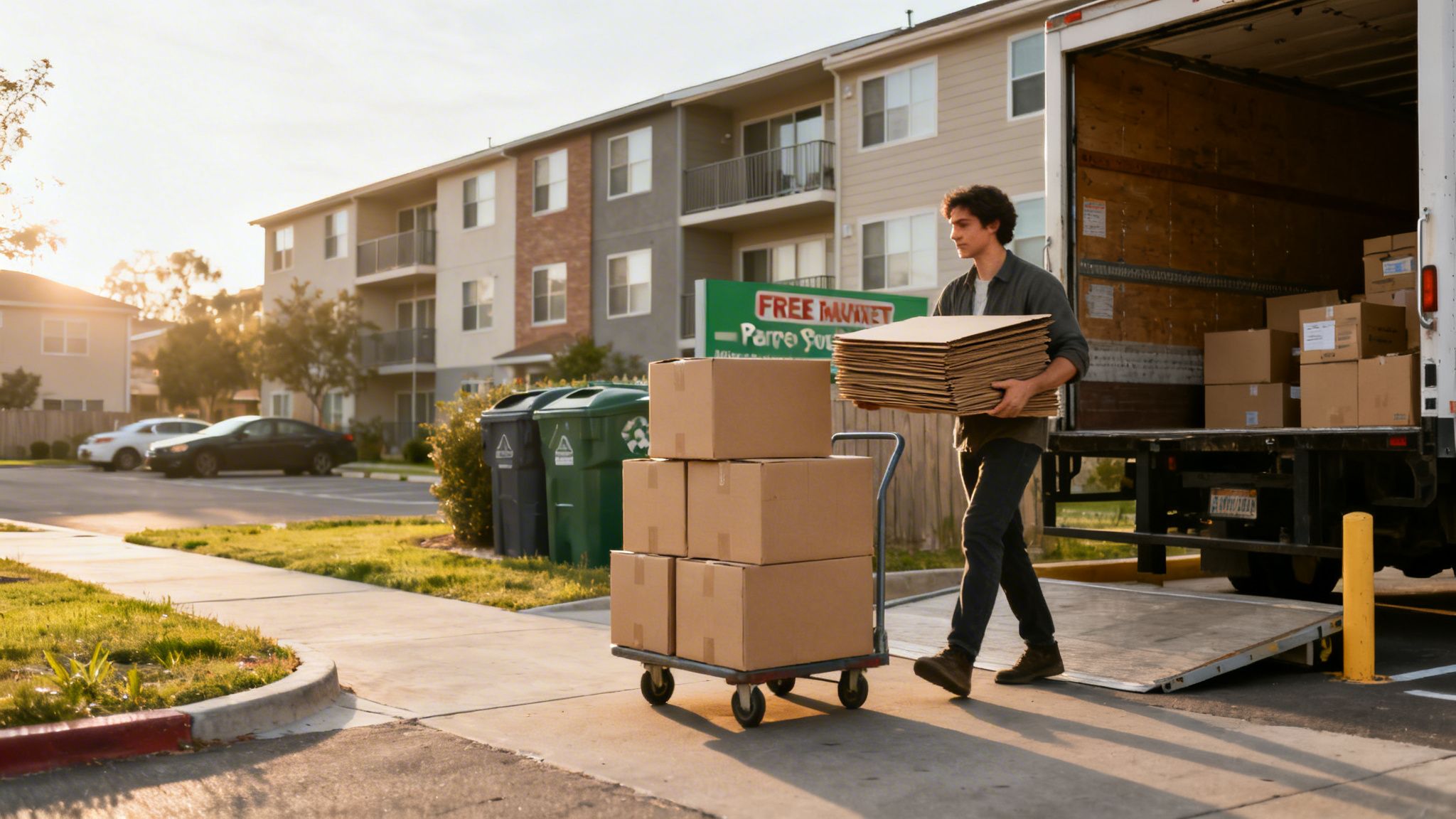
Getting your hands on a good supply of free boxes is the ultimate win when you're trying to move on a budget. This isn't just about saving a few bucks; it's about being smart and sourcing quality materials that will actually protect your stuff, whether you’re heading down the I-4 corridor in Orlando or moving across the Research Triangle.
The real secret is to tap into the rhythm of your local retail scene. Supermarkets and big-box stores are constantly getting shipments, which means they’re constantly breaking down cardboard. It’s all about timing.
After years in the business, our Family Movers Express crews have picked up on these schedules. For example, a lot of grocery stores in places like Cary or Winter Park restock mid-week. If you pop in on a Tuesday or Wednesday morning and politely ask a manager if they have any boxes you can take, you’ll often walk away with a great haul.
Your Local Box-Finding Blueprint
Beyond the big retail chains, your own community is a goldmine for free supplies. You just have to know where to look and who to ask.
- Community Recycling Centers: Swing by the recycling areas at large apartment complexes in Downtown Orlando or Brickell. You'll often find stacks of perfectly good, flattened boxes left by residents who just finished unpacking. The first and last few days of the month are prime time for this.
- Online Neighborhood Groups: Never underestimate your local digital communities. Check out Facebook Marketplace or neighborhood-specific groups for areas like Boca Raton or North Hills. You'll find tons of posts from people desperate to get rid of their entire moving kit—boxes, packing paper, the works.
- Specialty Retailers: Get creative and think beyond the usual suspects. Bookstores, liquor stores, and office supply shops all get shipments in surprisingly sturdy boxes. A quick, friendly phone call to the manager can get you on their list for the next time they're breaking down inventory.
Pro Tip from Family Movers Express: When you're asking stores for boxes, specifically ask for produce or liquor boxes. They're built to be tough—often double-walled—because they have to carry heavy, fragile items. This makes them absolutely perfect for packing up your own dishes, books, or anything else with some heft.
What to Look For and What to Avoid
Let's be clear: not all free boxes are created equal. Your top priority is making sure your belongings arrive in one piece, so a quick quality check is non-negotiable.
Before you start loading up your car, give every box a once-over for any red flags that could put your stuff at risk.
Always check for:
- Structural Integrity: The corners should be solid, and the cardboard shouldn't have any deep creases or weak spots.
- Dryness: If you see any water stains or the box feels even slightly damp, leave it. Moisture destroys cardboard's strength and can lead to mildew.
- Cleanliness: Pass on any boxes that held perishable food or oily items. You don't want to attract pests or have your belongings smell like old pizza.
Sourcing free boxes is a huge part of smart moving prep. For more advice on getting organized, check out our guide on how to prepare for a move. A little bit of resourcefulness now can make for a much smoother and more affordable move later.
Smart Shopping for New Moving Supplies
Let's be realistic—while free boxes are fantastic, there are times you just have to buy new. You can't beat the reliability of a brand-new wardrobe box for your clothes or a specialty dish pack for your fragile glassware.
Buying new doesn't mean blowing your budget, though. It just means you need a game plan.
Whether you're packing up a big house in Raleigh's North Hills or a sleek Fort Lauderdale apartment, the first step is always the same: figure out exactly what you need. Are you starting from scratch and need uniform, stackable boxes for that long-haul move between our NC and FL hubs? Or have you already scored some freebies and just need to fill in the gaps with a few specific containers?
Moving Kits vs. Buying A La Carte
When you start shopping, you'll immediately face a choice: buy a pre-packaged moving kit or pick and choose your supplies individually?
Moving Kits: These are convenient bundles that usually come with a mix of box sizes, tape, and maybe some packing paper. They can be a great value if you’re packing up a standard space, like a two-bedroom apartment in Cary.
A La Carte: Buying items one by one gives you total control. This is definitely the way to go if you have a lot of odd-shaped items or if you've already found a stash of free boxes and just need a few specific things.
If you have a large home, buying in bulk from a big retailer near the Research Triangle or Orlando’s I-4 corridor can save you a surprising amount of money. For smaller moves, you're often better off sticking to local suppliers and only buying what you absolutely need.
For a deeper dive into managing your moving expenses, take a look at our guide on affordable moves and budget-friendly relocation tips.
Finding the Best Deals on New Supplies
The good news is that the moving supply market is huge, and that competition works in your favor. The global market for moving boxes is expected to jump from USD 233.06 billion to USD 349.62 billion by 2032.
This boom, fueled by online shopping, has pushed prices down significantly. A standard wardrobe box that might have cost you $25 a few years ago can now often be found for around $15—that’s a 40% drop that really adds up! You can dig into these market trends over at Maximizemarketresearch.com.
A Pro Tip from Our Team: We always tell our clients to price-check between big-box stores like Lowe's or Home Depot and the big online suppliers. You’ll often find that online retailers have better deals on full kits, but nothing beats running to a local store when you realize you need a couple more heavy-duty boxes at the last minute.
Creative Alternatives for Packing Materials
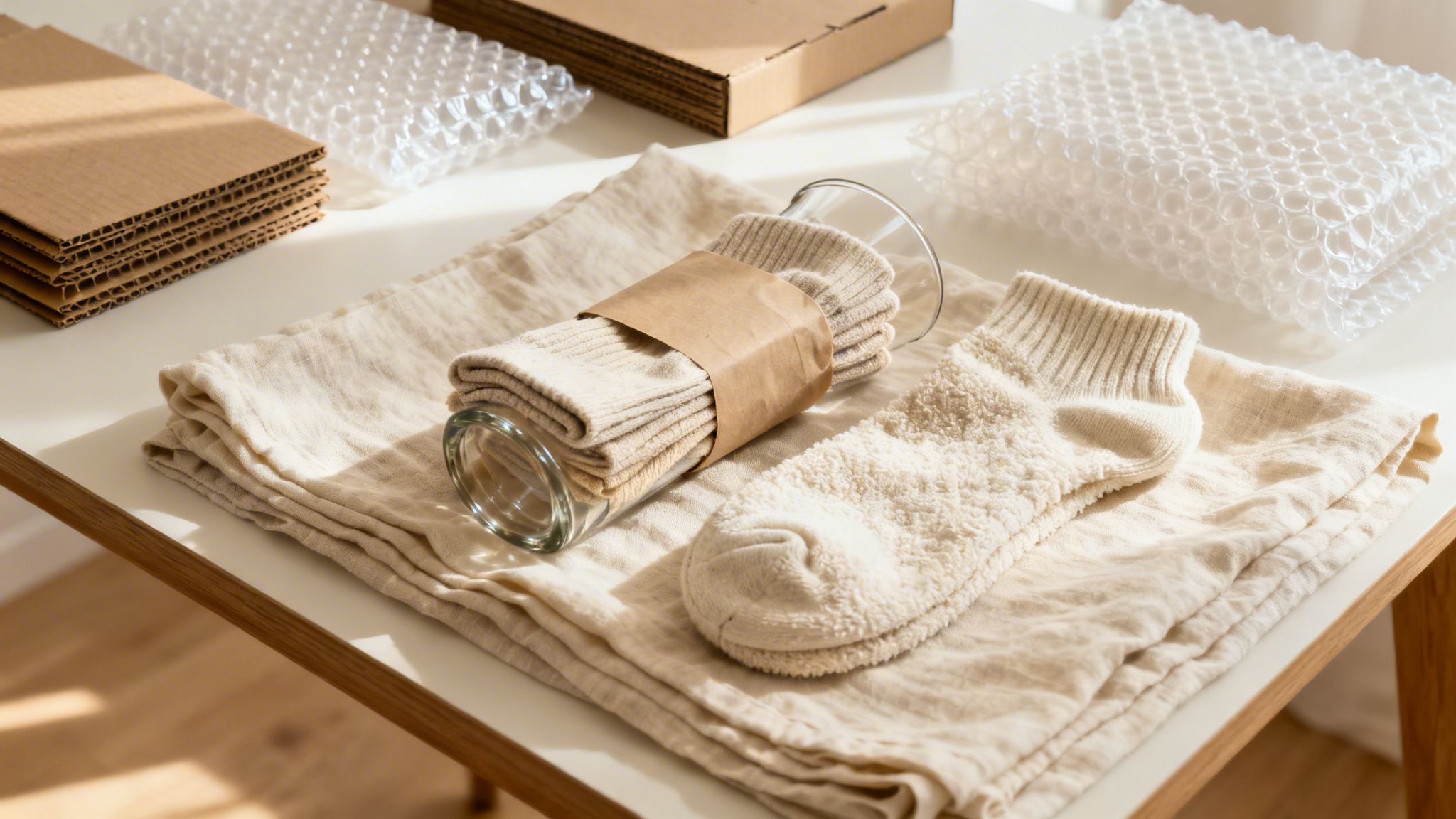
Before you spend a small fortune on bubble wrap and packing peanuts, take a look around your own home. Some of the best packing materials are probably already tucked away in your closets and drawers. This isn't just a budget-friendly trick; it's also an eco-conscious way to reduce waste during your move.
Our Family Movers Express crews have seen some truly inventive solutions on the job, whether we're helping families in Raleigh, Orlando, or South Florida. The secret is to think about an item's purpose—cushioning, padding, or filling empty space—and then find a household substitute. You save money and get a head start on packing your linens and clothes at the same time.
Tapping into Your Household Inventory
Take a walk through your house before you buy a single roll of packing paper. You'll be surprised how many items can pull double duty as cheap moving supplies.
- Linens and Towels: Got big, fragile items? Bath towels, bed sheets, and blankets are your best friends. They're perfect for wrapping up things like lamps, vases, or small electronics, giving them a thick, soft buffer against bumps.
- Clothing: Softer clothes like t-shirts, sweatpants, and sweaters are fantastic for wrapping everyday dishes and glassware. You can also stuff them into gaps in boxes to stop things from shifting around during the drive down I-95 or the Florida Turnpike.
- Socks: Clean socks are the unsung heroes of packing. They make perfect protective sleeves for individual glasses, mugs, or small knick-knacks. Just slide an item inside for instant cushioning.
You wouldn't believe how often our movers in Cary and Winter Park see a box of glasses with each one safely nestled in a sock. It’s a simple, brilliant technique that costs nothing and gets your kitchenware to its new home in one piece.
Smart DIY Packing Solutions
Once you get into this mindset, you’ll start seeing packing potential everywhere. These DIY alternatives are especially great for protecting delicate items, from your finest china to that antique end table. For a deeper dive, you can learn more about the best ways for packing dishes for a move in our comprehensive article.
A few more ideas we've seen work wonders:
Furniture Protection: Instead of buying expensive moving blankets for every single piece, use old comforters or quilts. Drape them over the corners and legs of wooden furniture to prevent scratches and dings during loading and transit.
Plate Cushioning: Don't have any packing paper left? Slip a paper plate between each of your ceramic or glass plates. It creates a thin but surprisingly effective buffer, and you can just toss them in the recycling bin when you unpack.
By repurposing what you already own, you can slash your moving supply budget. It’s a resourceful approach that keeps your belongings safe, whether you're moving to a new home in Durham or just down the street in Boca Raton.
Why Quality Still Matters with Cheap Supplies
Everyone loves saving a buck on moving supplies, but that savvy move can backfire if you're not careful. The whole point of hunting for cheap moving supplies is to cut costs, not to gamble with your belongings. That free box you got from the back of a grocery store? It’s not a bargain if it collapses mid-carry.
Think about it. A flimsy, water-stained box is just a disaster waiting to happen, especially when it's rattling around in a truck somewhere on I-95. As professional movers working between Raleigh, Orlando, and South Florida, we’ve seen it all—and trust me, the aftermath of a box bottom giving out is never pretty.
A quick quality check before you pack is one of the smartest things you can do.
Spotting Red Flags on Used Supplies
Before you start loading up secondhand boxes, give them a quick but thorough inspection. You’re looking for anything that screams "I'm not going to make it."
- Water Damage: Look for any stains, warping, or weird discoloration. Moisture is cardboard’s worst enemy; it completely destroys its strength.
- Weak Corners and Seams: The corners are the skeleton of a box. If they feel soft, are already torn, or have been taped over and over again, it's a sign the box is past its prime. Toss it.
- Weird Smells: Does it smell musty, greasy, or like old food? You definitely don't want those odors clinging to your clothes and linens or inviting pests along for the ride.
Here at Family Movers Express, we’re always telling clients that the longer the move, the more your boxes matter. A trip between our North Carolina and Florida hubs puts a lot of stress on your packing materials. You need supplies that can handle the journey.
Single-Wall vs. Double-Wall Boxes
Not all boxes are created equal, and knowing the difference is crucial.
For lightweight, non-fragile things—think pillows, towels, or blankets—a standard single-wall box will do the job just fine.
But for anything with some real heft or value, you absolutely need to spring for double-wall boxes. They have two layers of corrugated cardboard, which provides a massive upgrade in strength and protection.
Double-wall boxes are non-negotiable for:
- Books, files, and photo albums
- Dishes, glassware, and small kitchen appliances
- Electronics, power tools, and other heavy items
Spending a little extra on a handful of new, sturdy double-wall boxes for your heaviest items is one of the best investments you can make for a smooth move. For more pro tips, take a look at our guide on how to pack fragile items for moving.
This quality-first mindset applies to everything. For instance, when moving with pets, you wouldn't skimp on their safety. Investing in things like safe pet travel items is just common sense. The same logic applies to the boxes protecting your valuables.
The logistics world knows this well. The global transit packaging market is expected to hit USD 414.69 billion by 2032, with cartons and boxes making up over 40% of that. There's a reason so much is invested in quality containers.
For regular folks like us, the data is even more direct: using proper packing materials can slash damage claims by up to 35%. It’s clear proof that paying a little for quality up front saves you a lot of headache and money later on.
How Smart Packing Maximizes Your Savings
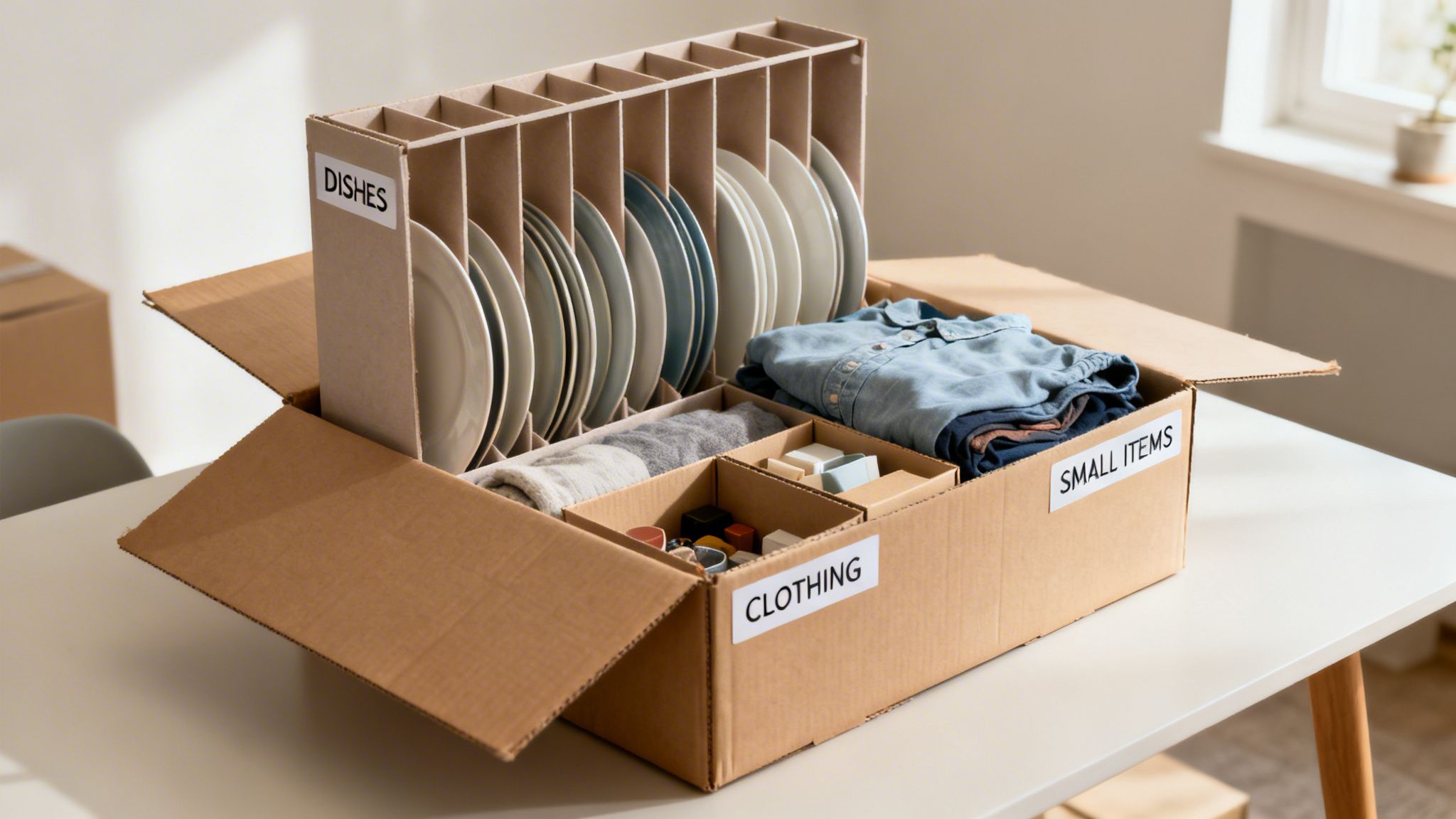
Scoring a great deal on moving supplies is a fantastic start, but the real magic happens in how you use them. This is where you can seriously cut down on waste, time, and stress. Our crews at Family Movers Express see it every day—a smart packing strategy is the difference between chaos and a completely smooth move, whether you’re navigating Orlando's I-4 corridor or heading up I-95.
A half-empty, poorly packed box isn't just a waste of cardboard; it’s an invitation for your belongings to shift, rattle, and break. Getting this part right protects your stuff and makes the most of every single box you've sourced.
The Foundation of a Well-Packed Box
It all starts from the ground up. The number one rule is to place your heaviest items at the bottom of the box. Always. This simple step creates a stable base and stops your lighter, delicate things from getting crushed.
Think of it like bagging groceries—you'd never toss a watermelon on top of the eggs. The same logic applies here, especially when you're packing kitchen boxes with a mix of heavy appliances and fragile dishware.
Once that solid base is in, fill the middle with your medium-weight items. Then, finish by tucking your lightest things, like dish towels or plastic containers, into the top layer. This tiered approach keeps the box balanced, which makes it much safer and easier to carry.
Labeling for a Sanity-Saving Unpack
Let's be honest, a perfectly packed box means nothing if you have no idea what's inside. A clear labeling system is your best friend on moving day. It saves you from that frantic moment of tearing open a dozen boxes just to find the coffee maker.
Here’s the simple yet effective system our pros swear by:
- Get Specific: Don’t just write “Kitchen.” Go a step further with “Kitchen – Pots & Pans” or “Kitchen – Mugs & Glassware.” You’ll know exactly what you’re grabbing.
- Assign a Room: Clearly mark the destination room on at least two sides of the box (the top and one side is perfect). This lets movers place it in the right spot without having to ask.
- Color-Code Everything: This is a game-changer. Assign a different color of marker or tape to each room—blue for the master bedroom, green for the kitchen, you get the idea. It makes spotting boxes at a glance incredibly easy. A dedicated label printer machine can also make this process a breeze, especially for a larger move.
It might feel a little tedious while you’re in the thick of it, but trust me, you will thank yourself when you’re unpacking. Knowing exactly where to find the essentials makes settling into your new place in Cary or Boca Raton so much faster.
With urbanization on the rise in cities like Miami and Raleigh, the demand for moving supplies is growing. The market is actually projected to expand from USD 741.8 million to USD 1,183 million by 2035. This e-commerce-fueled growth has helped push prices down, with some generic boxes costing as little as $1 each when bought in bulk. For the 28 million U.S. households that move each year, using these low-cost supplies smartly is key to keeping expenses in check.
Want to dive deeper? Check out our complete guide on how to pack for a move efficiently. By pairing savvy sourcing with these expert packing techniques, you'll get the absolute most value out of your supplies.
Sourcing cheap supplies is a smart first step, but the real savings come from a move executed with local expertise. For a seamless relocation within the Research Triangle, contact our Expert Raleigh Moving Company. If your move takes you to Central Florida, let our Professional Orlando Movers handle the logistics. And for moves anywhere from Palm Beach to Miami-Dade, our Reliable South Florida Movers are ready to help.
Ready to protect your upcoming move?
Click Here to Fill Out Our Quick Form & Secure Your Instant Quote!
