

The real secret to packing for a move without losing your mind? It all comes down to the game plan you make before a single roll of tape is unspooled. An efficient move isn’t magic; it’s built on three simple pillars: a realistic timeline, the right gear, and a ruthless approach to decluttering. This blueprint is what turns a mountain of a task into a series of manageable molehills.
Your Blueprint for a Stress-Free Move
Let’s be honest, moving can feel like a chaotic scramble to the finish line. But it doesn’t have to. With a bit of structure, you can stay in the driver’s seat and keep the stress way, way down. The trick is to start early and chip away at the monumental task of packing your life into boxes. This isn’t just about dodging that last-minute panic—it’s about building momentum and making steady, visible progress that keeps you going.
The foundation for a smooth move is laid weeks before the truck even shows up. To get started on the right foot, it’s worth checking out some essential tips for packing when moving house to lay some solid groundwork. This initial planning phase really sets the tone for everything that follows.
The Three Pillars of Efficient Packing
Your entire strategy should revolve around these three core ideas. Get them right, and the whole process becomes a thousand times easier.
- Map Out a Timeline: Don’t just vaguely “start packing.” A timeline turns that fuzzy goal into a concrete, week-by-week plan. It’s the single best way to keep from feeling completely overwhelmed.
- Get the Right Supplies: Nothing kills your packing flow faster than running out of boxes or tape mid-session. Do yourself a massive favor and get everything you need upfront—a good mix of box sizes, quality packing tape, bold markers, and plenty of bubble wrap or packing paper.
- Declutter Like You Mean It: Every single item you get rid of is one less thing to pack, haul, and find a place for in your new home. Be brutally honest with yourself. This one step will save you an incredible amount of time, money, and hassle.
I’ve seen it a hundred times: the single biggest mistake people make is underestimating how long packing actually takes. Kicking things off four weeks before moving day isn’t being overly cautious—it’s being realistic. It gives you the breathing room to sort, pack, and label properly without that frantic, deadline-driven pressure.
This planning becomes even more vital when you’re moving long-distance. The logistics are just on another level. If that’s you, you’ll want to dig into the specifics of https://familymoversxpress.com/how-to-plan-a-cross-country-move/ to make sure every base is covered.
Your 4-Week Packing Timeline
Breaking your move down into a four-week schedule is the most practical way I know to tackle it methodically. Each week gets its own focus, so you build momentum without burning out.
To make this crystal clear, here’s a simple timeline you can follow. It breaks down the entire month before your move into focused, actionable chunks.
The 4-Week Efficient Packing Timeline
A week-by-week breakdown of packing tasks to keep your move on track and stress-free.
| Week | Key Tasks | Goal |
|---|---|---|
| Week 4 | Plan and Purge. Start decluttering room by room. Research movers. Gather all packing supplies. | Lighten the load and get organized. |
| Week 3 | Pack non-essentials. Box up out-of-season items, books, decor, guest room contents. | Make a significant dent in the packing. |
| Week 2 | Tackle the main living areas. Focus on the kitchen, living room, offices, and other bedrooms. | Pack the bulk of your home. |
| Week 1 | Pack essentials. Finish final items. Prepare a "first-night" box with everything you'll need on arrival. | Finalize packing and prepare for moving day. |
Sticking to a schedule like this turns a daunting project into a checklist. You'll know exactly what you need to do and when, which is the key to keeping your sanity intact during one of life's biggest transitions.
The Smart Room-by-Room Packing Strategy
Knowing how to pack for a move efficiently isn’t about raw speed; it's all about the sequence. The real secret is to tackle your home in an order that causes the least amount of disruption to your daily life. When you strategically pack room by room, you create a methodical process that keeps the chaos from taking over and ensures you aren't frantically digging for your coffee maker the morning the truck arrives.
This approach turns a monumental task into a series of smaller, much more manageable victories. You'll build momentum and keep that crucial sense of control, which is the key to a low-stress move.
This packing preparation timeline gives you a great visual for breaking down the process into manageable chunks over the final four weeks.
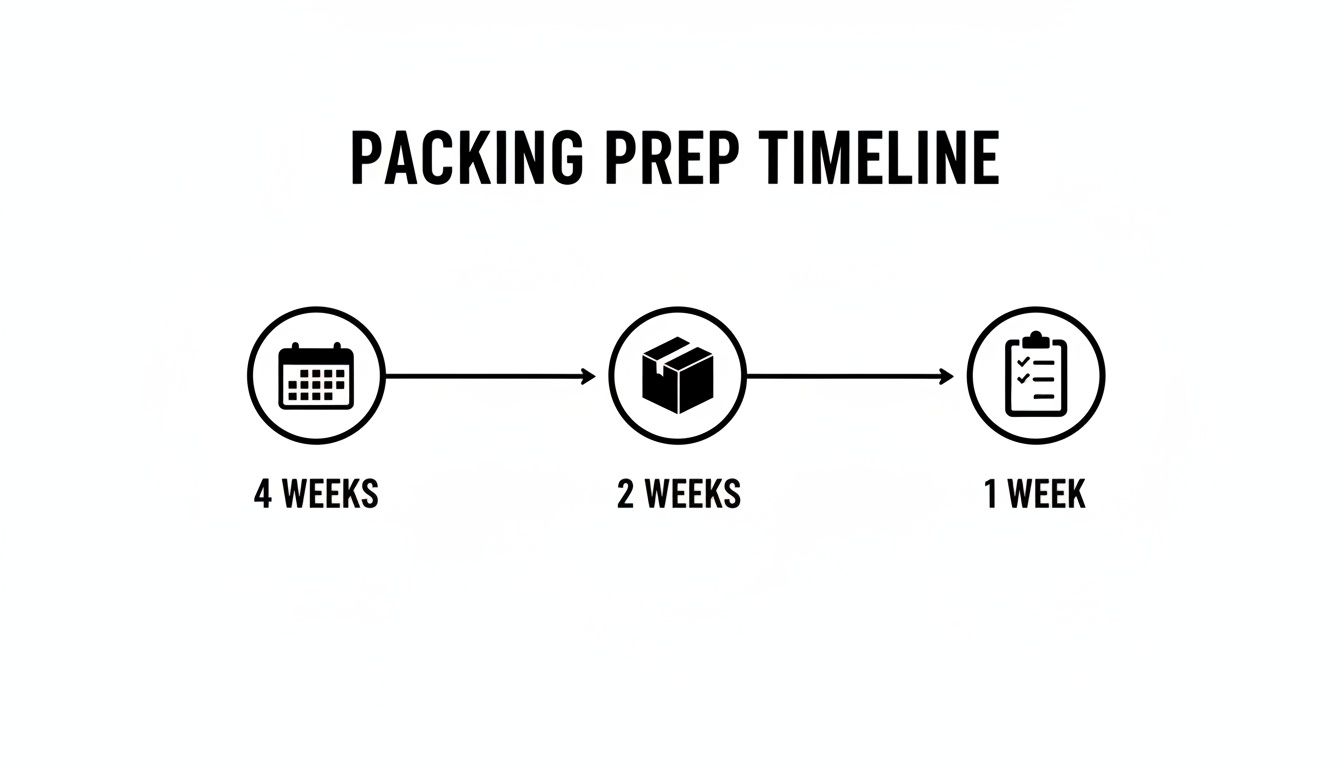
As you can see, a successful pack really starts weeks ahead of time. Dedicating specific blocks for planning, the actual packing, and final checks is what will save you from that last-minute panic.
Start with the Spaces You Use Least
The golden rule of efficient packing is to begin with the rooms and items you absolutely won't miss. I'm talking about those places like storage closets, guest bedrooms, the garage, or your attic. Packing these spaces first gets a huge volume of your stuff boxed up early without messing with your day-to-day routine.
A few great starting points:
- Storage Areas: Box up all those seasonal decorations, old files, and memorabilia.
- Guest Rooms: Pack away the extra linens, decor, and any furniture that isn't used regularly.
- Off-Season Items: Use vacuum-seal bags to shrink down bulky winter coats or summer clothes. This saves an incredible amount of box space.
This "out of sight, out of mind" strategy clears out a ton of clutter and gives you a powerful psychological boost. You're making real, tangible progress you can actually see, which fuels your motivation to keep going. Our guide on what to pack first when moving offers even more detail on how to prioritize your belongings.
Progress to Moderately Used Areas
Once the non-essential zones are done, you can move on to the next tier of rooms. This usually includes places like home offices, formal dining rooms, and living rooms. You might still use these spaces, but you can probably live without most of their contents for a couple of weeks.
In the home office, for example, pack up the bulk of your books but leave out your laptop and essential documents. In the living room, go ahead and box up decorative items, photo frames, and your movie or music collections. The key is just to leave enough out to keep the space functional until the final days. For a truly systematic approach, an ultimate moving house packing checklist can be an invaluable tool to keep you on track.
Save the Busiest Rooms for Last
The kitchen, master bedroom, and main bathroom should be the absolute last areas you even think about packing. These are the high-traffic hubs of your home, filled with things you need every single day. Trust me, waiting until the final week—or even the last couple of days—to tackle them is the smartest move you can make.
Based on what we see in the field, a structured, room-by-room packing method can cut down overall move times by as much as 28%. That efficiency is a big deal in a moving services market currently valued at $23.4 billion. Simple tricks, like packing plates vertically to reduce breakage by 30% or using vacuum seals to compress clothing volume by 60%, are small changes that make a huge difference.
When it's finally time for these rooms, work quickly and methodically. For the kitchen, leave out just one pot, one pan, and a plate and utensil set for each family member. In the bedroom, keep your bedding accessible and pack a small suitcase with a few days' worth of clothes, just like you're going on a short trip. This ensures you have everything you need right up until moving day without having to rip open boxes you just sealed.
Packing Techniques the Professionals Use
Knowing the right order to pack your home is one thing, but how you pack is what truly separates a smooth move from a chaotic one. We’ve seen it all, and the difference often comes down to a few key techniques that not only protect your belongings but also maximize every inch of space inside a moving box.
Learning these insider tricks is a huge part of packing efficiently. It prevents heartbreak over broken heirlooms and makes the unpacking process infinitely easier on the other side.
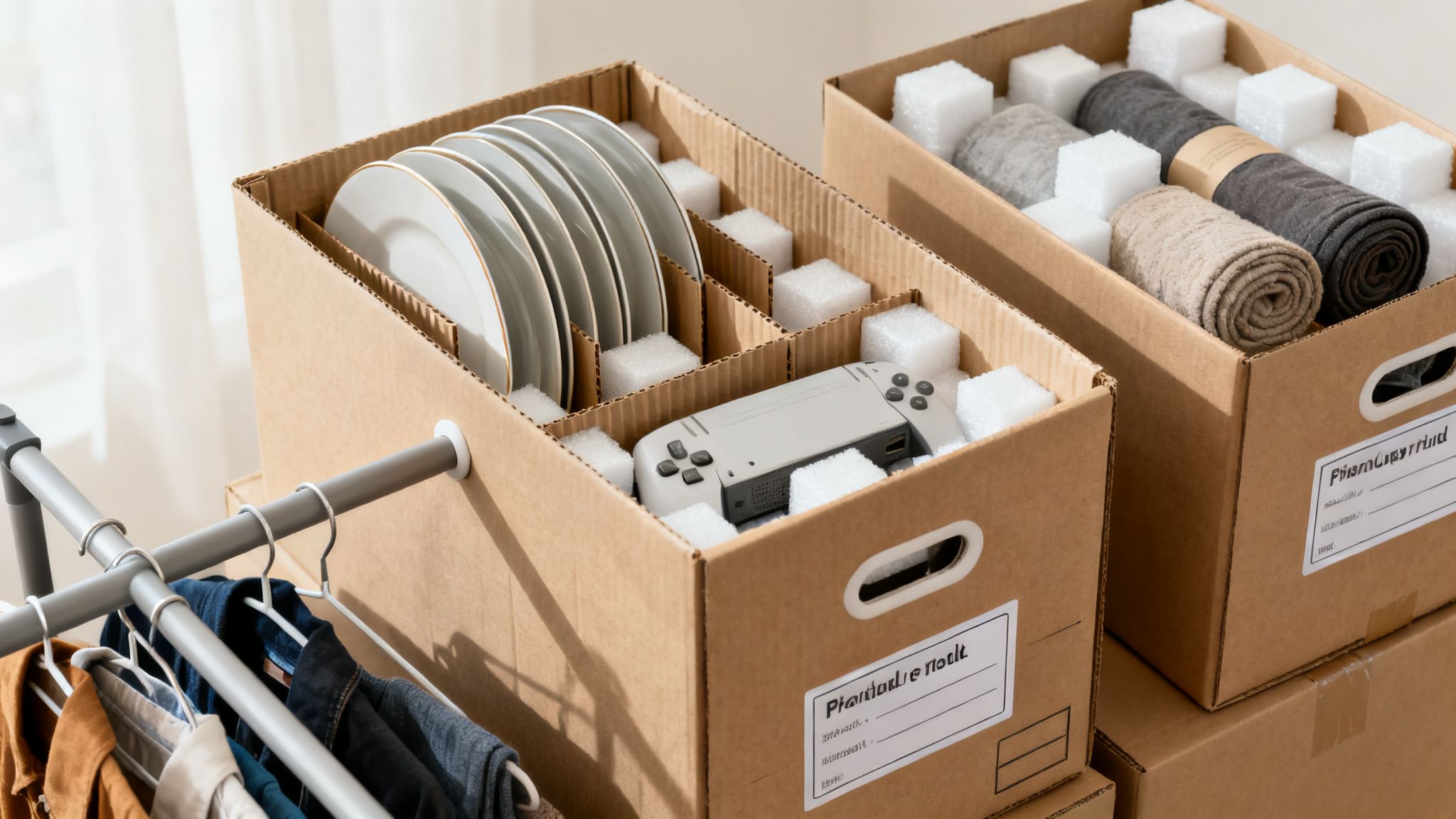
It all starts with using the right materials. While it’s tempting to grab any free box you can find, believe me when I say that quality supplies are a non-negotiable part of a successful move. This means investing in double-walled boxes for heavy items like books and using proper wardrobe boxes for your hanging clothes.
Protecting Your Fragile Items
The kitchen is almost always the most dreaded room to pack—it’s just full of breakables. If you learn one thing today, let it be the importance of vertical packing for your plates and dishes. Stacking them flat, one on top of the other, puts way too much pressure on the items at the bottom of the pile.
Instead, here’s what we do:
- Wrap each plate individually in packing paper.
- Bundle three to four wrapped plates together and give them a quick wrap of tape.
- Place these bundles into a box on their sides, like you’re filing records in a crate.
This method allows the plates to absorb shock and vibrations from the top and bottom, which drastically reduces the risk of anything chipping or shattering. For glasses and mugs, grab some cell-divider kits to create cushioned compartments inside your boxes. When it comes to the delicate stuff, a little extra time is your best friend. For a deeper dive, check out our complete guide on how to pack fragile items for moving.
Never leave empty space in a box of fragile items. Any room for movement is an opportunity for damage. Use crumpled packing paper, old towels, or even soft linens to fill every single gap and ensure a snug, secure fit. This simple step is what really keeps your belongings safe in transit.
Mastering Your Wardrobe and Linens
When it comes to clothing, folding is surprisingly inefficient. Tightly rolling items like t-shirts, jeans, and sweaters not only minimizes wrinkles but lets you fit significantly more into a standard box or suitcase. It's a simple trick that works wonders for saving space.
For clothing you want to keep on hangers—think suits, dresses, and nice blouses—wardrobe boxes are an absolute game-changer. These tall boxes have a built-in bar, letting you transfer clothes directly from your closet right into the box. It saves a massive amount of time on both ends of the move.
Handling Electronics and Heavy Items
Electronics need special care because of all their delicate components. If you happen to still have the original packaging for your TV, computer, or gaming console, use it. Those boxes were literally designed to protect those specific items perfectly.
If the original boxes are long gone, just follow these guidelines:
- Wrap Securely: Use anti-static bubble wrap to cover the entire device.
- Protect Corners: Add some foam corners for extra cushioning against bumps and drops.
- Label Cords: Before you unplug a single thing, snap a photo of the setup. Then, use colored tape or labels to mark which cord goes where. This will save you a massive headache during reassembly.
For heavy things like books, the rule is simple: small box, heavy items. It’s such a common mistake to fill a huge box with books, only to find it's impossible to lift or, even worse, the bottom gives out. Using small, sturdy book boxes keeps them manageable and secure. Just distribute the weight across multiple boxes instead of trying to cram it all into one or two.
By applying these methods, you're not just moving your stuff—you're protecting your investments and setting yourself up for a much, much smoother unpacking experience.
A Labeling System That Actually Works
Let's be honest, an unlabeled box is a mystery you don’t have time to solve on moving day. I've seen it a thousand times: a mountain of brown cardboard becomes a wall of frustration. A solid labeling system is probably the single most important thing you can do for an efficient unpacking process, turning chaos into a clear roadmap for your new home. This goes way beyond just scribbling "Kitchen" on the side with a marker.
Think of each box as a package you're sending to a specific destination inside your new house. Your label is the address. If it’s unclear, it gets lost in the shuffle, creating hours of extra work for you and your movers. A great system ensures every box lands exactly where it belongs from the moment it comes off the truck.
The Color and Number Combination
Over the years, the most effective method I've seen combines two simple elements: colors and numbers. This double-whammy approach gives you an at-a-glance visual guide while also letting you track things in more detail. It's a system that’s incredibly easy to set up but pays off big time.
Here’s the game plan:
- Assign a Color to Each Room: Go grab a pack of multi-colored packing labels or even different colors of duct tape. Pick one distinct color for each room in your new place (e.g., green for the kitchen, blue for the master bedroom, yellow for the living room).
- Create a Master Key: This is a simple but brilliant trick. At your new home, stick a small sheet of paper by the entrance with the color key. Or even better, just tape one of the colored labels to the doorframe of the corresponding room. A green sticker next to the kitchen door tells movers that any box with a green label belongs right there. No questions asked.
- Number Every Single Box: As you seal up a box, give it a unique number. Write this number big and bold, right next to the colored sticker. This number is your link to the master inventory list.
Trust me, this strategy is a game-changer. Some moving industry analyses even suggest that using colored stickers to designate rooms can slash unpacking chaos by as much as 50%. With North America dominating 42.3% of the global moving services market, efficiency tricks like this are what separate a stressful move from a smooth one. For a deeper dive into market trends, you can check out the latest moving services market report.
Create a Digital Master Inventory
So, what are all those numbers for? They need a reference point, and that's where a simple digital inventory comes in. You don't need any fancy software—a notes app on your phone or a basic spreadsheet is perfect.
Just create a list with two columns: Box Number and Key Contents. As you pack box #1 (your first green kitchen box, for example), you'll quickly jot down its main contents: "Box 1: Pots, pans, colander, mixing bowls." Then for the next one: "Box 2: Everyday plates, bowls, silverware."
This master list becomes your secret weapon on moving day. Instead of tearing open five green-labeled boxes just to find the coffee maker, you can search your digital list for "coffee maker" and instantly see it’s in Box #4. It transforms what would be a frustrating guessing game into a precise, targeted search.
Don't Forget Priority and Content Details
Okay, beyond the color and number, there are two final details that will make your move even smoother.
First, list a few key contents directly on the box. While your digital list is great for finding specific items, a quick summary on the box itself is super helpful for immediate identification. Below the number, just scribble 3-5 main items inside. For example: "MASTER BEDROOM – Box 14 – Sweaters, Jeans, Belts."
Second, mark your "Open First" boxes. Every move needs an "essentials" or "first night" box. This is where you'll put things like toiletries, medications, phone chargers, a basic toolkit, and maybe the coffee supplies. Make sure you mark these boxes with a big, bold "OPEN FIRST" on all sides. That way, they are immediately identifiable and can be set aside as soon as they come off the truck.
A well-labeled box saves you time twice. First, it helps the movers place it in the correct room without having to ask you where every single box goes. Second, it saves you from the frustrating 'box shuffle' when you're exhausted and just need to find the bath towels. It’s the ultimate investment in your moving day sanity.
Let's be honest, the idea of packing up your entire life yourself can feel like a great way to save a few bucks. But the reality? Time, stress, and the very real risk of your favorite vase ending up in a million pieces are all hidden costs that can add up fast. Knowing when to call in the pros isn't about giving up; it's a strategic move that can turn a frantic nightmare into a smooth, managed process.
Sometimes, the choice is pretty much made for you. If you’re staring down a last-minute move with a tight deadline, trying to pack a whole house on your own is a recipe for disaster. Imagine you land a dream job that needs you to relocate in two weeks—the sheer volume of packing, on top of everything else, makes professional help a necessity, not a luxury.
Evaluating the Cost Versus Benefit
Hiring professional packers is an investment, but it's one that often pays for itself. The biggest return you get is time. So much time. A trained crew can pack an entire house in a fraction of the time it would take the average person, freeing you up to handle the other hundred things on your to-do list, like switching utilities or enrolling the kids in their new school.
And then there's the stress factor. Packing is physically grueling and mentally exhausting. Pro teams do this every single day. They show up with the right materials, work with a system, and take that massive weight right off your shoulders. That peace of mind is priceless, especially when you're already navigating a huge life change.
The real value isn't just in how fast they work; it's in their expertise. Professionals use high-quality, industry-standard materials and proven techniques to protect your stuff. For anything fragile or valuable, their skill is the best insurance policy you could ask for.
Scenarios Where Professionals Just Make Sense
Every move is different, of course, but some situations are a clear signal that it's time to call for backup. If any of these sound familiar, it’s probably worth getting a quote for packing services.
- You Have High-Value or Specialty Items: Got a collection of delicate antiques, valuable art, or maybe even a grand piano? This is a non-negotiable. Professionals have the specific know-how and materials to crate and protect these items in a way you simply can't.
- You're Physically Unable or Just Plain Overwhelmed: Moving is a seriously physical job. If you have health issues or are just looking at the mountain of stuff in your home and feeling paralyzed, hiring help is the smartest thing you can do for your well-being.
- You're Relocating a Large Home: Packing a four-bedroom house, plus a garage and an attic, is a monumental project. A pro team can knock out in a day or two what might take you weeks of evenings and weekends to finish.
Considering Partial Packing Services
You don't have to go all-in. Many people strike a perfect balance with partial packing services. This is a fantastic option if you're on a budget but could really use an expert hand for the trickiest parts of the job.
For example, you could pack up the bedrooms and closets yourself but bring in the pros to tackle the kitchen—easily the most time-consuming room in any house. Or maybe you have them focus only on your fragile items, ensuring all your china, glassware, and electronics are packed with expert care. This hybrid approach lets you control the cost while still getting professional expertise right where you need it most. You can find out more by checking out options from trusted professional packers and movers to see how they can tailor a plan for your specific move.
Your Moving Day Essentials and Final Walkthrough
The last 24 hours before you hand over the keys are when all that hard work really starts to pay off. With the truck nearly loaded and your old place echoing with emptiness, your focus needs to narrow down to two final, critical tasks.
First up is your “first night” essentials box. This is your lifeline. Second is a meticulous final walkthrough. Getting these two things right sets the stage for a smooth, stress-free arrival.
Assembling Your Moving Day Lifeline
This isn't just another box. This is the one box that travels with you—not in the moving truck. When you finally stumble into your new home, exhausted and staring at a mountain of cardboard, the last thing you want to do is hunt for a phone charger, your toothbrush, or a roll of toilet paper.
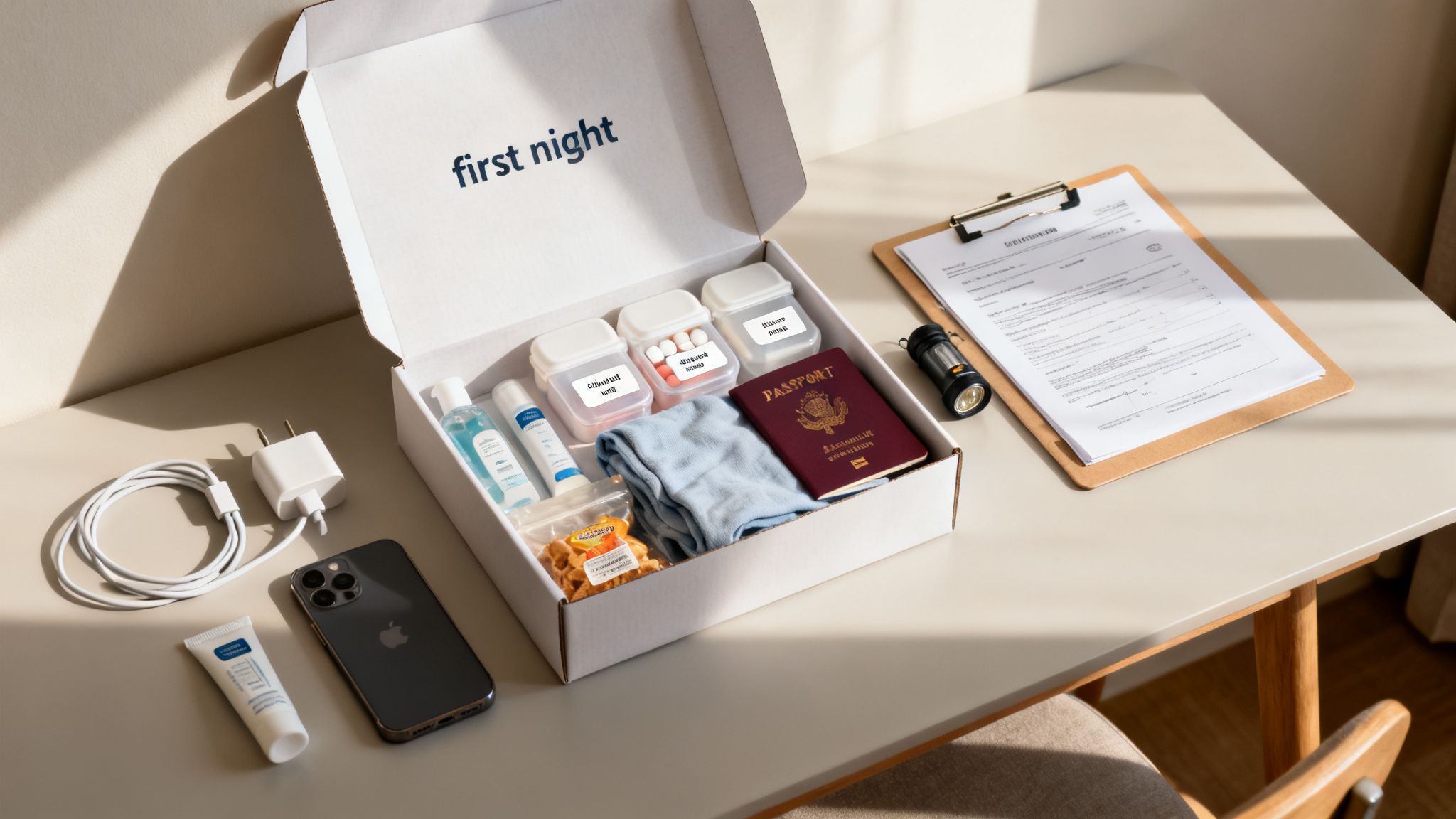
Think of it like packing an overnight bag for your first night in a new, empty house. The goal is pure comfort and functionality. A well-stocked essentials box is what prevents that late-night panic run to a store you don't even know yet.
Here’s what absolutely needs to be in there:
- Personal Items: A fresh change of clothes for everyone in the family, plus basic toiletries like a toothbrush, soap, and deodorant. Don't forget any required daily medications.
- Critical Documents: Keep your passports, birth certificates, moving contracts, and the new lease or closing papers on your person. Do not let these out of your sight.
- Tech and Tools: Phone chargers are a must. I also recommend a small toolkit with a box cutter, screwdriver, and a set of Allen keys for any quick furniture assembly.
- Comforts: A few snacks and some bottled water will feel like a five-star meal after a long day. If you’re a coffee or tea drinker, pack your supplies. And please, please, don’t forget toilet paper and a roll of paper towels.
I’ve seen this happen countless times: a family arrives at their new home late at night, only to realize the toilet paper is buried in one of fifty different boxes. Your essentials box isn't just a convenience; it's a crucial tool for maintaining your sanity on what is always a long and tiring day.
The Final Sweep and Handover
Once the last box is on the truck and the house is completely empty, it’s time for one last, thorough walkthrough. Whatever you do, don't rush this part. You’re looking to make sure nothing was accidentally left behind and that you're leaving the property in good condition for the next folks.
This is also your last chance to double-check administrative tasks. For instance, have you figured out how to change your address when moving?
Go through every single room. Open every closet, every cabinet, and every drawer one last time. Pay extra attention to those spots we all forget, like the top shelves of closets, the back of the pantry, or even inside the dishwasher and oven.
As you go, do a quick sweep of the floors and wipe down the counters. Make sure all windows are closed and locked, and snap a few photos or a quick video to document the home's condition when you left. This final, methodical check gives you peace of mind and ensures your move ends on a clean, positive note.
To help you stay on track during the final moments, we've put together a simple checklist. Print it out and tick things off as you go.
Printable Moving Day Final Checklist
| Task Category | Action Item | Status (Done) |
|---|---|---|
| Final Packing | Load personal essentials box into your car | |
| Confirm all other boxes are loaded on the truck | ||
| Do a final check of easily missed spots (attic, garage, shed) | ||
| Home Security | Close and lock all windows and doors | |
| Turn off all lights and ceiling fans | ||
| Set thermostat to an appropriate temperature (off or seasonal setting) | ||
| Documentation | Take photos/video of the empty home's condition | |
| Note final meter readings (gas, water, electric) | ||
| Leave keys, garage door openers, and any manuals for the new occupants | ||
| Final Handover | Do a final sweep of floors and wipe down surfaces | |
| Ensure all personal trash is removed from the property | ||
| Confirm you have the new keys and all necessary paperwork |
Completing this checklist is your final act in the old home. It’s the last step that officially closes one chapter and lets you turn your full attention to the new one waiting for you.
Even with the best-laid plans, a few questions always pop up when you're staring at a mountain of boxes. We get it. Here are some straight-shooting answers to the questions our moving crews hear all the time.
What Is the Fastest Way to Pack a House?
I know it’s tempting to just go into a frenzy and throw things in boxes, but trust me on this: methodical is always faster than rushed. The quickest way to actually get it done right is to declutter ruthlessly first. Then, tackle the house room by room, starting with the stuff you won't miss, like guest room linens or out-of-season clothes.
A pro tip? Use wardrobe boxes. Seriously. Moving clothes on their hangers takes seconds, whereas folding everything can eat up an entire afternoon. Have all your tape, boxes, and markers ready before you start a room so you're not constantly stopping and starting.
Should I Pack or Move Furniture First?
Always, always, always pack first. Imagine trying to pivot a king-size mattress around stacks of half-filled boxes. It’s a recipe for disaster—for your stuff and your toes.
Boxing up all the loose items clears out the space and gives you clean, safe pathways to move the big, heavy furniture. Clear the clutter, then bring in the muscle for the big stuff.
The biggest holdup on moving day is almost never the furniture itself. It's the dozens of loose odds and ends and half-taped boxes our crews have to navigate around. A completely packed-up house makes the loading process worlds faster and safer.
How Much Should I Pack Per Day?
Don't fixate on a magic number of boxes. Instead, just aim for consistent, steady progress. A really manageable goal is to pack for 1-2 hours each day in the weeks leading up to the move.
Some days, that might mean you knock out 5-10 boxes of books while watching TV. On a Saturday, you might dedicate a few solid hours to clearing out the entire garage. This approach keeps you from getting burned out and prevents that last-minute panic where you're just shoving things into bags.
When you hit a snag, having a professional team in your corner can make all the difference. For expert packing help or a full-service move where you don't have to lift a finger, you can count on Family Movers Express LLC. Get a transparent, no-nonsense quote by visiting us at https://familymoversxpress.com.
Ready to protect your upcoming move?
Click Here to Fill Out Our Quick Form & Secure Your Instant Quote!
