

When you’re staring down the barrel of a move, it’s easy to feel overwhelmed. But trust me, it all comes down to four key phases that start about eight weeks out: strategic planning, smart decluttering, organized packing, and final execution.
Whether you're trying to coordinate a high-rise move in Miami's Brickell or dealing with a strict HOA in Cary, NC, breaking it down this way keeps the chaos at bay. It puts you back in the driver's seat.
Your Quick Start Guide to a Smooth Move
Here at Family Movers Express, we’ve handled thousands of moves across Raleigh, Orlando, and all over South Florida. We've seen firsthand that a good move starts long before a single box is taped shut. It really begins with a solid plan that accounts for the quirks of your specific region.
Think of this as your high-level roadmap. We’ve broken the whole process into four manageable stages, each with a crucial local tip to help you sidestep common headaches. This quick look will get you started on the right foot before we get into the nitty-gritty of the week-by-week timeline. For a closer look at those first crucial weeks, you can learn more about how to plan your move 6-8 weeks prior to your move.
Moving Preparation Overview
To kick things off, this table gives you a bird's-eye view of the entire process. It’s a simple way to see what's coming and stay on track from the very beginning.
| Phase | Timeframe | Key Actions | Local Tip |
|---|---|---|---|
| 1. Strategic Planning | 8 Weeks Out | Set budget, create a moving binder, and get an in-home estimate. | For Orlando: Book early if moving between June and November to avoid hurricane season disruptions and secure your preferred date. |
| 2. Declutter & Downsize | 6 Weeks Out | Sort items into keep, donate, sell, and discard piles. Schedule donation pickups. | For Raleigh: College move-out times (May & August) create high demand for movers. Declutter and book your move with Family Movers Express well in advance. |
| 3. Organized Packing | 4 Weeks Out | Gather supplies, pack non-essential rooms, and create a detailed inventory list. | For South Florida: High humidity can damage electronics and furniture. Use plastic totes and proper wrapping for sensitive items. |
| 4. Final Coordination | 1 Week Out | Confirm with your movers, pack an essentials box, and notify utilities. | For All Hubs: Confirm elevator reservations and parking rules with your HOA or building management, especially in dense areas like North Hills or Boca Raton. |
See? When you break it down like this, it feels much more doable. Each phase builds on the last, setting you up for a seamless transition.
A well-structured plan is the single most effective tool against moving-day stress. By tackling tasks in phases, you transform a massive project into a series of achievable steps.
And once you’re all moved out, the next chapter begins. An ultimate moving into new house checklist is a great resource for settling in and making sure you don’t miss a beat on the other side.
Essential Moving Timeline: From Eight Weeks Out
A smooth move doesn't just happen in the final, frantic week before the truck shows up. I’ve seen it time and again: the best moves are the ones that start with a steady, organized game plan at least two months in advance. The key is to break down what feels like a massive project into simple, weekly tasks. This roadmap is designed to take the chaos out of the equation, with real-world tips for moves in Raleigh, Orlando, and South Florida.
Think of it as a clear sequence of events: you plan, you prep, you pack, and then you move. It’s that simple.
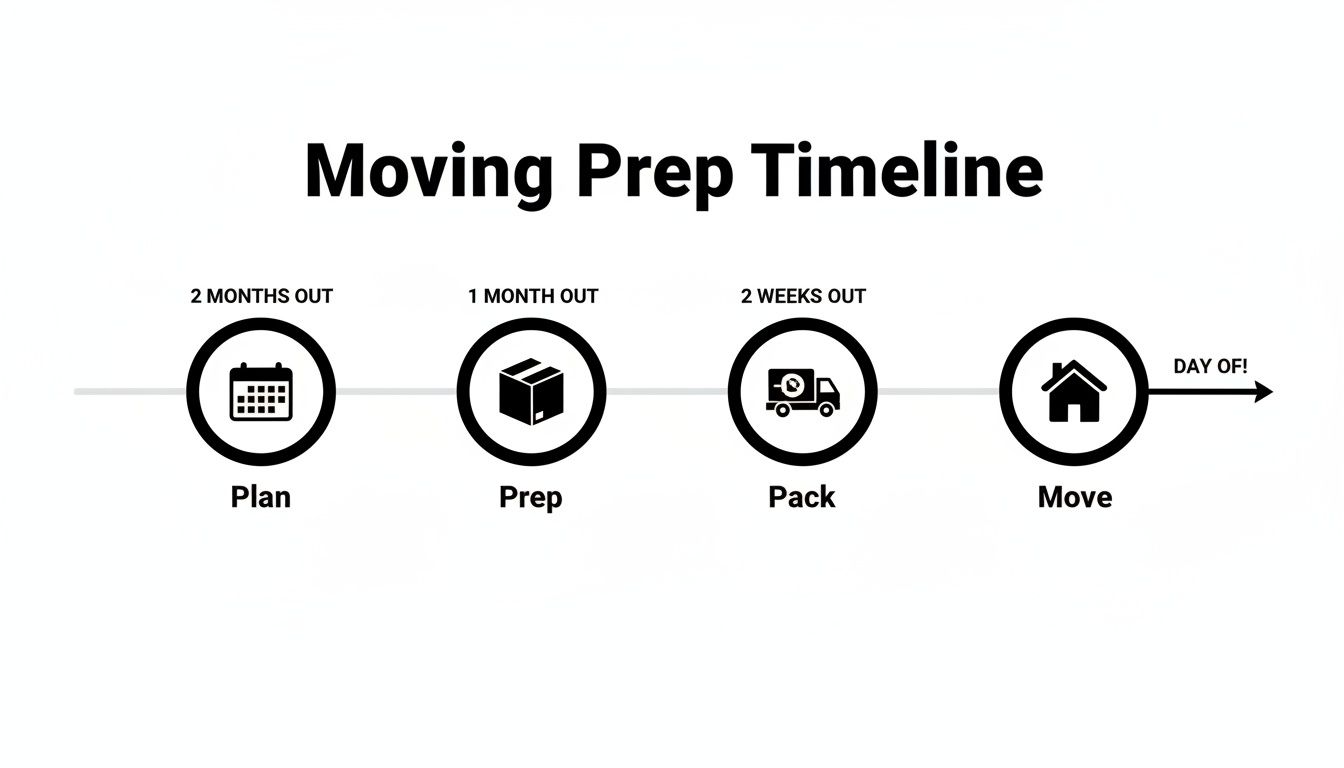
The takeaway here is straightforward: what you do in these early weeks will directly determine how smoothly moving day itself unfolds.
Eight Weeks Before Your Move
Right now, your first move is to create a "command center" for your move. This doesn't have to be complicated—a simple binder or even a dedicated folder on your computer will do the trick. This is where you'll keep all your estimates, receipts, and important contacts in one place.
Next up, let's talk budget. You need a realistic picture of the costs, which means looking beyond just the movers. Don't forget to factor in packing supplies, the potential need for a storage unit, and any fees for connecting your utilities. Once that financial picture is clear, it's time to get a quote.
Local Pro Tip: This is the absolute best time to schedule an in-home or virtual estimate with Family Movers Express. Booking early is a game-changer, especially if you're in Orlando and moving during hurricane season (June-November) or in Raleigh during the busy college move-in/move-out months of May and August.
Getting a jump on this now locks in your preferred moving date and gives you a solid foundation to build on for the weeks ahead.
Six Weeks Out: Finalizing the Plan
With your estimate approved and the budget set, it’s time to make it official and lock in your moving date. Once you're officially on the calendar with Family Movers Express, you can pivot to the most important job at this stage: sorting and decluttering.
This is also the moment to tackle any location-specific hurdles that can cause major headaches later.
- South Florida High-Rises: Living in a condo in Brickell or Fort Lauderdale? Get in touch with your building management now. You'll almost certainly need to reserve the service elevator, and they often have strict rules and time windows for moving trucks.
- Raleigh & Orlando HOAs: If you're in a planned community like North Hills in Raleigh or Lake Nona in Orlando, you need to give your Homeowners Association a heads-up. Many require advance notice to approve truck access and parking.
Clearing these permissions early saves you from last-minute stress and potential fines. If your move is taking you out of state, our long-distance moving checklist has extra tips you'll want to see.
Four Weeks Until Moving Day
The focus now shifts from planning to the physical work of packing and arranging services. Start gathering your supplies—boxes, tape, packing paper, the works. This is the perfect time to begin boxing up non-essential items you won't need for the next month. Think seasonal clothes, extra linens, books, and decorative items. Tackling this gradually makes the final weeks so much more manageable.
You'll also want to start arranging for your utility transfers. Call your current and future providers for electricity, water, gas, and internet to schedule when to shut off the old services and turn on the new ones.
Finally, let's confirm any specialty services you need. If Family Movers Express is handling something delicate like a piano, a large piece of art, or antique furniture, this is when we’ll finalize the plan for any custom crating or special handling. Nailing down these details now ensures everything is ready for a seamless move.
Decluttering and Downsizing Like a Pro

Let's talk about one of the most satisfying parts of moving: getting rid of stuff. Think about it—every single item you decide not to bring with you is a triple win. You save time packing it, money moving it, and precious space in your new home.
Honestly, lightening your load is one of the smartest things you can do. People who get strategic about downsizing can cut their moving costs by up to 20-30%. That’s a huge chunk of change saved just by having less to haul. You can see more trends like this in this 2025 industry report.
The best way to get this done without losing your mind is the Four-Box Method. It’s a classic for a reason. As you go through each room, every item gets sorted into one of four piles: Keep, Donate, Sell, or Discard. No maybes.
This forces you to make a decision on the spot, avoiding that dreaded "I'll deal with this later" pile that always comes back to haunt you. You're creating an immediate action plan for everything you own.
The Four-Box Method in Action
This isn’t about just mindlessly tossing things out; it’s about being intentional. My advice? Start in a room you don’t use much, like a guest bedroom or home office. You’ll build momentum and feel a sense of accomplishment before you have to tackle the really tough areas like the kitchen or garage.
- Keep: These are your non-negotiables. If it’s essential for daily life or something you genuinely love, it’s coming with you. Simple as that.
- Donate: Perfect for things that are still in good shape but just don’t fit your life anymore. Think clothes you haven't worn in a year, extra kitchen gadgets, or books you've already read.
- Sell: Have some quality furniture, electronics, or designer clothes you don't need? Selling them can put a nice bit of cash back in your pocket to help cover moving expenses.
- Discard: This is for the broken, the expired, the stained—anything that’s truly unusable. Be ruthless. Don't pay to move your own trash.
What about things you want to keep but don't need right away? A temporary storage unit can be a lifesaver. You can learn more about how storage solutions simplify your move right here on our blog.
Local Resources for Your Unwanted Items
Once everything is sorted, you need a plan to get it all out of your house. As local movers, we've seen it all and know exactly where to send you.
Our crews see it every day: a client in a Boca Raton gated community is stressed about their HOA's strict rules for junk removal, while someone in Winter Park needs a reputable place to sell antique furniture. Planning ahead with local resources is key.
Here are some of our trusted go-to's in the areas we serve:
For Raleigh-Durham Movers
- Donations: The Green Chair Project in Raleigh is a wonderful organization that accepts furniture and home goods to help furnish homes for families in need. For clothes and smaller items, TROSA Thrift Store in Durham supports a fantastic local cause.
- Junk Haulers: If you've got a mountain of stuff to discard, especially in neighborhoods around the Research Triangle, a service like Junk King Raleigh can make it disappear in one fell swoop.
For Orlando Area Movers
- Consignment & Selling: Avalon Exchange over in Winter Park is great for current, trendy clothing. For more high-end apparel and unique finds, check out one of the Dechoes Resale locations.
- Donations: The Russell Home for Atypical Children takes a wide variety of donated goods, and The Sharing Center in Longwood is a well-known spot for furniture and household items.
For South Florida Movers
- Donations: Down in Palm Beach County, you can’t go wrong with Habitat for Humanity ReStores. They are the perfect destination for furniture, appliances, and even leftover building materials.
- HOA-Friendly Junk Removal: For anyone moving out of a community in Boca Raton or a high-rise in Brickell with strict rules, we always suggest a professional service. Junkluggers of Broward & Palm Beach knows how to work with building management to schedule pickups that won't get you in trouble with the HOA.
Packing Strategies for Every Room
Let's be honest, packing is more than just throwing things in boxes. It’s a system. The way you pack dictates how smoothly your move-out and your move-in will go. A solid strategy means your treasures arrive safely, and unpacking in your new Raleigh or Orlando home is a breeze, not a week-long nightmare. It's how you turn potential chaos into a calm, controlled process.
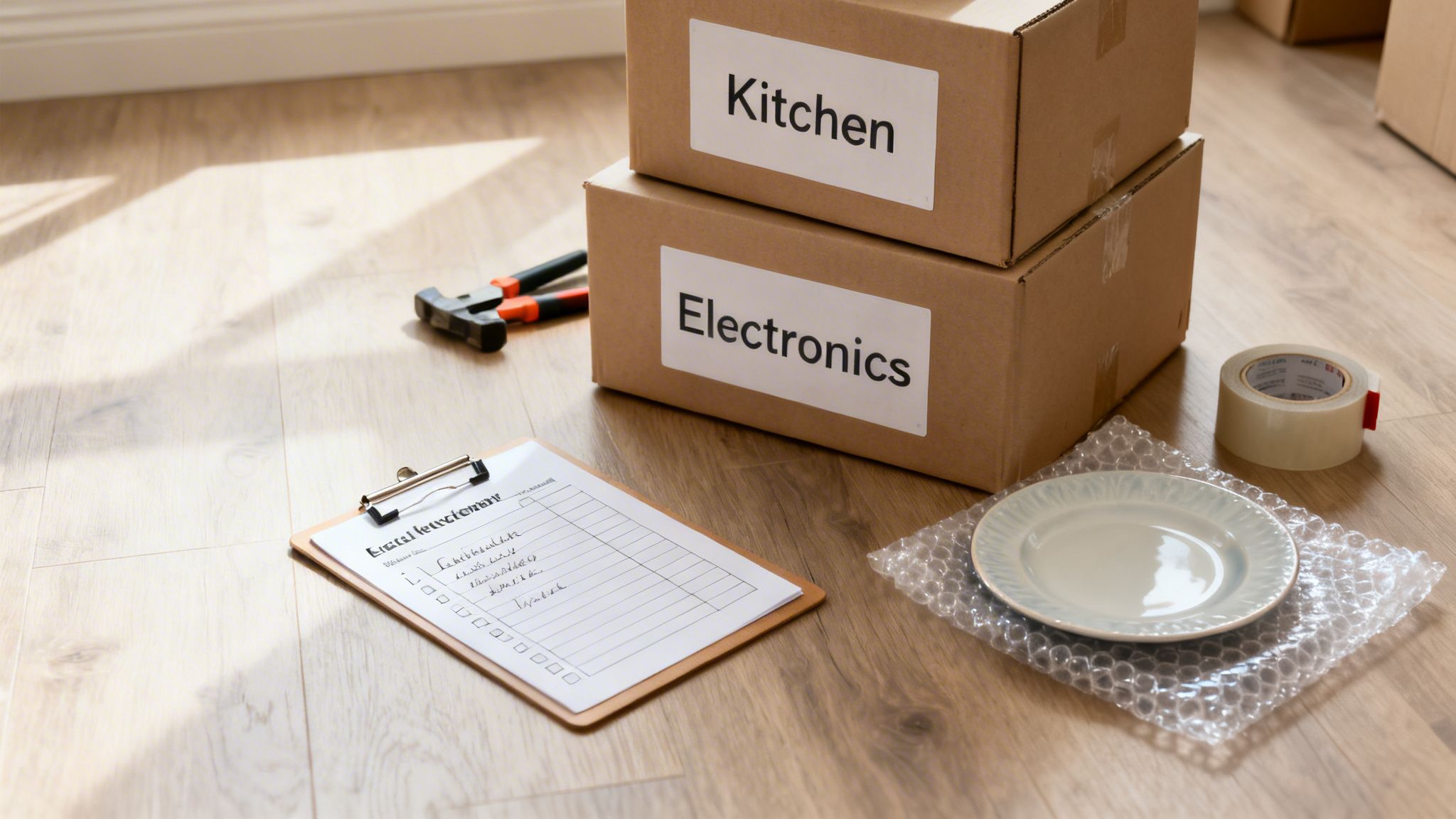
It all begins with getting the right supplies. I know it's tempting to grab mismatched boxes from the grocery store, but resist that urge. Uniform, professional-grade boxes are designed to stack securely in our trucks, which is absolutely critical for protecting your belongings, whether we're navigating I-95 or Florida’s Turnpike.
Mastering the Art of Labeling and Inventory
A simple black marker is your most valuable tool during a move. We’ve seen it all, and I can tell you the most successful moves always have one thing in common: a clear, consistent labeling system.
Here’s a method that works every single time:
- Go Four-Sided: Label each box on the top and at least two sides. This way, you can see what’s inside no matter how it's stacked in a room or on the truck.
- Get Specific: Don't just write "Kitchen." Instead, try "Kitchen – Everyday Dishes & Glasses." This little detail saves you from ripping open ten different boxes just to find a coffee mug on your first morning.
- Use Room Codes: Assign a simple code to each room (MBR for Master Bedroom, KIT for Kitchen, etc.). This helps our Family Movers Express crew place every box in its correct spot, speeding up the entire unload.
- Flag Fragile Items: Use a red marker to write "FRAGILE" in big, bold letters on all four sides of boxes with breakables. It’s also smart to draw arrows pointing up so everyone knows how to handle and store them.
For that extra layer of organization, create a basic inventory list. A spreadsheet or a simple notebook works perfectly. Just number each box and jot down its general contents next to the number. This is a lifesaver for keeping track of your belongings and making sure everything has arrived safely at your new home.
Room-Specific Tactics for a Secure Pack
Every room comes with its own set of packing challenges. The strategy you use for soft linens in the bedroom is completely different from what you need for sharp knives and heavy appliances in the kitchen. For a really detailed breakdown, check out our guide on how to pack a kitchen for moving—it's often the trickiest room of all.
Let's break down some pro tips for key areas of the house.
South Florida Humidity Alert: The moisture in the air in places like Boca Raton and Miami can be brutal on electronics and wood furniture. We often recommend using plastic totes for sensitive items and can talk you through specialized wrapping techniques that create a moisture barrier. Standard bubble wrap can sometimes trap humidity, so it's always best to discuss the right materials for your specific items.
Having the right tools for each room makes all the difference. This little checklist can guide your supply run and help you avoid those last-minute, panicked trips to the store.
Room-by-Room Packing Supply Checklist
Ensure you have the right materials for each room and avoid last-minute store runs.
| Room | Essential Supplies | Pro Tip |
|---|---|---|
| Kitchen | Dish pack boxes, packing paper, small & medium boxes, cell kits for glasses. | Pack plates vertically, like records in a crate, to prevent cracking. Never lay them flat. |
| Bedrooms | Medium & large boxes, wardrobe boxes, packing paper for lamps. | Use wardrobe boxes for clothes on hangers. Unpacking becomes as simple as moving them from the box to your new closet. |
| Living Room | Picture boxes, bubble wrap, stretch wrap, sturdy small boxes for books. | Always pack books in small boxes to keep them liftable. A large box of books is a classic, back-breaking mistake we see all the time. |
| Office/Electronics | Original packaging if you have it, plastic totes, zip ties, small boxes. | Snap a photo of the back of your electronics before you unplug everything. It will be your best friend for reconnecting it all in your new Cary or Winter Park home. |
| Bathroom | Small boxes, plastic bags for liquids, packing tape. | Double-seal any bottles with liquids in plastic bags before boxing them. This simple step can prevent some really messy and damaging spills. |
A great way to get started is to begin with the rooms you use the least, like guest rooms or storage areas. This builds momentum without totally disrupting your daily life. By the time you get to the high-traffic zones like the kitchen and master bedroom, you'll be a seasoned packing pro. Trust me, this methodical approach is the real secret to a stress-free move.
Handling Moving Logistics and Paperwork
Beyond the boxes and the satisfying rip of packing tape, the real engine of a successful move runs on paperwork and logistics. These are the behind-the-scenes tasks that can quietly sabotage everything if you let them.
From transferring your utilities to navigating the maze of building management rules in a Brickell condo, getting these details right is what separates a chaotic move from a smooth one. At Family Movers Express, we’ve seen it all, and mastering these "back-office" tasks is how we prevent delays, sidestep unexpected fees, and make sure your transition is seamless.
Think of this as your administrative command center for the entire move.
Your Essential Paperwork and Utilities Checklist
You never really think about the constant flow of water, power, and internet to your home… until it's suddenly gone. To avoid sitting in a dark, connection-less new house, you have to coordinate these service transfers with military precision. A simple misstep here can get surprisingly costly.
Here’s a wild fact for you: forgotten utility transfers cost Americans a staggering $1 billion every year in fees. It’s recommended to have old utilities disconnected 48 hours before your move-out and new services activated immediately upon arrival.
Use this checklist to stay on top of it:
- Four Weeks Out: Get on the phone with your current and future utility providers. That means electric, water, gas, and your internet/cable company. Schedule the end date for your old place and the start date for your new one.
- Two Weeks Out: Time to make it official. File your change of address with the USPS. This is also your cue to update your address with banks, credit card companies, insurance providers, and any subscription boxes you love. For a deep dive, you can check out our guide on changing your address when moving.
- One Week Out: Circle back and confirm all those utility appointments. And don't forget to double-check that you’ve notified your employer, doctors, and your kids' schools of the new address.
Navigating Local Rules and Regulations
Every city, and sometimes every neighborhood, has its own set of logistical hurdles. This is where having real local expertise becomes invaluable. What works for a quiet single-family home in the Raleigh suburbs just won't fly for a high-rise in the heart of South Florida.
A classic scenario we handle weekly at Family Movers Express involves coordinating with building management in downtown Miami or Fort Lauderdale. They almost always require a Certificate of Insurance (COI) from us, have strict windows for elevator reservations, and designated loading dock access. We handle this kind of paperwork every single day so our clients don't get hit with fines or frustrating delays.
Understanding these regional quirks is everything:
- South Florida High-Rises (Brickell, Boca Raton): You absolutely must reserve the service elevator. You'll also need to provide our insurance details to the building manager and follow their strict parking rules for the moving truck. We strongly suggest starting this process at least three weeks before your move.
- Raleigh & Orlando HOAs (Cary, Lake Nona): Many of the beautiful planned communities in the Research Triangle and Central Florida have specific rules about when and where moving trucks can park. As soon as you book your move, let your HOA know the date to get their guidelines in writing.
Understanding Your Moving Quote
Your moving quote is much more than just a price—it's the contract that outlines every service you're getting. Taking a few minutes to scrutinize the details now will save you from major surprises later. When you get a quote from Family Movers Express, here’s what you should be looking for.
First, is the inventory list accurate? The entire quote is built on the estimated volume and weight of the items you listed, so a precise list leads to a precise price. No shortcuts here!
Next, look closely at the insurance options. All licensed movers provide basic liability coverage by law, but you might want to consider Full Value Protection for more comprehensive coverage of your belongings. It’s usually worth the peace of mind.
Finally, scan for any potential extra charges. These could be things like "long carry" fees (if the truck can’t park right next to your door), extra costs for stairs, or handling oversized items like a piano. We pride ourselves on being totally transparent, which is why we established our No Travel Fee policy in South Florida. It ensures our clients aren't hit with bogus charges for moves between Palm Beach, Broward, and Miami-Dade.
Always, always ask your moving coordinator to walk you through every single line item until you feel 100% confident in the agreement.
Final Week and Moving Day Plan
The last seven days before your move are all about execution. You've done the heavy lifting with the planning; now it’s about tying up loose ends and getting everything buttoned up for the arrival of our Family Movers Express crew. This is where all that prep really starts to pay off.
One of the first things you'll do this week is have a final confirmation call with your moving coordinator. We’ll double-check the crew's arrival time, go over the final inventory, and handle any last-minute questions about parking or building access, whether you're in a cozy North Hills neighborhood or a sprawling waterfront property in Fort Lauderdale.
Prepping Your Home for the Movers
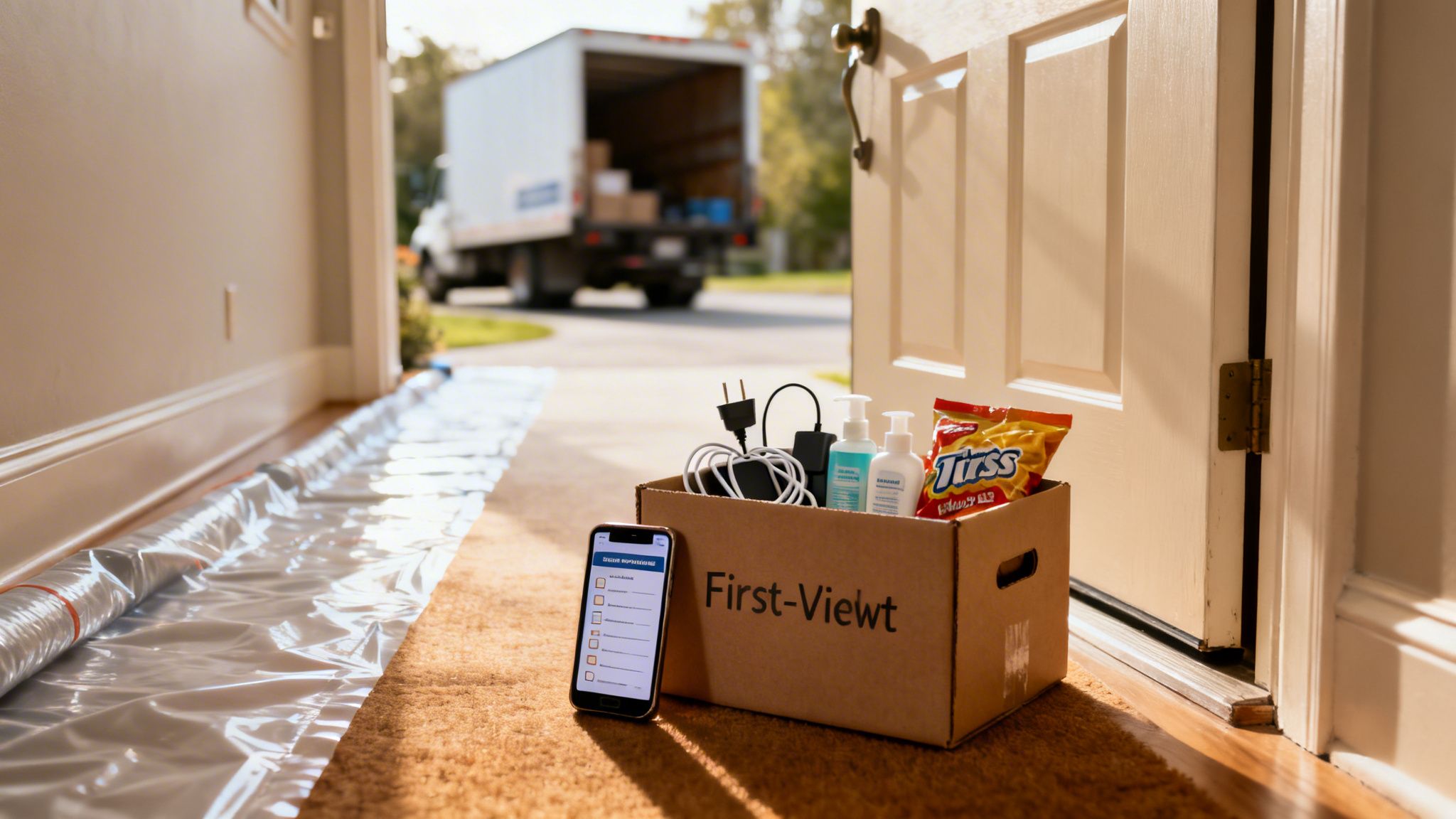
With all the logistics locked in, your attention can turn to the physical space. Protecting your home is priority one. We recommend laying down floor protectors like Ram Board or even just flattened cardboard boxes in high-traffic areas. Pay special attention to entryways and hallways—they’ll see the most action.
It's also go-time for final appliance prep. Your fridge and freezer need to be completely empty, defrosted, and wiped dry at least 24 hours before we show up. This little step is a huge deal for preventing mildew and potential water damage to your other belongings in transit.
If you’re renting, this is also the week to book your professional end of lease carpet cleaning. Getting this done is often a requirement to get your full security deposit back, so don't leave it to the last minute.
The one thing people almost always forget is the "first-night" essentials box. Seriously, pack this. Keep it separate from everything else and fill it with toiletries, meds, chargers, snacks, and a change of clothes. After a long day of moving, you will thank yourself for not having to dig through 10 boxes just to find your toothbrush.
The Moving Day Walk-Through
When our crew arrives, the very first thing we do is a walk-through. You (or someone you've authorized) will walk with our crew chief through every single room. This is your chance to point out anything that's especially fragile or, just as importantly, anything that is not supposed to go on the truck.
Clear communication here is absolutely vital. It gets everyone on the same page and helps our team work efficiently and safely. It’s also when we’ll make any real-time adjustments for the weather.
- For Raleigh Moves: If there's an unexpected morning frost, we’ll take extra precautions on slick walkways and driveways.
- For Orlando & South Florida Moves: A sudden afternoon downpour is always on the table. We come prepared with runners and coverings to keep your floors and belongings dry as we move from the house to the truck.
Staying Organized and Available
Think of yourself as the project manager on moving day. Your main job is to be available. Keep your phone fully charged and on you in case our team has any questions. It’s also a good idea to have your moving binder or folder handy with all your key documents, like the Bill of Lading.
Set up a "no-pack zone" for items you're taking with you personally—valuables, important papers, and that all-important essentials box. Make it obvious to the crew that this area is off-limits to prevent anything from being loaded by mistake.
As the truck fills up, do one final sweep of each room. Check every closet, cabinet, and don't forget the attic or garage. It’s amazing what can hide in an empty space. By staying organized and communicative, you can help ensure this final leg of your journey is as smooth and stress-free as possible.
Got Questions About Your Move? We’ve Got Answers.
We’ve seen it all across Raleigh, Orlando, and South Florida. After countless moves, we’ve heard just about every question you can imagine. Here are the answers to the ones that come up most often, filled with real-world advice from our Family Movers Express teams on the ground.
When Is the Best Time to Move in Florida or North Carolina?
Timing your move can be the difference between a smooth day and a major headache, not to mention a higher bill. While the "peak season" for moving is technically May through September, that's a tricky time in our neck of the woods.
In Orlando and South Florida, you're smack in the middle of hurricane season, which brings a whole new level of stress and potential delays. Up in Raleigh, you're dealing with scorching heat and the chaos of student move-in and move-out days around the universities.
For the best shot at milder weather and more competitive pricing, we always suggest aiming for the shoulder seasons. Think March through April or October through November. If a summer move is unavoidable, the key is to book with Family Movers Express 6 to 8 weeks in advance to lock in your date and crew.
How Should I Handle HOA Rules in My Community?
Ah, the HOA. If you live in a community like Lake Nona in Orlando, North Hills in Raleigh, or one of Boca Raton’s gated neighborhoods, you know they have rules for everything—and moving is no exception. Ignoring them can lead to fines and a logistical nightmare on moving day.
Get in touch with your HOA management at least four weeks before you move. You need to get clear answers on a few key things:
- Parking Restrictions: Where, exactly, can our truck park? Are there time limits?
- Elevator Reservations: If you’re in a condo or a high-rise, you’ll almost definitely need to book the service elevator. Find out the process and available time slots.
- Required Paperwork: Do they need a Certificate of Insurance (COI) from your moving company? This is a common one.
As soon as you have this info, pass it along to your Family Movers Express coordinator. We deal with these logistics every single day and can make sure all the right paperwork is in place to keep things running smoothly.
What Should I Pack in My First-Night Essentials Box?
Think of the "first-night box" as your moving day survival kit. This is the box you keep with you in your car, not on the truck. It's filled with everything you'll need for that first 24 hours in your new place before the real unpacking begins.
Here’s what we tell our clients to put in theirs:
- Personal Stuff: Toiletries, daily medications, a change of clothes for everyone, and critical documents (like closing papers or lease agreements).
- Basic Supplies: Paper towels, toilet paper, trash bags, a box cutter, and a simple screwdriver. You'll thank yourself later.
- Creature Comforts: Phone chargers, bottled water, snacks, and some paper plates and utensils for that first celebratory pizza.
- For the Kids: If you have little ones, pack a favorite toy, a comforting blanket, or a book. It helps make a strange new place feel like home right away.
How Do I Protect High-Value or Sentimental Items?
Some things just can't be replaced. For smaller valuables like jewelry, passports, or sentimental family heirlooms, the rule is simple: keep them with you. Pack them securely and transport them in your own vehicle.
For the big-ticket items—we’re talking pianos, large artwork, or that antique armoire you inherited—it’s absolutely critical that you flag these for us during the quoting process. Knowing ahead of time lets us bring the right equipment, whether it’s custom crating, extra padding, or specialized dollies. Our crews are trained to handle these pieces with the care they deserve, ensuring they arrive in perfect condition.
Ready to put this advice into action? The experts at Family Movers Express have the local know-how to handle any challenge, from Raleigh’s historic neighborhoods to Orlando’s sprawling communities and South Florida’s coastal high-rises.
- For a seamless move in the Research Triangle, get in touch with our Expert Raleigh Moving Company.
- If you're heading to or from Central Florida, our Professional Orlando Movers are ready to help.
- For any move between Palm Beach and Miami, count on our Reliable South Florida Movers.
Ready to protect your upcoming move?
Click Here to Fill Out Our Quick Form & Secure Your Instant Quote!
