

Think of a long distance moving cost calculator as your first step in budgeting, not the final word. It's a fantastic tool for getting a ballpark figure by looking at the big variables: how far you're going, how much stuff you have, and what kind of help you need. For a major move between our hubs like Raleigh to Orlando, it gives you a crucial baseline. Just remember, the estimate is only as good as the information you put in.
What Really Drives Your Moving Estimate

Before you start typing numbers into an online form, it helps to understand what’s actually happening behind the scenes. Your moving quote isn't just a simple calculation; it's a complex puzzle of logistics. Every single piece, from the size of your home to the specific challenges of the route, plays a part in the final cost.
As a local logistics expert with crews on the ground in Raleigh, Orlando, and South Florida, Family Movers Express sees how these factors play out every day. A generic calculator can't predict the nuances of I-95 traffic during spring break or know about the strict HOA rules in a Boca Raton community that limit when a truck can park.
Your estimate really boils down to three core pillars that every professional mover uses to build your quote.
Primary Factors Influencing Your Moving Quote
Here's a quick breakdown of the key variables that every long distance moving cost calculator uses to generate an estimate.
| Cost Factor | How It's Calculated | Example Impact on Your Move |
|---|---|---|
| Distance Traveled | The mileage between your old and new front door. | A move from a Cary, NC suburb to a Fort Lauderdale condo will cost more in fuel and driver hours than a shorter hop. |
| Shipment Weight/Volume | Based on the total weight (or sometimes cubic feet) of your belongings. | A 4-bedroom house filled with heavy, solid wood furniture will cost more to move than a lightly furnished 1-bedroom apartment. |
| Service Level | The specific services you request, from basic transport to full-service packing. | A "DIY" pack will be your most budget-friendly option, while having our crew pack every dish and book adds convenience and cost. |
These three factors are the foundation of any moving quote, setting the stage for the final price.
The Foundational Cost Factors
So, let's dig a little deeper into those core drivers.
Distance Traveled: This one is pretty straightforward. The miles between your origin and destination directly affect fuel costs, driver pay, and general wear and tear on the truck. It’s the most basic component of any long-distance quote.
Shipment Weight/Volume: This is a huge one. Long-distance moves are almost always priced by the total weight of your goods. That’s why one of the best ways to save money is to declutter before you start packing. Less stuff equals less weight, which means a lower bill.
Service Level: The choices you make here can dramatically swing your final price. If you handle all the packing yourself, you'll keep costs down. But if you opt for full-service packing, where our team comes in and does everything, you're paying for that convenience and labor.
Behind the scenes, things like fuel prices, driver wages, and truck maintenance are all managed through smart logistics. Movers use things like route optimization to run efficiently, which ultimately helps keep your costs in check.
At Family Movers Express, we know that no two moves are the same. A move into a high-rise in Miami's Brickell neighborhood has unique challenges—like booking service elevators and dealing with downtown traffic—that are completely different from moving into a single-family home in Raleigh's North Hills.
Getting a handle on these core components is the first step to creating a realistic moving budget. If you want to dive even deeper into planning your finances, check out our guide on the average moving costs. This knowledge will empower you to use any long distance moving cost calculator more effectively, giving you confidence that the number you see is a solid starting point for the real work involved.
Gathering Your Information for an Accurate Estimate

An online moving cost calculator is an incredible tool for budgeting, but it has one major catch: it’s only as good as the information you feed it. Think of it like a GPS. If you just type in "Florida," you won't get a very helpful route. To get an estimate that actually means something, you’ve got to do a little homework first.
This isn't just about a quick glance around your house. It means rolling up your sleeves, creating a real inventory, and thinking like a mover for a few minutes. When you gather accurate details upfront, you avoid that awful "sticker shock" moment when the final bill arrives.
Creating Your Home Inventory
The absolute bedrock of any good moving estimate is a solid inventory of your stuff. This is your chance to list out everything that needs to go on that truck, from your giant sectional sofa down to that box of old holiday decorations you forgot was in the attic.
The whole point is to get a handle on the total weight of your shipment, which is the single biggest factor in what you'll pay for an interstate move. You won't know the exact weight until the loaded truck hits a certified scale, of course, but a detailed inventory gets you surprisingly close.
Just go room by room. A simple spreadsheet, a notes app on your phone, or even a classic pen and paper will do the trick. The key is to be methodical.
- Living Room: Get the big stuff—couch, armchairs, coffee table, media console. But don't forget the smaller things like lamps, rugs, and artwork. They add up!
- Bedrooms: List out each bed frame, mattress, dresser, and nightstand. Then, try to estimate how many boxes you'll need for clothes and personal belongings.
- Kitchen: This is the room that always surprises people with its weight. All those pots, pans, dishes, and canned goods are heavy. Account for everything.
- Garage/Storage: Don't overlook the garage. Outdoor furniture, tool chests, and sports equipment can add some serious weight to the total.
A detailed list isn't just for the calculator; it's a huge help for you, too. To keep it all straight, our comprehensive long distance moving checklist can walk you through the entire process so nothing gets missed.
Accounting for Logistical Challenges
It's not just what you're moving that matters—it's where you're moving it from and to. A calculator can't see the narrow street outside your apartment or the three flights of stairs at your new place. It’s up to you to fill in those blanks. These details directly impact labor time, the kind of truck we can use, and whether any extra fees apply.
At Family Movers Express, we deal with these variables every single day. A move from a downtown Orlando high-rise with a tiny service elevator is a completely different ballgame than moving from a spacious single-family home in Cary with a huge driveway.
Think about the potential hurdles at both your old home and your new one:
- Access Issues: Are there tight streets the moving truck can't get down? We see this a lot in historic Raleigh neighborhoods, and it often means we need to use a smaller shuttle truck to ferry items back and forth.
- Stairs and Elevators: Count the flights of stairs, both inside and out. If you're in a condo in Brickell or South Beach, you'll need to know the rules for booking the service elevator.
- HOA Rules: Many communities, especially in places like Boca Raton and Lake Nona, have strict rules about when and where moving trucks can park. Finding this out ahead of time saves a lot of headaches.
- Long Carries: Is there a long walk from the curb to your front door? Movers call this a "long carry," and that extra distance can add to the labor cost.
Giving these logistical details to your mover is what turns a generic online number into a personalized, realistic estimate. It’s the difference between a guess and a plan.
When you take the time to build a thorough inventory and flag any potential access challenges, you're setting yourself up for success. You'll get a far more accurate number from any long distance moving cost calculator, giving you a budget you can actually rely on for a smoother, less stressful move.
Uncovering Hidden Variables and Additional Fees
That first number you see from a long-distance moving calculator? Think of it as a great starting point, a solid baseline. But it's almost never the final price. That initial estimate is based on the big two: distance and the size of your move. The real world, however, has a funny way of throwing curveballs—like trying to get your stuff from a quiet cul-de-sac in Raleigh into a high-rise apartment in Miami-Dade.
These aren't "hidden fees" in some sneaky sense. They're standard charges across the industry for situations that demand more time, specialized equipment, or extra sweat from the crew. Here at Family Movers Express, we'd rather you know about these things upfront. Being prepared helps you ask the right questions and keeps those budget-busting surprises from popping up on moving day.
Common Fees Tied to Property Access
Most of the time, any extra charges come down to the physical layout of your old and new homes. A moving truck is a beast of a vehicle, and if we can't get it parked right next to your door, things get a bit more complicated.
- Long-Carry Fees: This comes into play when the crew has to haul your belongings over a long distance—usually more than 75 feet—from the truck to your front door. It’s a frequent occurrence in dense urban spots like Brickell or in sprawling Orlando apartment complexes with detached parking lots.
- Stair Fees: Got a few flights of stairs and no elevator? You'll likely see a stair fee. This just covers the extra time and serious physical effort it takes to safely navigate heavy furniture up or down each flight.
- Shuttle Service Fees: Sometimes, a massive tractor-trailer just won’t fit down the charming but narrow streets of a historic neighborhood or the tight corners of a Fort Lauderdale waterfront community. When that happens, we bring in a smaller "shuttle" truck to ferry everything between your home and the main rig, which has its own associated cost.
It's good to remember that the bulk of your moving costs—about 70%—are driven by distance, the weight of your shipment, and the services you choose. The average household move lands around $4,300, but this fluctuates wildly. Moving along the East Coast is often 10-15% cheaper thanks to the heavy traffic on routes like I-95. A 1-bedroom apartment move over 1,000 miles can range from $2,300 to $4,900, whereas a 4-bedroom home could easily be $5,000 to $9,000, especially with the added logistics of a big city move.
Demystifying Valuation and Insurance Options
Protecting your stuff is a must, but the options can be confusing. What movers offer isn't your typical "insurance." It's called valuation coverage, and it sets the limit of the mover's financial responsibility if something gets lost or damaged.
You'll generally see two main choices:
- Released Value Protection: This is the free, basic option that all movers are required to offer by law. It provides the absolute minimum coverage at 60 cents per pound per article. If your 10-pound flat-screen TV breaks, you'd only be reimbursed for $6.00, no matter what you paid for it.
- Full Value Protection: This is the comprehensive upgrade you pay a premium for. With this plan, the mover is on the hook for the full replacement value of any lost or damaged items. They get to decide whether to repair the item, replace it with a similar one, or give you a cash settlement for its current market value.
Choosing the right coverage is all about balancing your budget with your peace of mind. If you have valuable furniture, electronics, or heirlooms, Full Value Protection is almost always worth it. If you're looking at different moving methods, you might also want to explore the cost of moving container rentals, as they come with their own unique liability and insurance rules.
When you understand these potential charges and coverage details, you're no longer just a customer—you're an informed partner in your own move. This knowledge helps you give us the details we need to turn a rough estimate into a reliable plan for your relocation.
Putting the Calculator to the Test: A Real-World Example
Let's stop talking theory and run some actual numbers. We'll walk through a common move we see all the time at Family Movers Express: a family relocating from a 3-bedroom house in Raleigh’s Research Triangle down to the sunny, master-planned community of Lake Nona in Orlando. It’s a straight shot down I-95, a route our crews know like the back of their hand.
This example will show you exactly how inputs like home size, the weight of your stuff, and the 550-mile journey create that initial quote. Then, we’ll layer in extra services and potential logistical hiccups to see how the price adjusts. It’ll give you a much better feel for how to run scenarios for your own move. To play along, a tool like an online Moving Company Cost Estimator can be great for seeing these variables in action.
Simulating a Raleigh to Orlando Move
Let’s picture a family of four living in a 2,200-square-foot home in Cary, NC. They’ve got a pretty standard amount of furniture and belongings for a 3-bedroom house, which from experience, we'd estimate at roughly 7,500 pounds.
Here’s what we’d plug into the calculator:
- Origin: Raleigh, NC (a single-family home with easy truck access)
- Destination: Orlando, FL (a newer house in Lake Nona, where HOA rules might affect parking)
- Home Size: 3 Bedrooms
- Estimated Weight: 7,500 lbs
- Distance: Approximately 550 miles
With just these details, the calculator will spit out a baseline number. For a long-distance move in the U.S., you're typically looking at a range of $4,500 to $7,780 for a standard household. On a trip like this one (under 1,000 miles), the final cost is really driven by the shipment weight and any extra services you choose.
Adjusting for Additional Services
Now, what happens when life gets in the way and you need a little more help? Our Cary family is juggling work and kids, so they decide to add a few common services.
- Professional Packing: They choose a full-service pack to save time. This adds labor and all the boxes and materials, which could tack on an extra $1,200 – $2,500.
- Specialty Item Handling: They have an old upright piano that's been in the family for years. Pianos are heavy, awkward, and require special care, adding another $400 – $800 to the quote.
- Temporary Storage: The closing date on their new home got pushed back a week. They need storage-in-transit, which might add $300 – $500 to hold their belongings safely.
Suddenly, that baseline quote starts to climb. This is exactly why being detailed and honest about your needs upfront is so crucial for getting an accurate estimate. While this example covers a family home, you can see how the numbers change for a smaller move in our guide to one-bedroom moving cost.
Factoring in Logistical Fees
Finally, we have to consider the on-the-ground realities. What if the moving truck can't pull right up to the front door of their new Lake Nona home because the street is too narrow or there are parking restrictions? This happens more than you'd think.
This is where accessorial fees come into play.
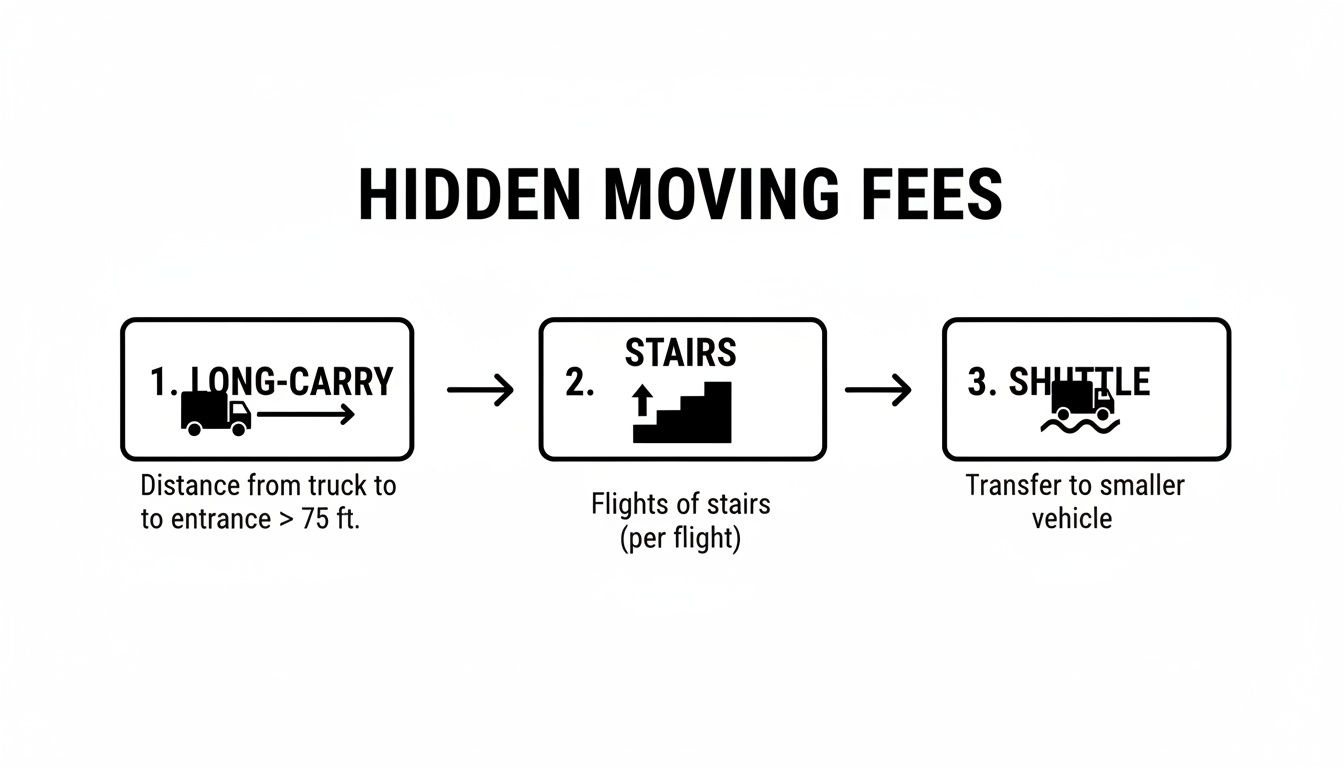
As the diagram shows, things like a long walk from the truck to your door, several flights of stairs, or needing a smaller shuttle truck are all standard charges in the moving industry. They compensate for the extra time and labor involved. If our crew has to carry everything over 100 feet (a "long-carry"), a fee is added. This really highlights why it's so important to be upfront about access at both your origin and destination.
When you run through a detailed scenario like this, a long-distance moving cost calculator becomes more than just a gadget—it becomes a serious budgeting partner. It gives you a clear picture of how your decisions impact the bottom line and sets you up for a much smarter conversation with your moving company.
Smart Strategies to Lower Your Moving Costs
After you get a handle on how a long-distance moving cost calculator works, the next thing on your mind is probably, "Okay, how do I make that number smaller?" With over a dozen years of moving families up and down the East Coast, our team at Family Movers Express has seen what really makes a difference. It all boils down to being strategic before a single box is loaded.
You'd be surprised how much small adjustments to your moving plan can save you. This isn't about cutting corners; it's about being efficient. For families moving between our hubs in Raleigh and South Florida, our direct I-95 corridor route already gives us a competitive edge, but there's still plenty you can do to bring your final bill down.
Declutter to Reduce Your Shipment Weight
This is, without a doubt, the most effective way to lower your bill. Long-distance moves are priced mostly by weight. Less stuff equals less cost. It’s that simple. Before you even think about packing, go through every single room and be ruthless about what you actually need.
Think about that old treadmill in the garage, the guest room furniture that collects dust, or those boxes of clothes you haven’t seen in years—every single item adds weight and, therefore, cost.
Here’s a great rule of thumb we share with our clients: if it costs more to move an item than to replace it, it’s time to let it go. Selling or donating can save you hundreds, if not thousands, of dollars.
For example, just purging 1,000 pounds of belongings—which could be a heavy sofa, a large dresser, and a few boxes of books—can slash your bill by $500 to $800, sometimes even more depending on how far you're going.
Be Strategic with Your Moving Date
In the moving industry, timing is everything. Demand goes through the roof during peak season, which generally runs from May through September. Moving then means you’re competing with everyone else for trucks and crews, which naturally drives prices up.
If you have some flexibility, aim for an off-peak move:
- Optimal Months: October through April are your best bet for lower rates.
- Mid-Week Savings: A Tuesday or Wednesday move is almost always cheaper than a weekend.
- Mid-Month Moves: Try to avoid the very beginning or end of the month when leases are turning over and demand spikes.
National moving data backs this up. With demand surging 25% in the summer, planning an off-peak move is one of the smartest budgeting tools you have. The average long-distance move of 1,000 miles is now around $5,450, but you can beat that average by dodging those seasonal spikes.
Handle Your Own Packing
Our professional packing services at Family Movers Express are a lifesaver for busy families, but tackling the packing yourself is a major money-saver. You save in two ways: you aren't paying for our crew's labor, and you can get creative with finding packing materials.
This DIY approach puts you in the driver's seat of your supply budget. We've seen many families successfully slash costs by sourcing free, sturdy boxes from local grocery stores, liquor stores, or community groups online. If you want to dig deeper into trimming your budget, our guide on 6 tips for saving money during a move has even more ideas.
By combining these strategies—lightening your load, choosing your date wisely, and packing yourself—you gain a ton of control over the final number on your moving quote. It empowers you to manage your budget and make your move as affordable as it is exciting.
From Online Estimate to a Guaranteed Quote
That online long-distance moving cost calculator is a fantastic starting point. Seriously, it gives you a solid baseline for your budget by running the numbers on distance, the size of your home, and the basic services you think you’ll need.
But let’s be real—that instant number is just an estimate. It's a ballpark figure, not a promise. To get a price you can actually bank on, you need to take the next step and get a professional, binding quote from a moving company you trust. This is where the digital meets the real world and where you get peace of mind knowing there won’t be any ugly financial surprises on moving day.
The All-Important On-Site or Virtual Survey
A calculator is only as smart as the information you feed it, but a seasoned moving expert sees things you’d never think of. This is exactly why a virtual or in-home survey isn't just a good idea; it's non-negotiable for getting an accurate, locked-in price. It’s the only way for a moving company to truly verify the details and spot any potential logistical hurdles ahead of time.
When one of our consultants from Family Movers Express does a survey, here’s what’s happening:
- We Confirm Your Inventory: We’ll do a walk-through of your home, either in person or on a video call, to get a precise feel for the volume and weight of your stuff. This isn’t just about counting boxes; it’s about making sure we assign the right-sized truck and the right-sized crew for the job.
- We Assess Your Access Points: We’re looking at things like driveway clearance, street access for a big truck, and any potential HOA rules. This tells us if we can pull a full-sized tractor-trailer up to your door or if we'll need a smaller shuttle truck—a common situation in communities from North Hills in Raleigh to Winter Park in Orlando.
- We Spot the Specialty Items: That grand piano, the antique armoire from your grandmother, or that oversized piece of art? We’ll note everything that needs special handling and build that into a safe and effective moving plan.
This hands-on approach is where our local expertise makes a huge difference. We know the unique challenges of our service hubs, whether it's navigating the tight parking of a South Florida condo complex or planning around the notorious traffic in the Research Triangle.
Understanding the Difference: Estimate vs. Binding Quote
It’s absolutely critical to know that the number a calculator spits out is worlds apart from the formal document a moving company provides. They serve very different purposes.
To make it crystal clear, here’s a quick comparison:
Online Calculator Estimate vs. Professional Binding Quote
| Feature | Online Cost Calculator | Family Movers Express Binding Quote |
|---|---|---|
| Purpose | Provides a preliminary, non-binding budget estimate based on user-provided data. | A formal, legally binding contract that guarantees your price, provided the inventory and conditions don't change. |
| Accuracy | Good for initial planning but can be inaccurate if inventory or access details are incomplete. | Highly accurate, based on a professional assessment of your specific moving needs and logistics. |
| Foundation | Based on industry averages for weight, distance, and standard services. | Based on a detailed inventory, confirmed logistics, and the specific services you’ve selected. |
| Reliability | Not a contract. The final price can and likely will differ. | A firm price you can rely on for budgeting, eliminating surprise fees and ensuring transparency. |
Think of it this way: the online calculator is your brainstorming tool. The binding quote is your blueprint for a successful move.
A binding quote is your financial protection. It’s a mover's promise to you, turning the uncertainty of a calculated budget into a stress-free reality. This commitment is central to how we operate at Family Movers Express.
Finalizing Your Moving Plan
Once the survey is done, you’ll get a detailed, written binding quote. This is the master document for your move. It will clearly outline every single aspect: the final cost, a full list of all included services, your insurance coverage, and the pickup and delivery windows.
That timeline is a big deal, and it's worth understanding exactly what it means. You can learn more about why guaranteed moving dates matter for your relocation in our detailed guide.
Whether you’re planning a move from the Research Triangle or anywhere in Central Florida, our teams are ready to provide a quote you can trust. Contact our Expert Raleigh Moving Company or our Professional Orlando Movers today to get started.
Ready to protect your upcoming move?
Click Here to Fill Out Our Quick Form & Secure Your Instant Quote!
