

When you're staring at a gap between moving out of your old place and into your new one, it can feel like a major headache. The easiest way to handle this common moving problem is to work with moving companies that offer storage. This turns a logistical nightmare into one smooth, coordinated process by letting a single trusted company handle both the moving and the temporary storing of your stuff.
Why Smart Movers Bundle Moving And Storage
Trying to manage a move with a timing gap often feels like you're juggling two completely separate, stressful jobs. First, you've got to find movers you can trust. Then, you have to track down a self-storage unit, figure out how to get your belongings there, unload it all, and then hire movers a second time to get everything out and to your final destination. It's a puzzle with too many pieces and a lot of room for things to go wrong.
Choosing a moving company that handles storage cuts out all that complexity. Think of it like booking an all-inclusive vacation versus trying to piece together your own flights, hotels, and tours. The all-inclusive option gives you one point of contact and a single, solid plan. The DIY method, on the other hand, creates a logistical mess where one missed connection can throw everything off course.
The Power of a Single, Trusted Team
The biggest win here is just how much less your belongings get handled. Every single time a box or a piece of furniture gets loaded and unloaded, there's a risk of something getting damaged. When you use a separate mover and a storage unit, your items are handled at least four different times:
- Loaded onto the first moving truck.
- Unloaded into the self-storage unit.
- Loaded onto a second moving truck.
- Unloaded at your new home.
With an integrated service like ours at Family Movers Express, your things are loaded just once. They’re taken to our secure company warehouse and stay put until it’s time to deliver them to your new home. This approach reduces handling by a massive 50%, which dramatically cuts the chances of dings, scratches, or broken items.
A bundled approach isn't just about making things easier; it's a strategic move to protect your possessions. When you trust one professional team with the whole job, you get consistent care, clear accountability, and a much smoother transition from start to finish.
Streamlining Your Relocation Timeline
Trying to coordinate different companies is a recipe for stress. You have to line up schedules, keep track of multiple contracts, and just hope everyone shows up when they say they will. A mover that also provides storage gets rid of all that friction. You have one schedule, one contract, and one team that's responsible for your entire move.
This unified strategy is a lifesaver, especially during long-distance relocations where timing is everything. If you want to dive deeper into this, you can learn how planning a long-distance move with storage can help simplify even the most complicated timelines. It takes a messy, multi-step process and turns it into a single, well-managed operation, giving you some much-needed peace of mind.
What Are My Moving Storage Options, Anyway?
When someone mentions "storage," the first thing that probably pops into your head is a roll-up metal door on a concrete slab. But when you're working with a moving company, the options are a whole lot more sophisticated and tailored to the unique headaches of relocation. Figuring out which type you need is the first step to making a smart choice for your timeline, your budget, and your stuff.
Think of it this way: you wouldn't book a fancy hotel suite for a quick one-night layover, right? And you definitely wouldn't try to cram your family into a tiny room for a month-long stay. It’s the same with storage. Matching the service to how long you'll need it is key to keeping things efficient and making sure your belongings are well-protected.
If you find yourself with a gap between moving out of your old place and into your new one, this little flowchart can help clear things up.
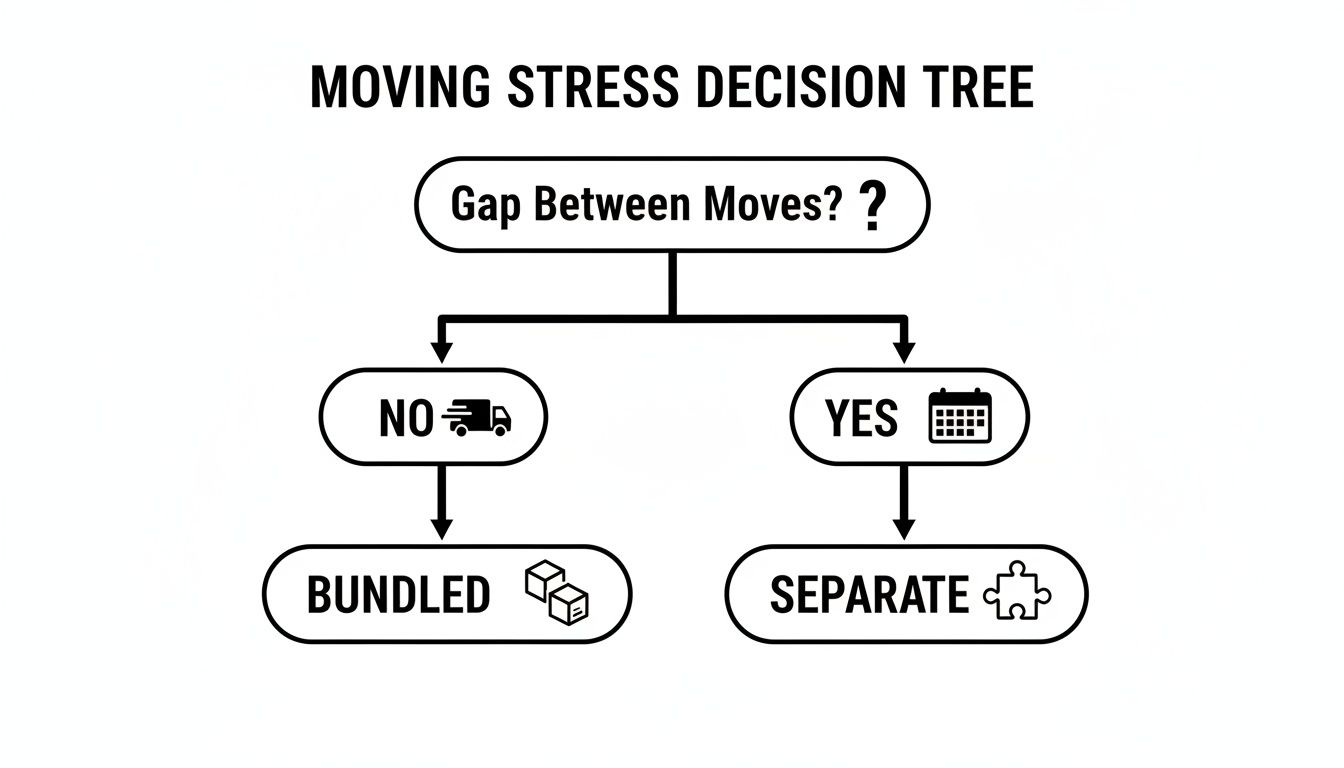
As you can see, when that gap appears, you've got a choice: go it alone with a separate storage unit, or bundle everything together for a much smoother ride.
Short-Term Storage in Transit
For those shorter gaps—maybe your closing date got pushed back a week, or the renovations on the new house are running behind—Storage-in-Transit (SIT) is your best friend. This is the go-to solution movers offer for exactly these kinds of hiccups.
With SIT, your belongings stay securely on the moving truck or are temporarily placed in the company's local warehouse, usually for up to 90 days. It’s basically a pause button for your move. This completely avoids the hassle of unloading everything into a self-storage unit just to turn around and load it all back up again a few weeks later. It means less handling, less risk of damage, and one less thing for you to worry about.
Dedicated Long-Term Storage Solutions
But what if you need to store things for a few months, or even a year? Maybe you're downsizing, taking an overseas work assignment, or just in a transitional phase. This is where a mover's dedicated long-term storage comes in.
This is a totally different ballgame from SIT. Your items are carefully inventoried and placed inside large, private wooden storage vaults. These vaults are then sealed and stacked securely inside the moving company’s warehouse. Because the warehouse isn't open to the public, it offers a level of security you just can't get at a standard self-storage facility with hundreds of people coming and going.
The Critical Role of Climate Control
Here in Orlando, we know a thing or two about humidity. That's why one of the most important features to look for is climate control. This isn't just fancy air conditioning; a true climate-controlled environment regulates both temperature and humidity. It's a game-changer for protecting your valuables.
Without climate control, that beautiful antique dresser can warp and crack. Your expensive electronics can corrode from the inside out. Photos, artwork, and important documents can be destroyed by mold and mildew. It's an absolute must-have for protecting anything you care about.
If you want to dive deeper into the science behind it, our guide explains in detail what climate-controlled storage is and why it's so crucial for keeping your items safe over time.
Moving Company Storage vs Self-Storage: A Head-to-Head Comparison
So, how do you decide between using the integrated storage from your mover versus renting a separate unit down the street? It really boils down to convenience, security, and how much you want to be involved in the process.
This table breaks down the key differences to help you see which path makes the most sense for your move.
| Feature | Moving Company Storage (e.g., Family Movers Express) | Traditional Self-Storage Unit |
|---|---|---|
| Convenience | High. Movers handle all loading, transport, and unloading into storage. | Low. You are responsible for transporting and moving items into the unit. |
| Security | Very High. Private, access-controlled warehouse with surveillance. | Variable. Public access with individual locks; security levels can vary. |
| Handling | Minimal. Items are handled only twice (load/unload), reducing damage risk. | Increased. Items are handled at least four times, increasing risk. |
| Best For | Short-term gaps (SIT), long-term secure needs, and reducing move complexity. | Frequent access to items and managing storage yourself. |
| Climate Control | Often Standard. Professional facilities typically offer this protection. | Optional. Available at a higher cost and not in all facilities. |
Ultimately, choosing a mover with built-in storage streamlines the entire process, minimizing the number of times your belongings are handled and keeping everything under one roof with one trusted team. For most people facing a gap in their moving timeline, it’s the simpler, safer, and less stressful option.
Understanding The True Cost Of Integrated Moving And Storage
Trying to pin down the cost of a bundled moving and storage service is a bit like asking, “How much does a vacation cost?” The real answer is: it depends. The final price tag isn’t a flat fee but a blend of several key factors, and getting a handle on them is the best way to budget properly and avoid any sticker shock.
The biggest driver, hands down, is the total volume of your goods. Movers don’t really think in terms of how many rooms you have, but rather how much space all your stuff will physically take up, measured in cubic feet. It’s simple math, really—a minimalist one-bedroom apartment will cost far less to move and store than a packed four-bedroom house.
Right behind volume is the duration of storage. A few weeks in transit storage to bridge a gap between closings will be much easier on the wallet than a six-month stay in a long-term vault. Think of it like a hotel booking: the longer the stay, the more it adds up. This is where having a clear timeline can really help you control your costs.
Key Factors That Shape Your Quote
Beyond those two big ones, a few other things can move the needle on your final quote. These variables are what make the service flexible, ensuring you only pay for what you actually need.
- Specialized Services: Got an antique piano or a prized art collection? You’ll want a climate-controlled unit to protect it. It costs a bit more, but for sensitive items, it’s an absolute must-have.
- Access Fees: A moving company’s warehouse isn’t like your local self-storage unit where you can just pop in. Your items are usually tucked away securely in large vaults. If you need to get to something, you’ll likely need to schedule an appointment, and there might be a labor fee to pull your specific vault out.
- Packing and Materials: If you have the pros do the packing, it’ll add to the upfront cost. But it also saves you a massive amount of time and guarantees your things are prepped correctly for long-term storage. The cost of boxes, protective wrap, and tape gets factored in, too.
The whole point of a detailed quote is to be transparent. A good moving company will lay all this out for you, so you know exactly where your money is going and can make smart choices about what services you truly need.
Uncovering The Value In A Bundled Service
At first, you might think you can save a few bucks by finding the cheapest mover and the cheapest storage unit separately. But that approach often backfires, leading to higher overall costs and a logistical nightmare. The real financial win is almost always in the bundled model.
Think about it: hiring movers twice—once to load into a storage unit and again to unload from it—means you’re paying for labor and truck time twice. An integrated service rolls that all into one streamlined operation. This has become even more important lately. Since 2020, the moving industry has been hit with rising costs for everything from fuel and labor to warehouse space. You can learn more about these cost pressures impacting the moving industry and see how bundling helps movers create efficiencies that keep prices down for customers.
How Promotional Offers Create Real Savings
Many top-tier moving companies that offer storage sweeten the deal with incentives that make bundling a no-brainer. At Family Movers Express, for instance, we include 30 days of free storage with our moving services. This isn’t just a simple discount; it’s a huge dose of flexibility right when you need it.
That first month is often the most stressful, whether you’re dealing with a delayed closing date or doing some quick renovations. Our offer completely wipes out that storage cost, giving you a financial cushion. Our guide on short-term storage solutions dives deeper into how this simplifies your timeline. When you actually sit down and compare the all-in cost of a bundled plan (with a free month of storage) to the cost of two separate moves plus a monthly self-storage bill, the savings are plain to see.
How Top Movers Keep Your Belongings Safe And Insured
Handing over everything you own to someone else takes a massive amount of trust. It’s not just about boxes and furniture; it’s about the very items that make up your life. That’s why digging into a company’s security and insurance protocols is absolutely non-negotiable when you’re looking at moving companies that offer storage.
Think of it like picking a bank. You wouldn’t just go with one that has a nice lobby; you’d want to know about their vault, their digital security, and their FDIC insurance. The same logic applies here. Your belongings deserve that same level of serious protection, both on the truck and in the warehouse.
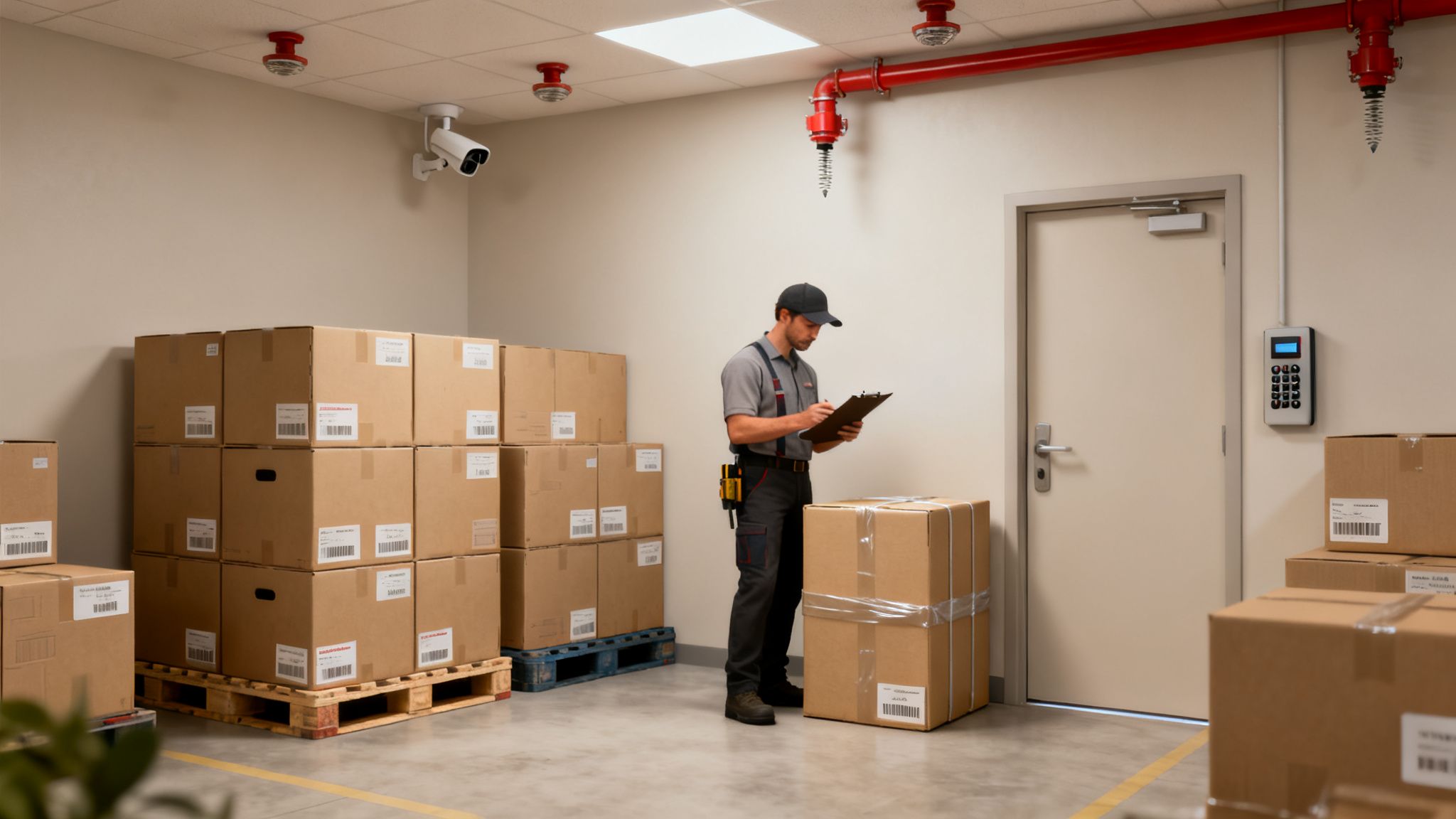
Unpacking Warehouse Security Measures
Right off the bat, you need to know that a moving company’s private warehouse is a totally different beast than a public self-storage facility. Self-storage lots are built for constant public access, which, by design, creates security risks. A mover’s warehouse, on the other hand, is a fortress built for one purpose: keeping your stuff safe.
Any mover worth their salt invests heavily in multiple layers of security to give you peace of mind. Here are the absolute must-haves you should be looking for:
- 24/7 Video Surveillance: High-definition cameras should be watching every entrance, exit, and storage area, all day, every day.
- Restricted Access Protocols: Only authorized, background-checked employees should ever be allowed inside. The complete lack of public foot traffic is a huge deal—it dramatically cuts down the risk of theft.
- Advanced Fire Suppression: This isn’t just a smoke detector on the ceiling. We’re talking professional-grade sprinkler systems and alarms to protect against the unthinkable.
- Climate-Controlled Environments: As we’ve already covered, this is what keeps your sensitive items from being ruined by humidity and wild temperature swings.
This tightly controlled environment is a game-changer. With access so carefully managed, your items are far more secure than they would be in a facility where hundreds of strangers come and go as they please.
Demystifying Valuation Coverage For Moving And Storage
Insurance is another area that trips people up, but it’s incredibly important. When you hire a mover, they don’t technically offer “insurance.” What they provide is called Valuation Coverage. It’s a federally regulated system that spells out how much the moving company is liable for if your things are lost or damaged.
Essentially, it’s the mover’s promise to reimburse you up to a specific amount if something goes wrong. This coverage should protect your belongings during the entire journey—from the moment they’re packed, to their time on the truck, and all the way through their stay in the storage facility.
It’s crucial to understand that your homeowner’s or renter’s insurance policy often does not cover your goods while in transit or in the care of a third party like a moving company. It’s on you to check your policy and choose the right valuation option.
Questions To Ask About Your Coverage
Not all valuation options are the same, and the basic coverage that movers are required to offer is pretty minimal. To make sure your prized possessions are actually protected, you need to ask some direct questions before you sign on the dotted line.
- What are my valuation options? By law, movers have to offer at least two levels. There’s Released Value Protection (the free, basic option that only pays 60 cents per pound per article) and Full Value Protection (a much better option where the mover is responsible for the replacement value of a lost or damaged item).
- Does my coverage extend to the storage period? You need to get this in writing. Always confirm that the valuation coverage you choose applies for the entire time your items are with the company, including the full storage term.
- How do I file a claim if something happens? Get familiar with the process, the deadlines, and what paperwork you’ll need. A transparent company will have a clear, straightforward procedure ready for you.
By asking these questions, you can move forward with confidence, knowing exactly how your belongings are protected from start to finish.
Packing For Storage: A Practical Guide
How you pack can be the difference between unboxing pristine family heirlooms and discovering a box of moldy, heartbreaking memories. Let’s be clear: packing for storage is a totally different ballgame than packing for a direct move. You’re not just getting things from Point A to Point B; you’re preparing them to withstand time, temperature shifts, and months of just sitting there.
Think of it as your first line of defense. This is especially true when you’re using moving companies that offer storage. Our crews rely on sturdy, clearly labeled boxes to stack everything safely in a transport vault. One poorly packed box doesn’t just put your own stuff at risk—it can threaten the stability of everything around it.

Short-Term vs. Long-Term Packing Strategies
The way you pack should absolutely change depending on how long your items will be tucked away. A few weeks in storage just requires basic protection. But long-term? That demands a much more thorough strategy to fight off gradual damage from dust, moisture, and pests.
For any short hold (think under 90 days), standard moving boxes and packing paper will get the job done. But if you’re looking at anything longer, you need to start thinking like a museum archivist trying to preserve priceless artifacts.
Key Long-Term Packing Steps:
- Clean Everything—No Exceptions: That tiny crumb left in a toaster or the lingering dampness in a washing machine is an open invitation for pests and mold. Appliances, furniture, and even clothes need to be totally clean and bone-dry before they get packed.
- Use the Right Protection: Don’t just shrink-wrap your furniture. That plastic wrap is notorious for trapping moisture. Instead, opt for breathable moving blankets or furniture pads. They’ll protect against dings and dust while still letting the piece breathe.
- Disassemble What You Can: Take apart bed frames, tables, and anything else with legs or bulky components. It saves a surprising amount of space and dramatically lowers the risk of something snapping under pressure. Just be sure to put all the screws and hardware in a labeled bag and tape it securely to the main piece.
Creating A Master Inventory List
I know, creating a detailed inventory list sounds tedious, but trust me, it’s one of the most critical steps you can take. This list is your personal map of everything you’ve stored, an absolute lifesaver for finding specific items, and non-negotiable documentation if you ever need to file an insurance claim.
Your inventory needs to be more than just “box of kitchen stuff.” A good entry will have the box number, a clear description of what’s inside, and a note on any high-value or fragile items.
Think of your inventory list as a treasure map to your own belongings. Without it, you’re navigating blind. A detailed list provides peace of mind and proves invaluable if you ever need to file a claim for a lost or damaged item.
This is an area where bringing in the pros really shines. The global moving services market is blowing up precisely because more people want these organized, all-in-one solutions. Valued at USD 111.23 billion in 2025, the market is projected to hit USD 159.67 billion by 2032. That growth is a testament to the demand for seamless moves, and you can dig into the trends in the moving services market to see why integrated services are becoming the new standard.
Pro Packing Tips For Maximum Protection
Once you’ve got the basics down, a few professional tricks can take your packing to the next level, ensuring everything stays safe and easy to find.
Label Like a Pro: Don’t just slap a label on top of the box. Mark each box on at least two or three sides with the contents, the room it belongs to, and a unique box number that matches your inventory list. It makes finding that one specific box in a stacked unit a million times easier.
Use Clear Bins Strategically: For things you might actually need while they’re in storage—like seasonal clothes or important documents—use clear plastic bins. You can see what’s inside at a glance without having to unstack and rip open a half-dozen cardboard boxes.
Pack Heavy to Light: This is a golden rule. The heaviest items always go on the bottom of the box, with lighter, more delicate things on top. This simple step prevents crushing and keeps the box from collapsing. Stuff any empty gaps with packing paper or bubble wrap to keep things from shifting around. For more on this, our guide on how to pack fragile items for moving dives into the best techniques for protecting your most delicate possessions.
Your Checklist For Choosing The Right Mover And Storage Partner
Choosing a partner to handle your move and store your belongings is a huge leap of faith. It’s not just about finding the lowest price; it’s about trusting a company with literally everything you own. The right choice makes for a smooth, stress-free experience. A bad one? It can turn into a nightmare of stress, damaged heirlooms, and surprise fees.
This checklist will walk you through the essential steps to find a provider you can actually count on.
Before you even think about comparing quotes, do a quick background check. Every single legitimate interstate mover is required to have a U.S. Department of Transportation (USDOT) number. You should see it displayed clearly on their website. If you don’t, that’s a red flag. If you do, pop it into the Federal Motor Carrier Safety Administration (FMCSA) database to verify it. This simple check confirms they’re a real, regulated business and not some fly-by-night operation.
Next, it’s time to play detective with their reputation. Don’t just skim the glowing testimonials on their own site—that’s the highlight reel. Dig into recent, independent customer reviews on Google, Yelp, or the Better Business Bureau. Look for patterns in what people are saying, especially about communication, timing, and how they solved problems when things went wrong.
Key Areas To Investigate
Once you’ve got a short list of contenders, it’s time to go deeper with some pointed questions. How they answer will tell you everything you need to know about their professionalism and how seriously they take security.
It’s no surprise that integrated moving and storage is booming. The global Self-Storage & Moving Services Market hit USD 59.42 billion in 2025 and is projected to climb to USD 89.4 billion by 2032. That’s a lot of people looking for these exact all-in-one solutions.
Drill down on these three critical areas:
- Licensing and Insurance: Ask them to show you proof of insurance. Make sure you understand their valuation coverage options. A professional company will patiently explain the difference between the bare-bones Released Value Protection and the comprehensive Full Value Protection.
- Quote Transparency: Don’t accept a verbal quote. Insist on a written, binding estimate that details every potential charge—think fees for long carries, flights of stairs, or even just accessing your own stuff in storage.
- Storage Facility Protocols: How do they protect your things? Ask about 24/7 surveillance, who can get in and out of the facility, fire suppression systems, and whether their units are climate-controlled. For more on this, these 10 tips for choosing a self-storage facility are a great resource.
Questions That Reveal The Truth
You can tell a lot about a company by how they handle detailed questions. Don’t be shy—a true professional will welcome your diligence because they have nothing to hide.
Your goal is to find a partner who offers complete transparency. A company that is evasive or provides vague answers about their security, insurance, or pricing is waving a major red flag. Trust your gut and move on.
Here are a few essential questions to get the conversation started:
- What is your process for inventorying my items before they go into storage?
- Can I access my belongings while they are in your warehouse, and what is the procedure?
- What specific security measures are in place at your storage facility?
- Is your storage facility climate-controlled to protect against humidity and temperature extremes?
For a more complete list, check out our guide on the most important questions to ask moving companies before you sign anything. Arming yourself with the right information is the best way to ensure your move is in the hands of pros who tick every single box.
Frequently Asked Questions
When you’re juggling a move and storage, it’s natural to have a few questions pop up. It’s a lot to coordinate! We’ve gathered the most common things people ask when thinking about using a moving company for their storage needs, so you can plan everything with complete peace of mind.
How Much Notice Do I Need for Moving and Storage?
While booking a few weeks ahead is always a smart move—especially during the busy summer months—some movers can accommodate last-minute requests. The best way to handle it? Mention that you might need storage right when you’re getting your first quote.
This gives the company a heads-up and lets them build that possibility into the plan from the very beginning, making for a much smoother experience. Just make sure to ask about their scheduling policies and if there are any fees for short-notice changes. No one likes surprise costs.
Can I Access My Belongings in Storage?
This is a big one, and the answer really depends on the provider. Most moving companies don’t use the kind of self-storage lockers you can pop into whenever you want. Instead, they use super-secure warehouse vaults, which are fantastic for security but not designed for frequent visits.
This usually means getting to your stuff is by appointment only. You’ll likely need to schedule a time in advance, and there might be a labor fee for the crew to pull your specific vault out. If you think you’ll need regular access to your things, you absolutely have to talk about this upfront to see how they handle it and what it might cost.
What Items Are Prohibited in Moving Company Storage?
For everyone’s safety and to meet insurance rules, some things just can’t be stored. This list pretty much always includes hazardous materials—think propane tanks, paint, chemicals, and anything flammable. It also covers perishable food, live plants, and anything illegal.
Beyond that, you should always keep your most valuable and irreplaceable items with you personally. This includes:
- Cash, stocks, and bonds
- Jewelry and precious metals
- Critical documents like passports, wills, and birth certificates
A key part of learning how to choose the best company for moving and storage is to ask for their specific list of prohibited items before you even start packing.
Ready to simplify your move with a single, trusted team? Family Movers Express offers secure, climate-controlled storage with 30 days free to make your transition seamless. Get your transparent quote today by visiting https://familymoversxpress.com.
Ready to protect your upcoming move?
Click Here to Fill Out Our Quick Form & Secure Your Instant Quote!
