

Knowing how and when to change your address is one of the biggest moving puzzles, but it really just boils down to a solid, time-based plan. This isn't just about telling the post office where to send your mail; it's a full-scale operation involving everyone from the DMV to your bank to your favorite subscription box.
A methodical approach turns a mountain of a task into a series of manageable steps.
Your Address Change Timeline: From 8 Weeks Out to Moving Day
A smooth move is all about good timing. Dropping the ball on an important address update can cause a domino effect of headaches—missed bills, lost packages, and even security risks. Following a clear timeline helps you tackle everything systematically, so you’re not scrambling at the last minute. It's about redirecting your entire life, making sure every official record and personal account moves right along with you.
This kind of planning has never been more relevant. The moving industry is booming, growing into a $23.2 billion market in 2024, with an average annual growth of 6.8% over the last five years. That's because a lot of people are on the move—about 12.1% of Americans relocated in 2023 alone, and every single one of them had to navigate this exact process.
To keep you on track, here's a week-by-week breakdown of who to notify and when.
Address Change Notification Timeline
| Timeframe | Key Tasks | Pro Tip |
|---|---|---|
| 6-8 Weeks Out | Create a master list of all accounts: government, financial, utilities, insurance, subscriptions, and personal contacts. | Walk through your home, room by room, to jog your memory about services and subscriptions you might otherwise forget. |
| 4 Weeks Out | File your official Change of Address with USPS. Schedule utility disconnections and new service activations. | File your USPS change of address online. It costs a small fee for identity verification, but it's much faster than going in person. |
| 2-3 Weeks Out | Start notifying financial institutions (banks, credit cards), insurance providers, and your employer's HR department. | Many banks and credit card companies let you update your address right in their mobile app, saving you a phone call. |
| The Final Week | Confirm all utility transfers. Follow up with anyone you haven't heard back from. Update online shopping profiles (like Amazon). | Pack a "Day One" box with chargers and important documents, including confirmations of your address changes. |
| Moving Day & After | Leave a forwarding address for the new residents for any straggler mail. Update your driver's license and vehicle registration. | Check your old mailbox one last time before you hand over the keys. You'd be surprised what can show up at the last minute. |
Let’s dive a little deeper into what each of these phases looks like.
The Foundation: Eight Weeks Out
Your journey starts long before you even see a moving truck. About two months before the big day, your main job is to create a master list of every single account tied to your current address. Think of it as a complete audit of your life.
Your master list should cover all the bases:
- Government: USPS, IRS, Social Security Administration, DMV, and Voter Registration.
- Financial: Banks, credit cards, auto or student loan providers, investment accounts, and even payment apps like PayPal.
- Utilities & Home Services: Electricity, gas, water, internet, cable, trash collection, and home security systems.
- Insurance: Health, dental, vision, life, auto, and homeowners or renters insurance.
- People & Places: Your employer (HR department), doctors, dentists, your kids’ schools, and your vet.
- Subscriptions: Magazines, meal kits, streaming services, and major online shopping accounts (Amazon is a big one!).
Getting this list down on paper (or in a spreadsheet) early gives you a clear roadmap. You’ll know exactly who needs to be contacted and can start gathering any necessary account numbers, which will make the actual notification process a breeze. You can learn more about how to plan your move 6-8 weeks prior to your move.
The Critical Window: Four Weeks Before Moving
With your move date getting closer, it’s go-time. The single most important task now is to submit your official Change of Address (COA) request with the U.S. Postal Service. The easiest way to do this is online, which requires a small verification fee to confirm your identity.
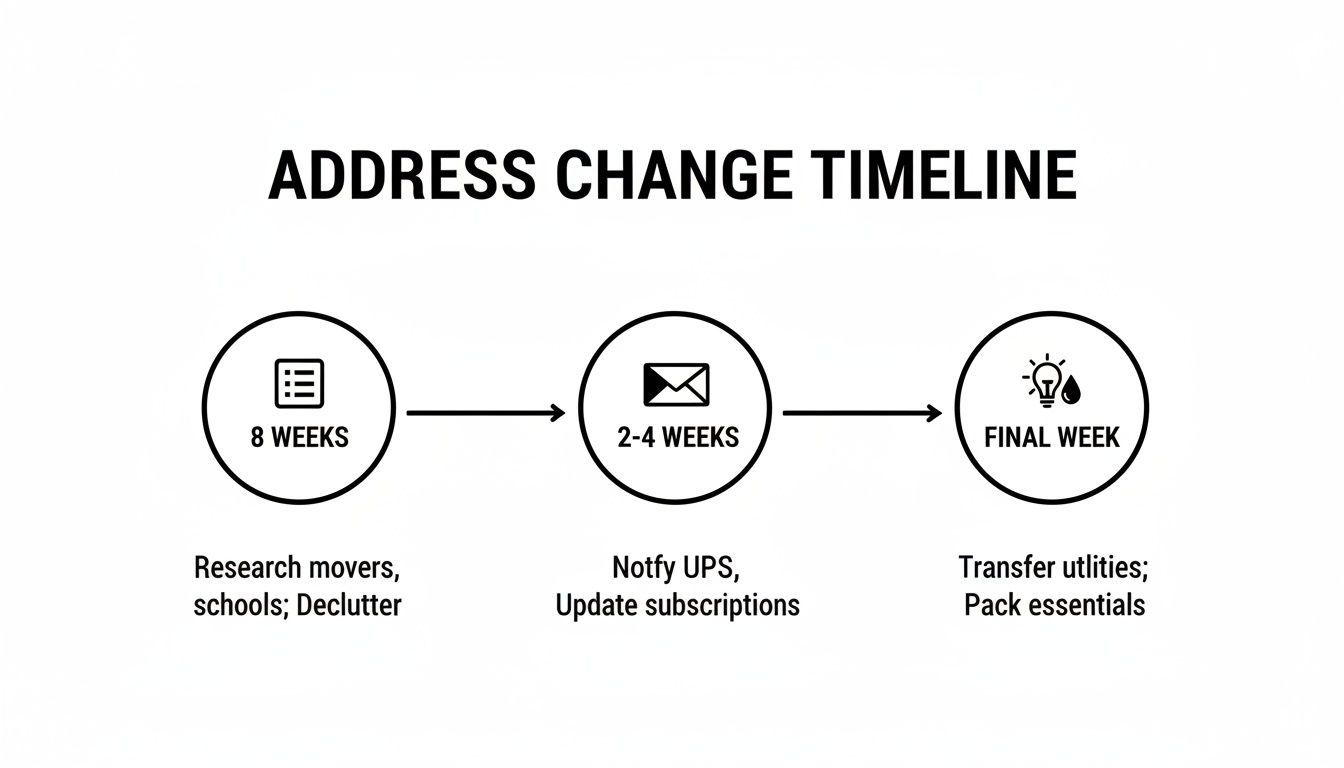
This is also the perfect time to get your utilities scheduled. Contact your providers for electricity, gas, water, and internet to set a stop date at your old place and a start date for your new one.
My advice? Have the services at your old home shut off the day after you move out and have everything at your new home turned on the day before you arrive. That little bit of overlap is your safety net against being left in the dark.
Pro Tip: When you’re on the phone scheduling utility transfers, don’t be afraid to ask if there are any new customer promotions or better plans available at your new address. A move is the perfect excuse to shop around and potentially lower your bills.
For a great example of how to systematically plan a move, this UK moving checklist is fantastic. Even though it’s geared toward the UK, the core principles of good planning are universal.
The Final Week Countdown
In the last seven days, it’s all about confirming and double-checking. Call your utility companies to make sure everything is on track. Log in to the USPS website to verify that your mail forwarding is set to begin on the right day.
This is your last chance to scan that master list. Did you remember to update your address with your bank? What about your car insurance? A quick final review can catch any small detail that might have slipped through the cracks, setting you up for a truly seamless transition on moving day.
Alright, with your moving timeline sketched out, it’s time to tackle the big stuff: the official government address changes. These aren’t just items on a to-do list; they’re mandatory notifications that keep you legally compliant, protect your identity, and ensure you actually get important mail. Getting this right from the start is the foundation of a successful move.
From your driver’s license to your tax returns, getting these details squared away early prevents massive headaches later. Let’s walk through exactly who needs to hear from you and the smartest way to get it done.
Start With the US Postal Service
First stop, always: the U.S. Postal Service (USPS). Filing an official Change of Address (COA) request is your safety net. It tells the postal service to forward mail from your old place to your new one, catching anything you might have missed.
Most people moving will need a permanent forward, which keeps first-class mail coming your way for 12 months. This gives you a generous buffer to update your address directly with banks, subscriptions, and everyone else.
The easiest way to do this is online at the official USPS website. They charge a small identity verification fee of about $1.10, which is a smart security step to make sure no one else is trying to reroute your mail. It’s a tiny price to pay to avoid a trip to the Post Office.
Update Your Driver’s License and Vehicle Registration
Next on the list is your state’s Department of Motor Vehicles (DMV). This one is time-sensitive. Most states give you a pretty tight window—often just 10 to 30 days after you move—to update the address on your driver’s license and vehicle registration.
Miss that deadline, and you could be looking at fines. The good news is that many states let you handle this online, saving you from spending an afternoon in a notoriously long line. If you’re moving to a new state, however, plan on an in-person visit. You’ll need a brand-new license and plates.
Key Takeaway: Don’t drag your feet on this one. Before you even pack a box, check the DMV website for your new state. Find out their exact requirements, deadlines, and what documents to bring so you can get it done in one trip.
Ensure Your Voter Registration Is Current
Moving doesn’t mean you have to lose your voice in elections. Updating your voter registration is a quick but critical step to make sure you can cast your ballot without a hitch. If you just moved across town (within the same county), you can usually update your registration online in a few minutes.
Moving to a new county or state means you’ll have to re-register completely. You can often kill two birds with one stone and do this when you’re at the DMV updating your license—a process known as “Motor Voter.” For other state-level updates, a comprehensive list of Secretary of State websites can be a huge help.
Notify Federal Agencies Like the IRS and SSA
Beyond the post office and DMV, a couple of key federal agencies need to know you’ve moved. This is crucial for your finances and legal standing.
The two big ones are:
- The Internal Revenue Service (IRS): To get your tax refund and any other official notices, you need to tell the IRS your new address. The official way to do this is by filling out and mailing Form 8822, Change of Address.
- The Social Security Administration (SSA): If you get any kind of Social Security benefits—retirement, disability, or Medicare—you have to update your address with the SSA right away. You can usually do this online through your “my Social Security” account.
Knocking out these official changes early is one of the smartest things you can do for a less chaotic move. Once you’re settled, you’ll have a whole new list of things to do. For a smooth transition into your new home, take a look at our guide on the 10 crucial steps to take following a move.
Notifying Banks, Insurance, and Financial Services
Your financial life is practically tethered to your physical address, making this part of the moving checklist one of the most critical. Dropping the ball here can snowball into some serious headaches—we’re talking missed payments, potential fraud, or even a lapse in crucial insurance coverage right when you need it most.
Making these updates ensures that sensitive documents, like a new debit card or critical tax forms, land in your mailbox, not the old one. Think of it as shoring up your financial perimeter during the chaos of a move.
Start with Your Primary Bank and Credit Cards
The first places to notify are the accounts you use every day. This means your main checking and savings accounts, plus every single credit card you own. Thankfully, most banks have made this incredibly easy.
You can usually knock this out in a few minutes through your bank’s mobile app or their online portal. It’s a lot faster than sitting on hold. For security, they’ll likely ping your phone with a confirmation code, so have it ready.
If you’d rather talk to a person, a phone call still works perfectly well. Just be ready to go through the security wringer and verify your identity with your Social Security number, date of birth, and those security questions you hopefully remember setting up.
Expert Tip: Don’t just update your billing address; double-check your shipping address, too. Many online banking systems have separate fields for these. A mismatch could send a replacement credit card to your old home, creating a security nightmare and a massive inconvenience.
Don’t Forget Loans and Investment Accounts
Beyond your day-to-day banking, there’s a whole ecosystem of other financial accounts that need your new address. Forgetting about these can have real consequences, especially when it comes to official letters and tax documents.
Make sure your notification list includes:
- Loan Providers: This is a big one. It covers everything from auto and student loans to personal loans and your mortgage (if you kept your old property). A missed statement can easily lead to a late payment, which is a quick way to ding your credit score.
- Investment and Retirement Accounts: Your 401(k) administrator or brokerage firm needs your current address to mail you annual statements and essential tax forms like your 1099s. You don’t want those floating around.
- Online Payment Platforms: Yep, even services like PayPal and Venmo are tied to your physical address for billing and identity verification. It only takes a second to log in and make sure your info is up to date.
Safeguard Your Coverage by Updating Insurance Policies address
Insurance is often intensely location-specific, so updating these providers is absolutely non-negotiable. Your rates for things like car and home insurance can change dramatically just by moving to a new zip code.
Get in touch with every one of your insurance providers:
- Auto Insurance: Your premium is calculated using local factors like traffic data and even crime rates. A new address will almost certainly adjust your rate. Failing to report the move could actually void your policy if you need to make a claim.
- Homeowners or Renters Insurance: This one’s a no-brainer. You need coverage for the new place. Call your provider to see if you can transfer your policy or, more commonly, set up a new one that accurately reflects the new property.
- Health, Life, and Disability Insurance: These might seem less dependent on your location, but your provider absolutely needs your correct address for billing and official communications. If your health insurance is through your job, updating your info with HR should take care of it, but it never hurts to double-check.
Getting Utilities and Home Services address Switched Over
Picture this: you’ve just survived a marathon moving day. You’re exhausted, you’re sore, and all you want to do is collapse. But when you walk into your new place and flip the light switch… nothing happens. And forget about Wi-Fi. It’s an incredibly common and frustrating moment, but thankfully, it’s one you can sidestep with a little planning. Sorting out your utilities isn’t just a task to tick off a list; it’s about making sure your new house feels like a home the second you walk through the door.
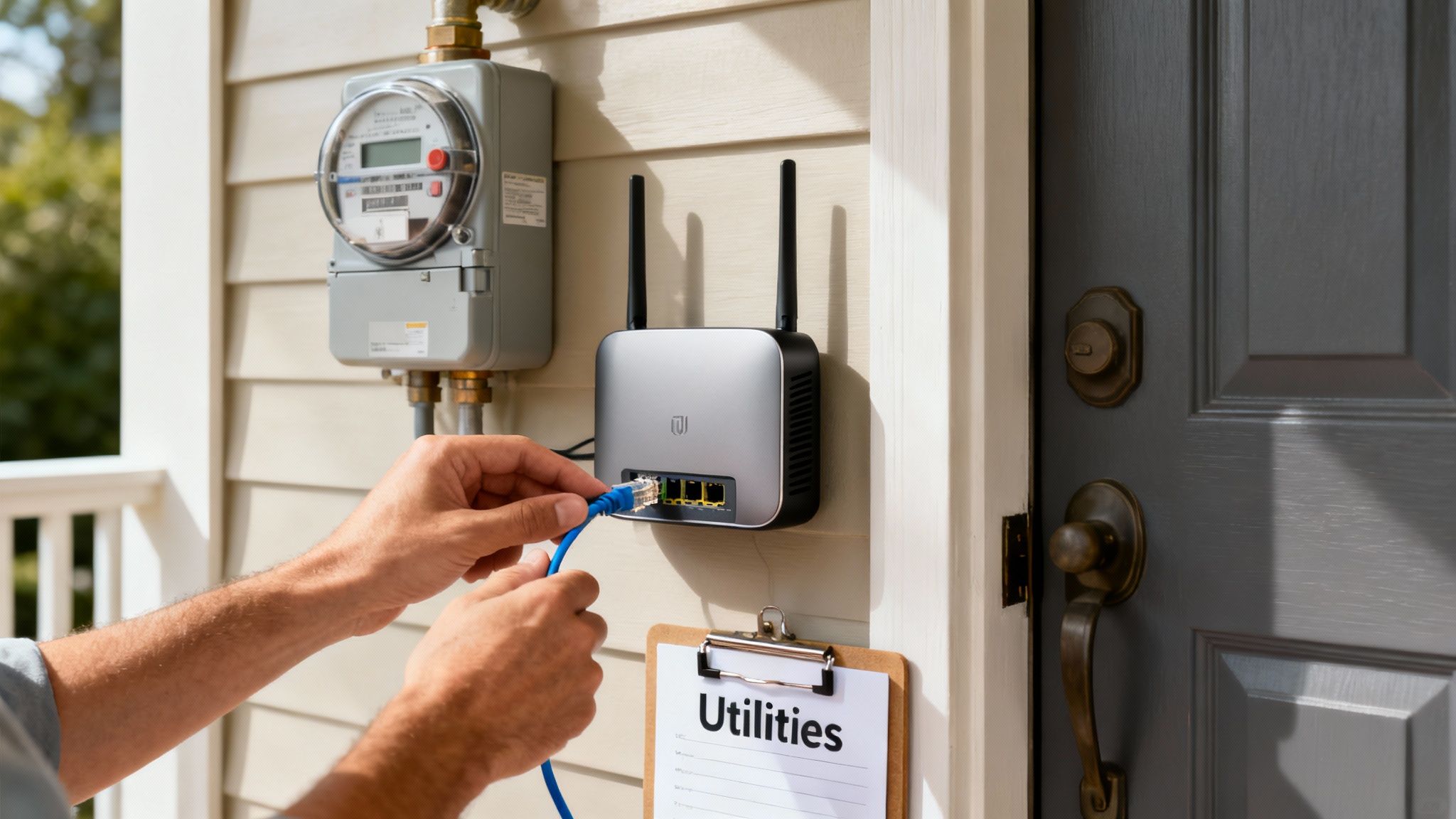
The secret here is all about timing. You’ll want to start getting your utility transfers in order about three weeks before you move. That buffer gives the companies plenty of time to get everything scheduled without any last-minute chaos. Your goal should be a perfectly smooth transition: services at your old place stop the day after you move out, and services at your new place start the day before you arrive. That little one-day overlap is your best friend—a small safety net that prevents a lot of headaches.
Coordinating the Core Utilities
First things first, let’s tackle the absolute must-haves: electricity, gas, water, and garbage/recycling services. These are the non-negotiables that make a space livable.
Get in touch with your current providers to schedule the day you want service to end. At the same time, you’ll be setting up brand-new accounts for your new address. If you’re just moving across town and using the same company, you can often just “transfer” the service. But if you’re moving to a new city or state, you’ll be starting from scratch with entirely new providers.
A quick search for “[Your New City’s Name] utility providers” is all it takes to find who you need to call. When you do, make sure you have this info handy:
- Your complete new address
- The date you’re moving in
- Your Social Security number and a valid ID (they’ll need this to set up the account)
- The exact date you want to stop service at your old home
A Mover’s Insight: When you’re on the phone setting up new accounts, don’t be shy. Ask them if they have any new customer deals, budget billing options, or energy-saving programs. A move is the perfect excuse to hunt for a better rate and find ways to keep your monthly bills down from the very beginning.
Managing Internet and Communications
Let’s be honest, in today’s world, the internet is right up there with electricity. Don’t leave your Wi-Fi to chance. You need to call your internet and cable provider well ahead of your move, as it can sometimes take a week or even longer to get an installation appointment on the books.
This is also the perfect time to take a hard look at your current plan. Is your provider even available in the new neighborhood? A quick address check on their website will answer that. If they are, you can usually just transfer everything over.
But hold on—moving might unlock better options. The new area could have zippy fiber-optic internet that wasn’t available before, or a competitor might be offering a much better deal. It never hurts to do a little comparison shopping before you commit to just transferring what you already have. For anyone tackling a bigger relocation, our guide on how to plan a cross-country move has a ton of extra tips for handling these long-distance details.
Don’t Overlook Other Home Services
Finally, think about the other services connected to your address that need to be wrapped up or moved.
Run through a mental checklist for services like:
- Home Security Systems: Give your provider a call. Can they move your current system, or will you need a whole new installation at the new place?
- Pest Control: Line up a final spray at your old home and schedule an initial treatment at the new one, which is especially important if you’re moving to a region with a different climate (and different critters).
- Landscaping or Pool Maintenance: Make sure to officially cancel any recurring services and get your final bill settled so there are no surprises.
Working your way through this list systematically ensures every little piece of your household is ready and waiting for you. This proactive approach saves you from those day-one disasters and lets you get right to the fun part: making your new house a home.
Taking Care of Subscriptions, Memberships, and Personal Contacts
Once you’ve sorted out the official business with the government and your bank, it’s time to turn your attention to the smaller, everyday connections in your life. It’s so easy to overlook these, but forgetting them is what leads to those classic moving headaches: packages showing up at your old place, memberships lapsing, and important professional mail getting lost in the shuffle.
Honestly, getting these smaller updates done is what makes your personal life feel like it’s moved along with your furniture. This isn’t about legal deadlines; it’s about keeping your lifestyle, career, and health on track without any annoying interruptions.
Lock Down Your Deliveries and Memberships
We live in an age of online shopping and subscription boxes, which means our front door is a pretty busy place. If you forget to update an address, your monthly coffee subscription or that book you ordered could end up with the new tenants. The best way to tackle this is to do a quick audit of everything you have delivered.
A great trick is to scroll through your credit card statements for the last few months. That’ll jog your memory. You’ll want to check:
- Online Shopping Accounts: Amazon is usually the first stop. Go into your account settings and change your default shipping address. Don’t forget other places you shop frequently, like Target, Chewy, or any smaller online stores.
- Subscription Boxes: Meal kits, beauty boxes, pet supplies—log in to each service’s website and switch your delivery info over to the new place.
- Magazines and Newspapers: These are notorious for being forgotten. Most publications have a simple online portal where you can manage your subscription.
- Club Memberships: Think Costco, Sam’s Club, or even your local gym. They all need your current address for renewal notices and other mailings.
Mover’s Tip: When you’re updating online retailers, do yourself a huge favor and delete your old address from your profile completely. This will stop you from accidentally clicking it during a rushed checkout. Trust me, it happens more than you’d think in the chaos of a move.
Get Your Professional and School Contacts in the Loop
Your professional life is just as connected to your physical address as your personal one. Making sure the right people have your new info is critical for everything from receiving your W-2 to keeping your professional licenses active.
Start with your employer. Let the HR department know your new address right away for payroll, tax forms, and health insurance correspondence. This is especially important if your move is happening near the end of the calendar year.
Beyond your current job, think about other professional connections:
- Professional Licensing Boards: If you have a state license—like for nursing, law, or as a contractor—you’re often legally required to update your address within a certain window of time.
- Alumni Associations: Want to keep getting those newsletters and invites to networking events? Let your alma mater know where you’ve landed.
- Networking Groups: Any local business or trade groups you’re part of will need your updated contact info as well.
If you have kids, getting their schools, daycares, and any extracurricular programs updated is a huge priority. This ensures you won’t miss report cards, emergency notifications, or invoices.
Update Your Healthcare Team
Last but certainly not least, let your entire healthcare network know you’ve moved. This means every single provider you and your family see, from your primary doctor to your dentist.
Your list should include:
- Doctors: Your general physician, your kids’ pediatrician, and any specialists.
- Dentists and Orthodontists: For appointment reminders and billing statements.
- Veterinarians: To keep your pet’s records straight and get reminders for check-ups or vaccinations.
- Pharmacies: So that your prescriptions can be filled and billed without a hitch.
Keeping this info current is essential for seamless insurance claims and continuity of care. If you’re moving out of the area, it’s always a good idea to ask your current providers for referrals to help you build a new healthcare team. For more on wrapping things up at your old place, take a look at our helpful move-out checklist.
It’s worth noting how much the “average” mover has changed. The moving population is more diverse than ever, with single women making up 24% of home purchases, multigenerational families accounting for 17% of buyers, and experienced professionals relocating at all stages of their careers. Each situation comes with its own unique checklist of contacts to update.
Common Questions About Changing Your Address
Even with the best checklist in hand, changing your address can throw some real curveballs. You start getting into the weeds of mail forwarding, government notifications, and state-specific rules, and things can get confusing fast. Let’s tackle some of the most common questions we hear, clearing up any doubts so you can move forward with confidence.

How Long Does USPS Mail Forwarding Address Take to Start?
Once you submit your Change of Address (COA) request with the U.S. Postal Service, don’t expect your mail to show up at the new place overnight. Officially, USPS says to allow 7-10 business days for the forwarding service to really kick in.
In our experience, it often starts sooner, sometimes within just a few days. But you can’t bet on a best-case scenario during a move. To be safe, get your request submitted online at least two full weeks before moving day. This gives you a nice buffer to make sure nothing gets lost in the shuffle.
Is USPS Mail Forwarding Enough When I Move?
This is a big one: absolutely not. It’s probably the single biggest misunderstanding about moving. Think of USPS mail forwarding as a temporary bridge, not a permanent solution. Its job is to catch mail sent to your old address and reroute it for a limited time—usually 12 months for first-class mail. It does not actually change your address with anyone sending you mail.
If you only rely on forwarding, you’re setting yourself up for headaches down the road. Once that 12-month period ends, any mail still going to your old address gets returned to the sender or just tossed out.
Crucial Takeaway: You have to personally contact every single organization—your bank, your job, your insurance company, your doctor, and all your subscriptions—to permanently update your address on their files. Forwarding buys you time, but it’s not the real fix.
While you’re at it, it’s a good idea to research key questions to ask moving companies to ensure every aspect of your move is covered.
Do I Really Need to Tell the IRS That I Moved?
Yes, this is non-negotiable. Notifying the IRS of your move is critical for getting important tax documents, especially refunds and official notices, without any delay. If the IRS mails a refund check to your old home, it might not be forwarded correctly. That can lead to major hassles and a long wait for your money.
The official way to do this is by filling out and mailing Form 8822, Change of Address. You can also update your address when you file your annual tax return, but it’s far safer to just send in the form as soon as you move to avoid any communication gaps.
Can I Update My Driver’s License Address Online?
This completely depends on which state you’re in and the rules of its Department of Motor Vehicles (DMV). The good news is that many states have modernized their systems and now let you update the address on your driver’s license and vehicle registration through an online portal. It’s a massive time-saver.
However, some states still require an in-person visit, particularly if you’re moving from out of state and need a brand-new license. The deadlines are also strict; you typically have to get it done within 10 to 30 days of moving.
Your first step should be to check the official DMV website for your new state. That’s where you’ll find the most accurate info on their process, what documents you’ll need, and whether an online update is an option for you.
Planning a move shouldn’t be a source of stress. The team at Family Movers Express LLC is here to handle the heavy lifting, from professional packing to guaranteed delivery dates, so you can focus on settling into your new home. Let us make your next move your best move. Get your free quote today!
Ready to protect your upcoming move?
Click Here to Fill Out Our Quick Form & Secure Your Instant Quote!
