

Embarking on a long distance move from Orlando requires more than just boxes and tape; it demands a strategic plan tailored to Central Florida’s unique logistics. Whether you’re navigating the final loop around I-4, leaving a community in Lake Nona or Winter Park, or coordinating a move across state lines via the Florida Turnpike, a detailed checklist is your most critical tool. This isn’t generic advice. This is your expert-backed, hyper-local long distance moving checklist from Family Movers Express, designed by professionals who handle the specifics of Orlando-area relocations every day. From understanding HOA rules in planned communities to planning around unpredictable afternoon thunderstorms, we’ll guide you through every phase of your journey, ensuring a smooth transition from the Sunshine State to your new home.
This comprehensive guide breaks down the entire process into actionable, timeline-based steps. You will learn precisely what to do eight weeks out, what to finalize in the last 48 hours, and how to settle in post-move without missing a beat. We’ll cover everything from creating a detailed inventory and decluttering your home to the nuances of hiring movers with guaranteed pickup dates, a crucial factor for interstate relocations. We also address specialized needs, such as moving with pets. As you embark on your long-distance moving journey, remember that detailed planning is key, and if you have feline companions, a stress-free resource like this can provide a comprehensive guide to moving across country with cats.
Our goal is to transform the overwhelming task of moving into a manageable, step-by-step project. Let’s get started on your seamless move out of Orlando.
1. Research and Book a Reputable Moving Company
Choosing the right professional mover is the most critical first step in any long-distance moving checklist. This isn’t just about transporting boxes from Orlando; it’s about entrusting your entire household to a team for a journey that could span hundreds or thousands of miles. A reputable company handles the complex logistics, regulatory requirements, and physical labor, setting the stage for a smooth transition. This foundational step, best completed 4 to 8 weeks before your move, ensures you secure a reliable partner for your journey.
Vetting Your Moving Partner
For an interstate move, such as one originating from the Orlando area and heading up the I-95 corridor, your mover must have an active USDOT number, verifying they are licensed for interstate commerce. Beyond federal compliance, look for a proven track record. Companies like Family Movers Express, known for their 4.9/5 satisfaction rating, provide services essential for long-haul moves, including guaranteed pick-up and delivery dates. This guarantee is a game-changer, eliminating the frustratingly vague “moving windows” many other companies provide.
Key Actions to Take
To ensure you select the best partner for your move from Orlando, follow these practical steps:
- Get at Least Three Quotes: Contact multiple companies to compare pricing, services, and availability. Be wary of quotes that are significantly lower than others, as they may indicate hidden fees.
- Verify Credentials: Check the company’s USDOT number on the Federal Motor Carrier Safety Administration (FMCSA) website. Confirm their insurance and read recent Google and Yelp reviews specific to their Orlando operations.
- Ask Targeted Questions: Don’t be shy. Ask about their insurance coverage limits, whether they offer climate-controlled storage for sensitive items, and if they provide flexible payment options, such as “move-now, pay-later” plans. For a comprehensive list of what to ask, review these essential questions to ask your moving company.
- Document Everything: Once you book, keep detailed records of all agreements and payments. For clear documentation, you can easily generate a moving service receipt to maintain a professional paper trail for your expenses.
2. Declutter and Downsize Your Belongings
Before a single box is packed, the most impactful step you can take is to declutter and downsize your belongings. This isn’t just about tidying up; it’s a strategic move that directly reduces the cost and complexity of your long-distance relocation from Orlando. Since long-haul moves are priced based on the weight and volume of your shipment, every item you choose not to move saves you money. Starting this process 6 to 8 weeks before your move date provides ample time to sort through your home without feeling rushed.

A Strategic Approach to Downsizing
For Orlando residents in neighborhoods like Lake Nona or Winter Park, downsizing effectively can mean the difference between needing one truck or two. The goal is to avoid paying to transport items you no longer need, use, or love. Consider the popular KonMari Method, which encourages keeping only items that “spark joy,” or the simple ‘one-year rule’: if you haven’t used it in the last 12 months, it’s a candidate for removal. Our customers have significantly lowered their moving costs, some reducing their shipment weight by a ton or more, simply by dedicating a few weekends to this critical task.
Key Actions to Take
To streamline your decluttering process and maximize savings on your move from Orlando, follow these steps:
- Categorize and Conquer: Instead of tackling one room at a time, which can be overwhelming, sort by category (e.g., all clothes, all books, all kitchen gadgets). This prevents shuffling items from room to room and gives you a clear picture of what you own.
- Sell Valuable Items: Use online platforms like Facebook Marketplace or OfferUp to sell furniture, electronics, and other high-value items. This not only lightens your load but also adds funds to your moving budget.
- Schedule Donation Pickups: For larger items like furniture or multiple bags of clothing, schedule a free pickup from organizations like The Salvation Army or Goodwill in the Orlando area. This saves you a trip and ensures your items go to a good cause.
- Digitize and Discard: Scan old photos, documents, and children’s artwork to create digital copies, then shred the originals. This drastically reduces paper clutter and weight. For more tips on trimming down your inventory, review our detailed guide on how to plan a cross-country move.
3. Create a Comprehensive Moving Inventory
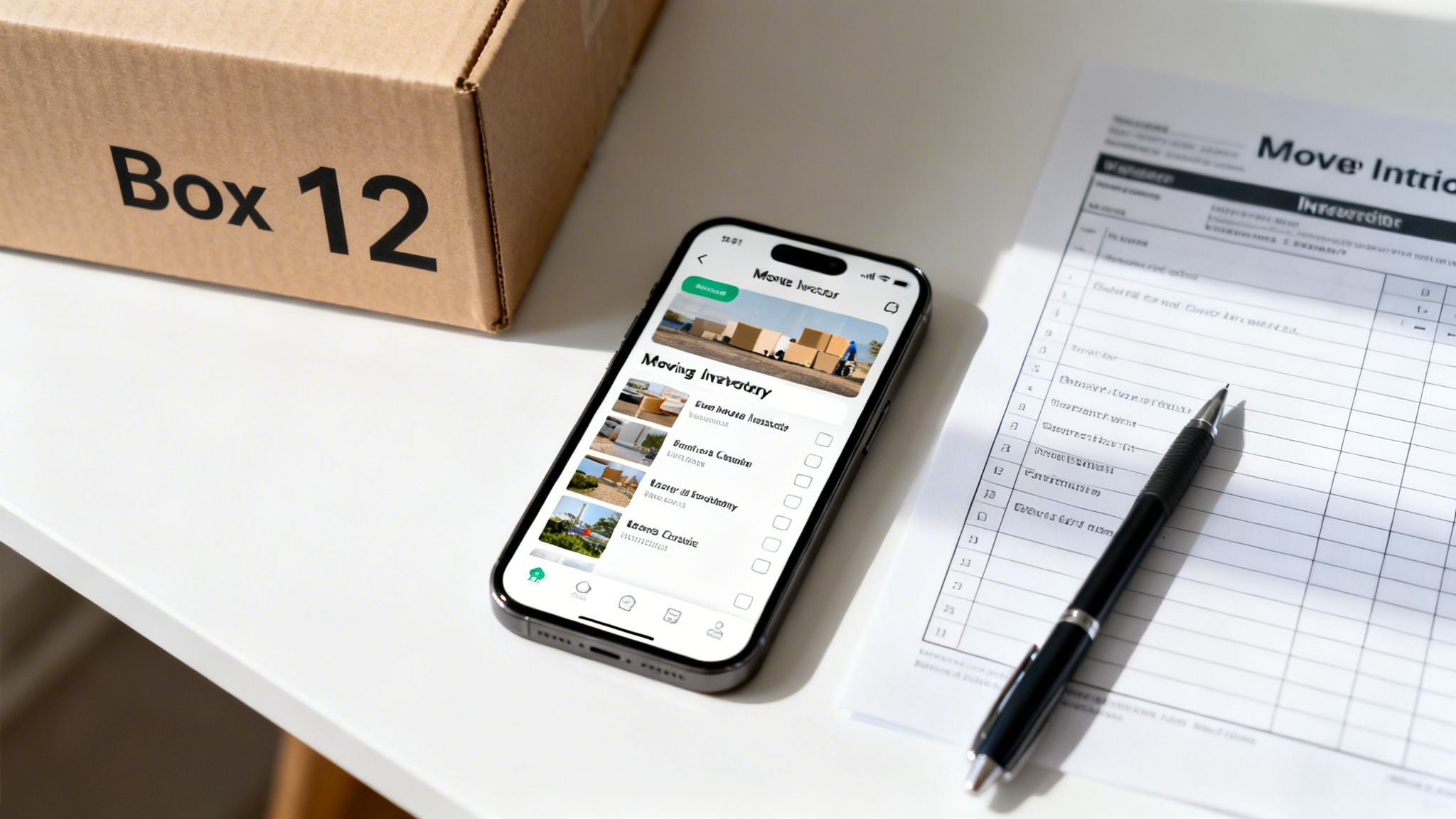
Creating a detailed inventory of your belongings is a non-negotiable part of any long-distance moving checklist. This process goes far beyond simply knowing what you own; it’s a powerful tool for accountability, insurance, and organization. An accurate list ensures your movers have a clear understanding of the shipment size, protects you in the event of loss or damage, and transforms unpacking from a chaotic scramble into a streamlined process. For a move originating in Orlando, this step should begin 4 to 6 weeks out, as you start decluttering and preparing to pack.
Modernizing Your Inventory Process
Gone are the days of handwritten lists that can easily get lost. Today, digital inventories are the industry standard for transparency and accuracy. Companies like Family Movers Express utilize digital systems to document every item, often including photos, providing both you and the moving team with a shared, verifiable record. This is especially critical for high-value possessions, from sensitive electronics to cherished antiques, ensuring their condition is documented before they are loaded onto the truck in Winter Park and transported up the East Coast.
Key Actions to Take
To build a robust inventory for your move from the Orlando area, implement these practical steps:
- Utilize Technology: Download a dedicated inventory app like Sortly or use a simple spreadsheet. Go room by room, listing major items and the general contents of each box you pack.
- Photograph Everything: Take clear photos of valuable items, such as artwork, furniture, and electronics. Capture existing wear and tear for your records, which is crucial for any potential insurance claims.
- Number Your Boxes: Assign a unique number to every box. On your inventory list, note the box number, its contents, and its destination room (e.g., “Box #27 – Kitchen – Small Appliances”).
- Document Condition: For high-value or fragile items, make a brief note about their condition before the move (e.g., “Living Room – Oak Coffee Table – slight scratch on left leg”). This detail is invaluable if a damage claim becomes necessary.
- Share with Your Mover: Provide a copy of your completed inventory to your moving company. This ensures everyone is aligned on the scope of the move and the items being transported.
4. Arrange Transportation and Logistics
Coordinating transportation is the engine of your long-distance move, determining how and when your entire household travels from your Orlando home to your new one. This involves more than just booking a truck; it’s about mapping out the journey, scheduling rest stops, and securing storage if needed. Properly arranging logistics, ideally 4 to 8 weeks before moving day, ensures a predictable and safe transit for your belongings, whether you’re navigating I-4 traffic one last time or heading north on the Florida Turnpike.
Mastering Your Move’s Itinerary
For an interstate move, the logistics can be complex, involving route planning along major highways like I-95 and adherence to strict driver safety regulations. This is where a professional mover’s expertise becomes invaluable. Companies like Family Movers Express simplify this process by offering guaranteed pick-up and delivery dates, which removes the uncertainty and stress of coordinating travel timelines. This commitment means you won’t have to guess when your belongings will arrive, allowing you to plan your own travel and new home setup with confidence.
Key Actions to Take
To ensure your transportation logistics are seamless and stress-free, follow these actionable steps:
- Choose Your Moving Method: Decide between a full-service move, where professionals handle everything, or a DIY approach with a truck rental. For long-distance moves originating in Orlando, a full-service option is often safer and more efficient.
- Confirm Transit and Storage Details: Ask your mover about their transit timeline, including planned overnight stops for driver safety. If there’s a gap between your move-out and move-in dates, inquire about their climate-controlled storage options; some companies offer 30 days of free storage.
- Lock In Your Dates: Book your mover as early as possible to secure your preferred dates. Discuss their pickup window policies, whether they offer a tight 4-hour block or a broader 8-hour one. Having backup dates is a smart contingency.
- Plan Your Personal Travel: Once your household goods’ journey is set, you can arrange your own travel. To dive deeper into the nuances of scheduling, you can explore this guide on how to plan a cross-country move.
5. Notify Utilities and Service Providers
Managing the transfer of utilities and services is a crucial logistical task in any long-distance moving checklist. This step ensures you maintain essential services like power and internet without interruption, avoiding the stress of arriving at a dark, unconnected new home. Properly scheduling disconnections at your old Orlando address and connections at your new one prevents overlapping bills and service gaps. This process should be initiated 4 to 6 weeks before your move to allow ample time for scheduling with various providers.
Coordinating Service Transfers
A seamless transition of utilities is about precise timing. For instance, a long-distance move from an Orlando apartment in Lake Nona to a new home requires you to coordinate with multiple entities. You’ll need to schedule a disconnection with the Orlando Utilities Commission (OUC) and set up a new account with the provider at your destination. Simultaneously, you must arrange for your internet service, perhaps with Comcast or Spectrum, to be transferred, which can be a multi-step process. Failing to plan this can leave you without Wi-Fi for days, disrupting work and communication.
Key Actions to Take
To manage your utility and service transfers effectively, follow these actionable steps:
- Create a Master List: Build a spreadsheet detailing each provider (electricity, water, gas, internet, etc.), their contact information, and your account numbers. This keeps all necessary information in one organized place.
- Schedule Smartly: Arrange for utilities at your current Orlando home to be disconnected the day after you move out. Schedule connections at your new home to be activated the day before you arrive. This provides a buffer for any potential delays.
- Confirm Everything in Writing: After speaking with a representative, request written confirmation of your service start and stop dates. Obtain final meter readings for your old address to prevent billing disputes.
- Update All Accounts: Beyond utilities, remember to update your address with banks, credit card companies, insurance providers, and any subscription services. Transfer medical records and prescriptions to providers in your new city well in advance. For a detailed guide, see how to change your address when moving.
6. Update Address with Government and Financial Institutions
Failing to update your address is one of the most disruptive yet preventable mistakes in a long-distance moving checklist. This crucial task ensures that sensitive mail from the IRS, your bank, and insurance providers follows you from Orlando to your new home. For anyone moving out of Central Florida, updating your address is about more than just getting packages; it’s about maintaining your financial identity and legal compliance. Completing this step 2 to 3 weeks before your move prevents service interruptions and protects you from potential identity theft.
Ensuring a Seamless Transition
The United States Postal Service (USPS) processes millions of change-of-address requests annually, and their mail forwarding service is a vital safety net. However, it’s not a permanent solution. Government agencies like the Social Security Administration and the Florida Department of Highway Safety and Motor Vehicles (FLHSMV) require direct notification. Likewise, financial institutions may flag or even close accounts if they lose contact with you, a common security measure to prevent fraud. Properly managing this process ensures continuity and security for your Orlando departure.
Key Actions to Take
To guarantee a smooth administrative transition for your move from Orlando, follow these targeted steps:
- File with USPS First: Go to the official USPS website to submit your change of address online. This costs a small verification fee (around $1.10) and allows you to set a specific start date for mail forwarding. Opt for the full 12-month forwarding service to catch any mail you may have missed.
- Notify Government Agencies: Update your address directly with the IRS (using Form 8822), the Social Security Administration (online at ssa.gov), and be sure to update your voter registration for your new jurisdiction. If leaving Florida, you’ll need to contact your new state’s DMV for license and vehicle registration updates.
- Contact Financial Institutions: Log into your online banking portals for all banks, credit card companies, and investment firms to update your mailing address. Also, notify your auto, health, and life insurance providers to ensure your coverage remains active and valid in your new location.
- Inform Your Employer: Don’t forget to update your address with your employer’s HR and payroll departments to ensure your W-2 and other critical employment documents are sent to the correct address.
7. Arrange Professional Packing or Gather Packing Supplies
Deciding between professional packing and a DIY approach is a pivotal moment in your long-distance moving checklist. The quality of your packing directly impacts the condition of your belongings after a journey that could span over 1,000 miles. For items traveling from Orlando up the I-95 corridor, proper protection is not a luxury; it’s a necessity to guard against the inevitable bumps and vibrations of transit. This decision, typically made 4 to 6 weeks before your move, determines whether you invest time in packing yourself or money in a professional service.
Leveraging Professional Expertise
For many, especially those with high-value estates or complex corporate relocations in areas like Windermere or Lake Nona, professional packing is the most secure and efficient option. Full-service movers like Family Movers Express provide trained crews who use high-quality, commercial-grade materials to pack an entire Orlando home in just 1 to 3 days. This service not only saves dozens of hours of labor but also ensures fragile items like antiques, fine art, and electronics are custom-crated or packed using industry best practices for maximum protection.
Key Actions to Take
Whether you hire pros or do it yourself, careful planning is essential. Follow these steps to prepare your belongings for the long haul:
- Book Services Early: If opting for professional help, book your packing service at least 2 to 4 weeks in advance to secure your desired dates. Explore your options to learn more about professional packing and moving services that can be tailored to your specific needs.
- Gather Quality Supplies: If self-packing, start gathering materials 4 to 6 weeks out. Invest in double-walled dish pack cartons for glassware, sturdy wardrobe boxes to keep clothes on hangers, and plenty of bubble wrap and packing paper (avoid newspaper to prevent ink transfer).
- Pack Strategically: Start with non-essential rooms first. Fill every box completely with padding to prevent items from shifting, and wrap fragile items individually. Clearly label each box with its destination room and a brief summary of its contents to streamline unpacking.
- Create an Inventory: Keep a detailed inventory list as you pack each box. This is invaluable for tracking your possessions and is often required for moving insurance claims.
8. Transfer or Cancel Subscriptions and Memberships
A long-distance move is the perfect opportunity to audit your recurring expenses, and subscriptions are a major, often overlooked, category. This step involves reviewing all your memberships and services to decide what to transfer, cancel, or update. From a gym membership in Orlando’s SoDo district to streaming services you forgot you had, tackling this task 2 to 4 weeks before your move can save you hundreds of dollars annually and prevent service disruptions for the subscriptions you keep.
Streamlining Your Recurring Expenses
With the average household juggling 9 to 12 active subscriptions, it’s easy to lose track of where your money is going. A move from Orlando to a new state provides a natural reset button. Canceling a local gym membership or a community-specific service is obvious, but this is also a chance to uncover redundant or unused digital subscriptions that have been quietly draining your bank account. This financial cleanup simplifies your budget as you settle into your new home.
Key Actions to Take
To effectively manage your subscriptions and memberships before your long-distance move, follow these practical steps:
- Audit Your Statements: Carefully review your last three months of bank and credit card statements. This is the most reliable way to identify every recurring charge, including those you may have forgotten.
- Categorize and Decide: Create a simple list of all subscriptions. For each one, decide whether to keep, transfer, or cancel it. For example, a student leaving the UCF area would cancel their local gym membership but update their address for a monthly subscription box.
- Take Action Early: Contact providers at least two weeks before your move date to request cancellations or address changes. Ask for a confirmation number or email for every cancellation to avoid future billing disputes.
- Research New Local Options: Before canceling a service you enjoy, like a yoga studio or professional association, research alternatives in your new city. You might find better rates or more convenient locations, making the switch an upgrade.
9. Organize Important Documents and Create Essentials Box
Amid the chaos of packing, it’s easy to lose track of the small, irreplaceable items that keep your life running. Designating a secure place for critical documents and packing a first-night essentials box are crucial steps in any long-distance moving checklist. This strategy ensures that from the moment you arrive, you have immediate access to everything you need, from your passport to your toothbrush, without having to frantically search through dozens of boxes. These tasks are best started 6 to 8 weeks before your move, with the essentials box being packed just a day or two before departure.
Safeguarding Your Critical Paperwork
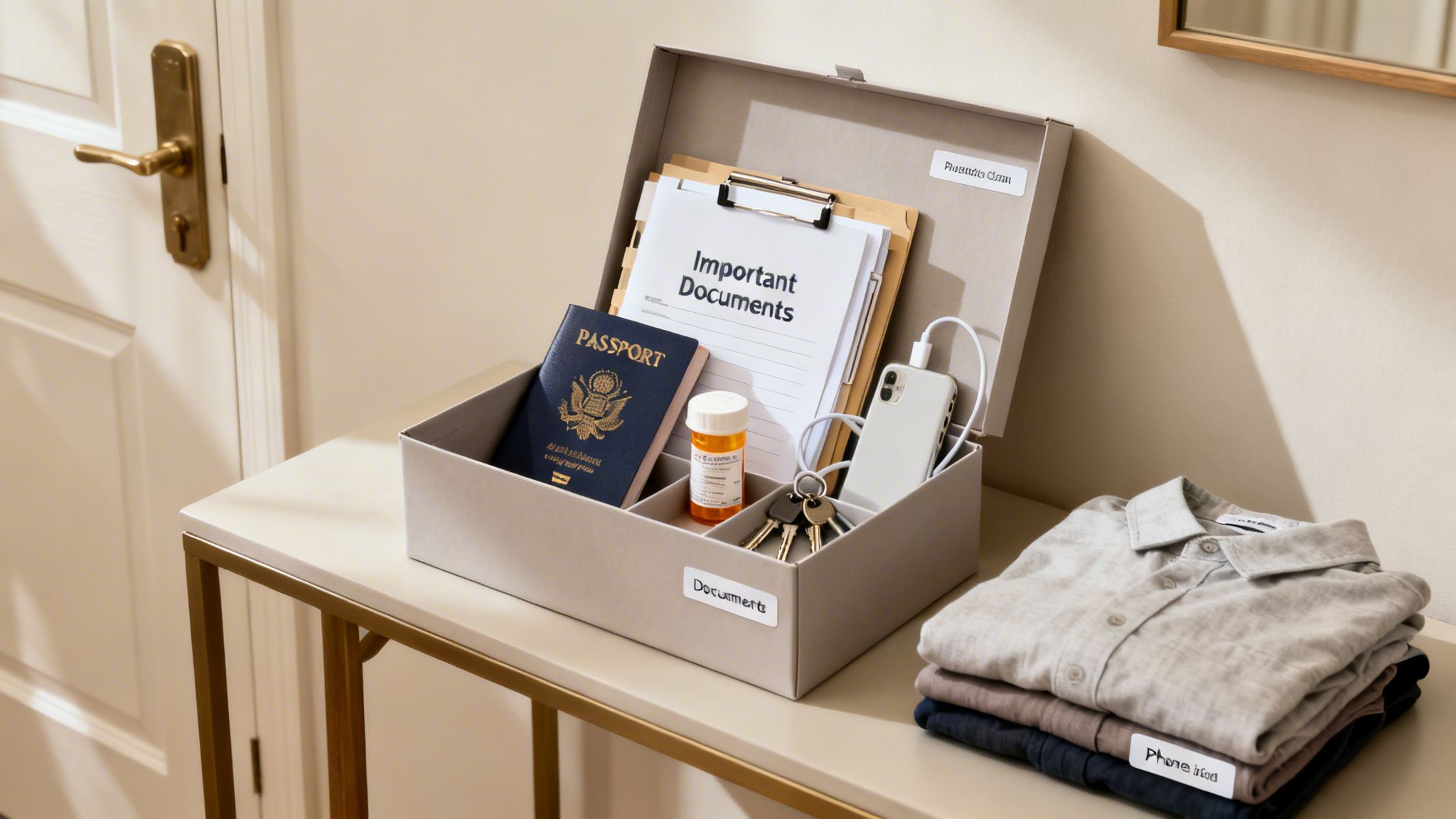
Imagine arriving at your new home after a long drive up I-95 from Orlando, only to realize your new home’s closing documents or your child’s school registration papers are on the moving truck, which won’t arrive for another week. To prevent this, gather all vital documents such as birth certificates, social security cards, passports, property deeds, and medical records. Store these in a dedicated, portable, and fireproof lockbox. This box travels with you in your personal vehicle, never on the moving truck, guaranteeing their safety and accessibility.
Key Actions to Take
To master this part of your move, follow a two-part strategy for your documents and your immediate-need items:
- Create a Digital Backup: Before packing the originals, scan every important document. Store these digital copies in a secure, encrypted cloud service like Dropbox or Google Drive. This provides a crucial backup in case anything happens to the physical copies.
- Assemble Your Essentials Box: This is your first-24-hours survival kit. Pack it with toiletries, a change of clothes for everyone, necessary medications, phone chargers, basic tools (like a box cutter and screwdriver), and some non-perishable snacks. Also include the lockbox with your important documents inside.
- Label and Isolate: Clearly label the box on all sides with “DO NOT MOVE” or “ESSENTIALS – CARRY IN CAR“. Keep this box completely separate from the items being loaded by your movers to avoid any accidental mix-ups.
- Plan for Transport: Ensure this box is one of the last things you handle and one of the first things you place into your personal vehicle on moving day. It should remain with you for the entire journey.
10. Plan Your Move Day and Communicate Final Details
The week before your move is when the abstract plan becomes a concrete reality. This phase is all about final confirmations and preparing your Orlando home for the physical moving process. Effective communication with your moving company and meticulous preparation of your space are crucial elements of a successful long distance moving checklist. This step, best completed 1 to 2 weeks before your move, eliminates last-minute surprises and ensures a smooth, efficient moving day.
Finalizing Logistics with Your Mover
Proactive communication is key to preventing delays. For a long-distance move originating from an Orlando suburb like Lake Nona, you must confirm that your movers have clear instructions for navigating community gates and parking regulations. Reputable companies like Family Movers Express prioritize this final check-in, confirming the exact arrival window and ensuring their team has your direct contact number. This confirmation process is essential for coordinating logistics, especially when dealing with apartment buildings in areas like Downtown Orlando that require reserved elevator times.
Key Actions to Take
To prepare your home and coordinate with the moving crew for a seamless departure from Orlando, follow these practical steps:
- Confirm All Details: Call your moving company a week out to verify the pickup date, arrival time window, crew leader’s contact information, and final inventory list.
- Prepare Your Residence: Clear pathways for the movers. Protect your floors with cardboard or old blankets, especially in high-traffic areas. Disconnect and prepare all appliances the day before.
- Provide Clear Access Instructions: Give your movers detailed directions, including any gate codes, parking restrictions, or specific instructions for navigating tight corners or narrow stairwells in your Orlando home.
- Arrange for Someone on Both Ends: Plan for a designated person to be present at both your old home for the pickup and your new home for the delivery. This person will be responsible for signing paperwork and directing the crew.
- Conduct a Final Walkthrough: After the truck is loaded, walk through every room, closet, and storage area one last time to ensure nothing was left behind. Take photos of the empty residence to document its condition.
10-Step Long-Distance Moving Checklist Comparison
| Task | Implementation Complexity 🔄 | Resources & Cost ⚡ | Expected Outcomes 📊 | Ideal Use Cases & Tips 💡 | Key Advantages ⭐ |
|---|---|---|---|---|---|
| Research and Book a Reputable Moving Company | 🔄 Medium — requires vetting, calls and scheduling | ⚡ Moderate–High: quotes, deposits, possible higher total cost | 📊 Predictable timeline; reduced damage risk; insurance coverage | 💡 Best for interstate/long-distance moves; get ≥3 quotes and verify USDOT/BBB | ⭐ High reliability and protection |
| Declutter and Downsize Your Belongings | 🔄 Medium — systematic room-by-room effort | ⚡ Low direct cost; high time investment; potential resale/donation gains | 📊 Lower moving weight/volume; 20–40% potential cost savings | 💡 Ideal when reducing cost or starting fresh; use one-year rule; start 6–8 weeks out | ⭐ High cost reduction and simpler unpacking |
| Create a Comprehensive Moving Inventory | 🔄 Medium–High — time-intensive documentation | ⚡ Low monetary cost; requires phone/app and time | 📊 Better insurance claims outcome; fewer missing items; organized unpacking | 💡 Use inventory apps and photos for high‑value moves; update as you pack | ⭐ High protection for valuables and claims |
| Arrange Transportation and Logistics | 🔄 High — route, vehicle, storage and timeline coordination | ⚡ Moderate–High: rental or full-service fees, possible storage costs | 📊 Smooth transit schedule; reduced delays; controlled delivery windows | 💡 Critical for complex multi-stop or long-distance moves; book 4–8 weeks ahead | ⭐ High impact on move timing and reliability |
| Notify Utilities and Service Providers | 🔄 Medium — multiple providers to contact | ⚡ Low direct cost; time and coordination required; possible fees | 📊 Minimized service gaps and billing overlaps | 💡 Start 4–6 weeks before move; schedule disconnections/connects near move dates | ⭐ High for continuity of essential services |
| Update Address with Government & Financial Institutions | 🔄 Medium — many separate updates required | ⚡ Low cost (USPS $1.10); time to complete forms | 📊 Protects mail, identity, legal and financial continuity | 💡 File USPS 2–3 weeks prior; forward mail 12 months as buffer | ⭐ High importance for legal/financial security |
| Arrange Professional Packing or Gather Supplies | 🔄 Medium — choice between pros or DIY | ⚡ Variable: pro packing adds 15–30%; DIY requires buying supplies | 📊 Reduced damage risk (pro); time savings; faster unpacking | 💡 Book pro packers 2–4 weeks out; self-pack start 4–6 weeks; use wardrobe/dish boxes | ⭐ Professional packing = high protection and speed |
| Transfer or Cancel Subscriptions and Memberships | 🔄 Low–Medium — audit and multiple account changes | ⚡ Low cost; time to audit; potential cancellation fees | 📊 Savings ($200–500/yr); fewer recurring charges | 💡 Review last 3 months of statements; use management apps; cancel ~2 weeks prior | ⭐ High recurring-cost reduction |
| Organize Important Documents & Create Essentials Box | 🔄 Low — focused organization task | ⚡ Very low cost; time to scan/secure items | 📊 Immediate access to critical items; reduced first‑night stress | 💡 Start collecting 6–8 weeks prior; pack essentials box 1–2 days before; keep with you | ⭐ Crucial for security and immediate readiness |
| Plan Move Day & Communicate Final Details | 🔄 Medium — last‑mile coordination and home prep | ⚡ Low–Moderate: time, possible permits or protection materials | 📊 Fewer delays; protected property; efficient loading/unloading | 💡 Confirm details 1–2 weeks out; provide access/parking info and contact numbers | ⭐ High for preventing day‑of problems and delays |
Your Trusted Partner for the Long Haul
Embarking on a long-distance move, whether you’re leaving the sunny avenues of Lake Nona or the vibrant neighborhoods near downtown Orlando, marks a significant chapter in your life. It’s a journey that involves more than just transporting boxes; it’s about carefully transitioning your life from one point on the map to another. The comprehensive long distance moving checklist we’ve outlined provides the strategic framework for this complex operation, transforming a potentially chaotic process into a series of manageable, well-defined tasks.
By now, you understand that a successful interstate move is built on a foundation of early planning and meticulous organization. From the initial decluttering phase eight weeks out to the final unpacking in your new home, each step is a crucial building block. We’ve covered the essentials: researching and vetting movers, creating a detailed inventory, handling the critical administrative tasks of address changes and utility transfers, and strategically packing your belongings. These aren’t just suggestions; they are proven tactics to mitigate risk, save money, and preserve your peace of mind.
Key Takeaways for Your Orlando Relocation
Mastering this checklist means taking control of your move. The most critical takeaways revolve around proactivity and documentation:
- Early Vetting is Non-Negotiable: Choosing your moving partner is the single most important decision you will make. Start your research early, ask pointed questions about guaranteed pickup and delivery dates, and insist on a binding estimate to avoid surprise costs.
- The Inventory is Your Shield: A detailed inventory, complete with photos or videos, is your best protection. It’s not just for insurance purposes; it’s a powerful organizational tool that holds both you and your movers accountable.
- Documentation and Administration Matter: Forgetting to forward your mail, update your driver’s license, or notify your bank can create significant headaches post-move. Designate a specific folder for all move-related paperwork and keep it with you, not on the truck.
- The “Essentials Box” is Your Lifeline: Do not underestimate the value of having immediate access to medications, chargers, important documents, toiletries, and a change of clothes upon arrival. This small step provides immense comfort after a long journey.
Think of this long distance moving checklist as your operational playbook. Executing it diligently means you’re not just reacting to problems as they arise; you’re preventing them from happening in the first place. It’s the difference between arriving at your new home exhausted and stressed, versus arriving feeling organized and ready to start your next chapter on the right foot.
The ultimate goal is to remove uncertainty from the equation. When you know your belongings are being handled by professionals who understand the logistics of navigating major routes like I-95 or I-4, and that your delivery date is secure, you can focus on the more personal aspects of your transition. A well-executed plan frees up your mental energy to say goodbye to your Orlando community and get excited about the new opportunities awaiting you. This is the real benefit of mastering your move: it gives you the freedom to embrace the journey, not just endure it.
Ready to put your plan into action and ensure your move from Orlando is seamless and stress-free? The most crucial step in your long distance moving checklist is choosing the right partner. Let our team of professional Orlando movers provide the guaranteed service and peace of mind you deserve for your interstate relocation.
➡️ Get Your Free Long-Distance Moving Quote from Family Movers Express Today!
Ready to protect your upcoming move?
Click Here to Fill Out Our Quick Form & Secure Your Instant Quote!
