

So, you’re ready to find a moving company. The key is to start with a solid list of professionals you’ve actually vetted. This isn’t just about a quick Google search; it’s about doing a little homework upfront to save yourself from a world of hurt later. Think of it as laying the groundwork for a smooth, stress-free move.
Laying the Groundwork: Finding Reputable Movers
Before you even think about getting a quote, your first move should be to ask around. Forget the search bar for a minute. Talk to friends, family members, and coworkers who have moved recently. Personal recommendations are gold because you get the unfiltered truth about how a company operates, especially when things don’t go exactly as planned.
Once you have a few names, it’s time to play detective online. A slick website is nice, but it doesn’t tell the whole story. Look for a physical business address on their site—not a P.O. Box. A real mover has a real home base. You should also check how long they’ve been in business. A company that’s been around for a while has likely weathered a few storms and knows what they’re doing.
Digging Into Customer Reviews
Next up, head over to review sites like Google, Yelp, and the Better Business Bureau (BBB). Don’t just look at the star rating and call it a day. You need to read the actual comments and look for patterns.
- Communication: Are people constantly saying the company was easy to get ahold of? Or was it radio silence?
- Punctuality: Do their crews show up on time, or is there a theme of them being hours late?
- Problem Resolution: This one is huge. No company is perfect, and issues can pop up. How did they handle it? A mover who responds professionally to a negative review and tries to make things right shows they care.
Here’s a great example of a strong BBB profile. You can see the accreditation and high rating right away.
That A+ rating and years of being accredited mean something. It shows a commitment to doing things right. In the massive $86 billion moving industry, where over 16,000 firms are all competing for a slice of the 28 million moves that happen each year in the U.S., these ratings are a massive signal of reliability.
A mover’s online reputation is a direct reflection of their real-world service. Focus on consistent, recent feedback that details the entire moving process, from the initial quote to the final box being unloaded.
By taking the time to filter your list this way, you’ll end up with a small group of genuinely reputable companies. This is the single most important step. It ensures you’re only inviting movers who have already proven their worth to bid on your move. And if you’re thinking about getting some help with the packing itself, our guide on packers and movers can give you even more to think about. This initial research is what separates a smooth move from a disaster.
Decoding Moving Quotes: A Look Beyond the Bottom Line
Once you’ve got a shortlist of movers, the quotes will start rolling in. This is where things get interesting, but it’s not about jumping on the cheapest price. Trust me, the lowest number on paper can quickly balloon into a moving day disaster if it’s hiding extra fees or leaving key services out.
The real skill is understanding the value behind those numbers. Learning how to choose the right moving company means knowing exactly what kind of quote you’re looking at, because each one offers a totally different level of financial security.
Know Your Quote Types
You’ll likely see three main types of estimates. Here’s the breakdown:
- Non-Binding Estimate: Think of this as a ballpark guess. Your final bill is based on the actual weight of your stuff, and legally, it can end up being much higher than what they first told you. This one offers the least protection.
- Binding Estimate: This is a fixed, guaranteed price. As long as you don’t sneak in extra boxes or that antique armoire you forgot about, the price you’re quoted is the price you pay. Simple as that.
- Binding-Not-to-Exceed Estimate: This is the gold standard for consumers. The price is capped—it won’t go above the estimate. But here’s the best part: if your shipment weighs less than they thought, your final bill will be lower. It’s a win-win.
To really compare apples to apples, you absolutely need to get at least three detailed quotes. Make sure they’re based on an in-home or virtual walkthrough. This forces the movers to see what you actually have, making their estimates far more accurate and holding them accountable.
Comparing Moving Company Quotes: What to Look For
When you lay those quotes out side-by-side, you’re looking for more than just the total. A lowball offer might look tempting, but it often means you’ll be nickel-and-dimed later. This table shows what a transparent, value-focused quote looks like compared to the others.
| Feature | Mover A (Low-Cost Quote) | Mover B (Mid-Range Quote) | Family Movers Express (Transparent Quote) |
|---|---|---|---|
| Estimate Type | Non-Binding | Binding | Binding-Not-to-Exceed |
| Labor Costs | Vague hourly rate | Fixed labor included | Itemized: 3 movers @ $X/hr for 6 hours |
| Packing Materials | "Materials extra" | Basic materials included | All boxes, tape, wrap itemized |
| Fuel Surcharge | Not mentioned | Included in flat fee | Clearly listed as a separate line item |
| Valuation Coverage | Basic minimum only | Options available upon request | Full Value Protection details provided |
| Hidden Fees? | High potential (stairs, long carry) | Some exclusions noted in fine print | All potential fees disclosed upfront |
See the difference? The cheapest quote is often the least detailed, leaving you exposed. A slightly higher price from a company like Family Movers Express often means everything is covered, giving you total peace of mind.
Digging Into the Details
A good quote should be a roadmap for your move, not a mystery. Look past the grand total for a complete breakdown of services. If it’s not itemized, that’s a red flag.
A transparent quote will spell out:
- Transportation fees and any fuel surcharges.
- The cost of packing materials like boxes, tape, and padding.
- Labor costs, including the number of movers and their estimated hours.
- Liability coverage (also called valuation), with clear options for protecting your belongings.
- Any extra charges for things like taking apart furniture or handling special items.
This simple process—research, verify, and check reviews—is the foundation for finding a mover you can actually trust.
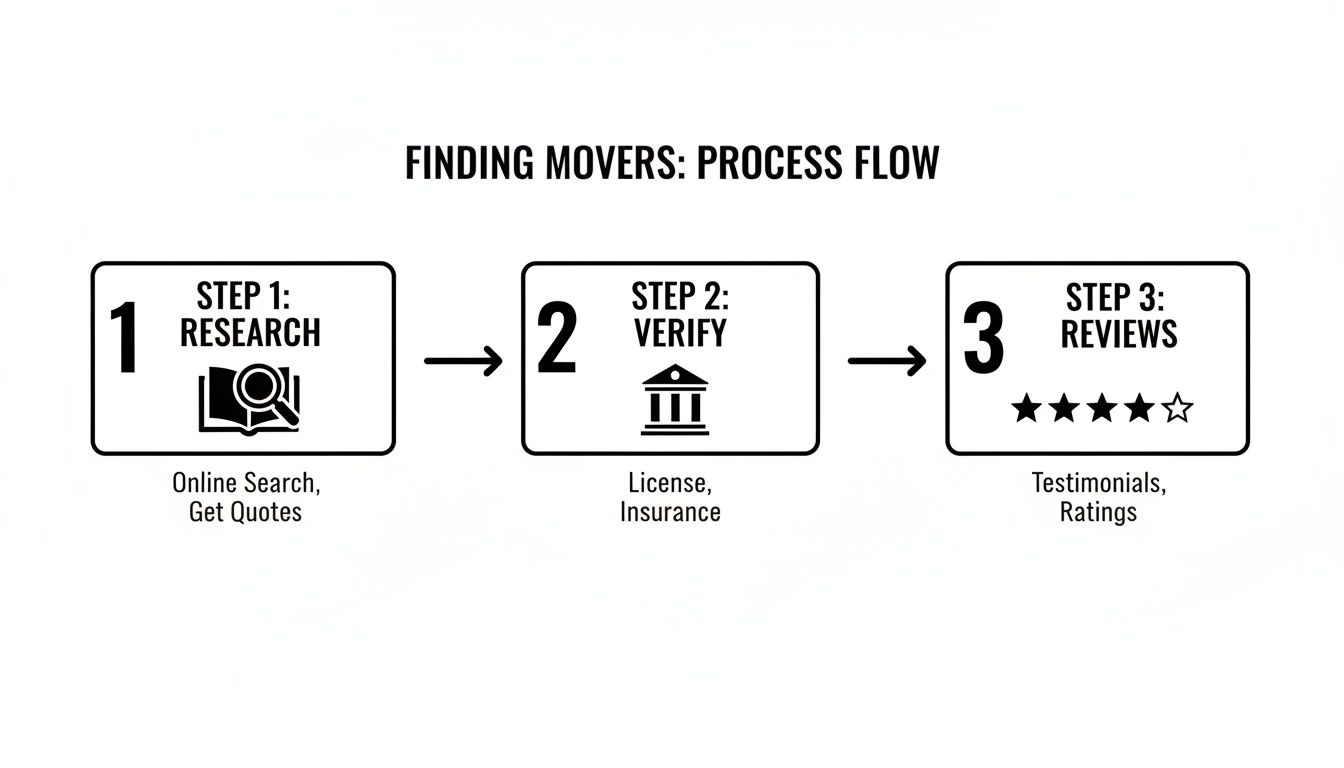
As the graphic shows, a smooth move starts long before the truck pulls up. It begins with solid, diligent homework on your part.
My Pro Tip: Don't be shy. Ask them directly, "Are there any other charges not listed here that I could possibly face on moving day?" A good company will be straight with you about potential costs for things like a "long carry" (if the truck can't park close to your door) or extra flights of stairs.
When you have a few quotes in hand, the odd one out will become obvious. If one estimate is dramatically lower than the others, get your magnifying glass out. They’ve either left services out that others included, or it's a classic bait-and-switch.
To get a feel for what’s fair, use a moving company cost calculator to benchmark the estimates you get. It’s a great reality check.
In the end, a slightly higher quote from a mover who is upfront and all-inclusive is almost always the better deal. It buys you peace of mind, and on moving day, that’s priceless.
Verifying Licenses, Insurance, and Credentials
Once you've got a few solid quotes, it's time to do some real detective work. You're about to hand over everything you own to a group of strangers, which requires a huge leap of faith. Verifying their credentials turns that leap into a confident, informed step.
This isn't just about ticking boxes on a checklist; it's your primary defense against scams, horror stories, and sheer incompetence.
The All-Important DOT Number
Any company that moves your stuff across state lines is required by federal law to be registered with the government. This means they absolutely must have a U.S. Department of Transportation (DOT) number. Don’t just take their word for it, either. Ask for the number and look it up yourself.
The Federal Motor Carrier Safety Administration (FMCSA) runs a public database where you can plug in that DOT number. It's a goldmine of information, showing you the company's operating status, safety record, and any official complaints filed against them.

This quick search confirms the company is legit and gives you a snapshot of their history. If a mover gets cagey about providing their DOT number or the details don't match up online, that's a massive red flag. Walk away.
Understanding Your Insurance Options
Insurance—or "valuation coverage" as it’s known in the moving biz—is another critical checkpoint. Movers are legally required to offer two basic types of liability coverage. Knowing the difference is crucial for protecting your belongings.
- Released Value Protection: This is the standard, no-extra-cost option. It provides the bare minimum coverage, paying out only 60 cents per pound per item. If your 50-pound flat-screen TV gets smashed, you’ll get a check for a measly $30. It’s better than nothing, but not by much.
- Full Value Protection: This is the option you want for real peace of mind, though it does cost extra. Under this plan, the mover is on the hook for the full replacement value of any lost or damaged items. They can choose to repair the item, replace it with a similar one, or give you a cash settlement for its current market value.
While you're at it, ask if they carry Commercial General Liability (CGL) insurance. This is essential coverage that protects against things like a mover accidentally damaging the walls in your old apartment or someone getting injured on the job.
Expert Tip: Don't assume your homeowner's or renter's insurance will cover your belongings while they're on a moving truck. Most policies don't. Give your insurance agent a call to clarify what’s covered before you sign anything.
In a massive $23.1 billion U.S. moving industry with over 17,936 companies competing for your business, taking the time to confirm these details is non-negotiable. Proper licensing and insurance are what separate the true professionals from the risky operators. For a deeper dive, check out our guide on how to select interstate moving companies for more tips tailored to long-distance relocations.
How to Spot Red Flags and Avoid Moving Scams
Knowing what a good mover looks like is only half the story. The other, arguably more important half, is knowing how to spot a bad one from a mile away.
I've seen it happen too many times: shady operators use the same old tricks to lure in unsuspecting people. They turn what should be an exciting new chapter into a costly, stressful nightmare.
Your gut is one of your best tools in this process. If someone on the phone is pushy, can't give you a straight answer, or just sounds unprofessional, trust that instinct. Real professionals understand they're handling your entire life's worth of possessions and will always communicate with patience and clarity.
Common Warning Signs of a Bad Mover
Scammers feed on confusion and high-pressure situations. They’ll often throw out a quote that seems too good to be true, and that’s because it is. A classic move is to give a super-low estimate over the phone without ever seeing your stuff, only to jack up the price dramatically on moving day itself.
Here are some of the biggest red flags I tell people to watch out for:
- Large Upfront Deposits: Legitimate movers bill you upon delivery. A company demanding a huge cash deposit before they’ve even started the work is a massive warning sign.
- No Physical Address: Be very wary if a mover’s website only lists a P.O. box or has no physical location at all. Established companies have a real-world presence, with offices, warehouses, and branded trucks.
- Unmarked Rental Trucks: If a crew shows up in a generic, unmarked rental truck, that's a problem. A professional moving company invests in its brand and equipment—their trucks should be clearly marked with their name and logo.
- Vague or Incomplete Paperwork: A real mover will provide a detailed contract (the Bill of Lading) that outlines every single cost, service, and item being moved. Never, ever sign blank or incomplete documents.
With over 16,000 moving companies operating across the country, the competition is fierce. That competition, combined with a pretty low barrier to entry, creates the perfect environment for scammers. Victims lose an average of $431 per incident. And with residential moves making up 51.3% of the massive $23.2 billion moving industry, it's clear why homeowners need to be so careful.
BEWARE THE "HOSTAGE LOAD"
This is one of the ugliest scams out there. A fraudulent company will load all your belongings onto their truck and then, once they have your stuff, refuse to unload it until you pay a ridiculously inflated, extortionate fee.
This is exactly why verifying a company's credentials and getting every single detail in writing is absolutely non-negotiable. If you run into any of these red flags, your best move is to walk away and keep looking.
If you do find yourself in a bad situation, our guide on handling moving company complaints can help you figure out what to do next.
Finalizing Your Choice and Preparing for Moving Day
You’ve done the hard work—you’ve researched companies, compared quotes, and double-checked all their credentials. Now it’s time to make your final call and shift gears into getting ready for the big day. This is the moment where all that careful planning starts to really pay off.
After you’ve officially picked your mover, the most important document you’ll handle is the Bill of Lading. Think of this as the master contract for your entire move. Read every single line before you even think about signing it.
This document should spell out everything you've agreed to: the exact cost, the pickup and delivery windows, and a complete inventory of what's going on the truck. If a single detail looks off or is missing, hold off on signing. Get it corrected first.

The Bill of Lading is your legal safety net. Make sure it clearly states the type of quote (you’re looking for a binding-not-to-exceed estimate) and the exact valuation coverage you chose. A handshake or a verbal promise is worth nothing once that truck door closes; what’s in writing is all that counts.
Your Pre-Move Checklist
With the contract signed, your focus pivots to pure preparation. A bit of organization now will save you from a world of chaos later. Keep the lines of communication open with your moving coordinator—they are your go-to person for any last-minute questions.
Here’s what you should be tackling:
- Set Up a "Do Not Move" Zone: Pick a spot—a small bathroom, a closet, or just a corner of a room—for everything you plan to move yourself. This is for your absolute essentials: important papers, medications, phone chargers, and a box with everything you'll need for the first night in your new place.
- Get Your Home Ready: Make sure the movers have clear, unobstructed paths to work with. It's a good idea to put down some floor protection in the main walkways and, if you can, reserve a prime parking spot for the moving truck.
- Pack Strategically: If you’re doing the packing yourself, consider grabbing some quality house removal packs to make life easier. And don't forget the most important rule: label every single box with its contents and which room it's destined for.
Pro Tip: Keep your Bill of Lading and all the mover's contact info somewhere you absolutely cannot lose it—like your purse or backpack. The last thing you want is to have that critical paperwork buried in a box somewhere on moving day.
A successful move is a true team effort between you and your movers. By getting your side of things organized and ready to go, you’re setting everyone up for a smooth, efficient day.
For a complete week-by-week timeline, check out our detailed guide on how to prepare for a move.
Got Questions? We've Got Answers
Even after you've done all the research and narrowed down your list, a few last-minute questions always seem to pop up.## Got Questions? We've Got Answers
Even after you've done all the research and narrowed down your list, a few last-minute questions always seem to pop up. It’s totally normal. Knowing how to choose a moving company also means getting solid, straight answers to these final nagging concerns.
Think of this as your final gut check. You’ve done the hard work, but now it's time to make sure you haven’t missed a small detail that could become a big headache on moving day.
How Far in Advance Should I Book Movers?
The ideal time to book really hinges on when you’re planning to move. If you’re looking at a move during the peak season—think anywhere from May through September—you absolutely want to lock in your movers at least two to three months ahead of time. The good companies get snatched up fast during the summer rush.
Moving in the off-season gives you a little more breathing room. You can usually find a quality crew with about four to six weeks' notice. But let's be honest, waiting until the last minute is always a gamble, no matter the season.
- Peak Season (May-September): Book 8-12 weeks out.
- Off-Season (October-April): Book 4-6 weeks out.
Booking early doesn’t just guarantee you a spot; it can often secure you a better rate before the seasonal demand really kicks in.
Are Full-Time Employees Better Than Temp Workers?
This is a great question to ask, and the answer is a resounding yes. Companies that invest in their own full-time, trained employees almost always deliver a more consistent, high-quality service. These aren't just random people; they're a team that works together every day, knows the company’s standards, and has a real stake in protecting its reputation.
On the flip side, movers who lean on temp workers or day laborers can be a total roll of the dice. You just don't know what you're getting. These individuals often lack proper training in everything from packing china to safely maneuvering a sofa, which dramatically increases the risk of damage. For a full rundown of what to ask, our guide on questions to ask moving companies has you covered.
When you hire a professional moving company, you're not just renting a truck. You're paying for the skill, experience, and reliability of the people handling everything you own. A company that invests in its team is investing in your move.
What Is a "Long Carry" Fee?
A long carry fee is an extra charge that might pop up if the moving truck can't park reasonably close to your front door. This is super common in apartment complexes with funky parking situations or on city streets where the truck has to park a hundred feet away.
Basically, the fee compensates the crew for the extra time and physical effort it takes to haul your belongings over that longer distance. A good, upfront mover will flag this as a possibility during your estimate and will tell you exactly what distance triggers the charge. It should never be a surprise bill at the end of the day.
This is exactly why a thorough, on-site or virtual walkthrough is non-negotiable. A mover who actually sees the layout can anticipate these kinds of logistical quirks and build any potential fees right into your binding-not-to-exceed quote. No games, no surprises.
Ready to move with a team that has all the right answers? Family Movers Express LLC provides clear communication, professional full-time crews, and transparent quotes to make your relocation seamless. Get your free estimate today and experience a truly stress-free move.
Ready to protect your upcoming move?
Click Here to Fill Out Our Quick Form & Secure Your Instant Quote!
