
Ever wondered how much your move is really going to cost? Trying to budget for a move without a clear starting point is like trying to navigate a new city without a map. That’s where a moving company cost calculator comes in—think of it as a financial GPS for your relocation.
It’s an online tool that gives you a solid first estimate of your expenses, all based on a few key details like how big your home is and how far you’re going.

Let’s be honest, planning a move can feel chaotic, especially when it comes to the budget. You’re not just moving boxes; you’re trying to solve a complex financial puzzle with a ton of different pieces. This is exactly why a moving company cost calculator is such a game-changer. It cuts through the confusion by turning your specific moving details into a tangible dollar figure.
Instead of just guessing, these tools give you a data-driven starting point. They’re built to process the biggest cost factors—distance, home size, and the services you need—to paint a realistic financial picture. This first look helps you dodge any sticker shock later on and gives you a solid baseline for your moving budget.
The real magic of a moving cost calculator is how it transforms your abstract plans into a number you can actually work with. It makes you think about details you might have otherwise glossed over, like the number of bedrooms you’re clearing out or if you’ll need professional packers to lend a hand. As you plug in this information, you start building a much clearer picture of what your move entails, which is absolutely crucial for getting accurate quotes down the line.
The price tag on professional movers can swing wildly, so an estimator is key for setting the right expectations. For a local move, you might see costs for a two-bedroom home hover around $1,000 to $1,800. For long-distance treks over 100 miles, that same two-bedroom home could cost anywhere from $2,200 and $5,000, with bigger moves easily hitting $8,000 or more. As you can see, a calculator helps you figure out where your move might land on that spectrum.
By giving you a ballpark figure early in the game, a moving cost calculator empowers you to plan all the other parts of your move with more confidence, because you know you have a foundational budget locked in place.
To give you a quick idea of what to expect, we’ve put together a table with some typical cost ranges. It’s a great way to see how quickly the numbers can shift based on the size and distance of your move.
| Move Type | Home Size (Bedrooms) | Average Cost Range |
|---|---|---|
| Local (Under 100 miles) | 1 Bedroom | $600 – $1,200 |
| Local (Under 100 miles) | 3 Bedrooms | $1,500 – $2,500 |
| Long-Distance (1,000+ miles) | 1 Bedroom | $2,000 – $4,500 |
| Long-Distance (1,000+ miles) | 3 Bedrooms | $4,500 – $8,000 |
Having this foundational knowledge is the first step toward a smooth, well-managed move. When you’re ready for a more personalized look at your expenses, you can dive right into our detailed moving budget calculator.
Think of a moving quote like a recipe. The final cost isn’t just one number pulled out of thin air; it’s a blend of several key ingredients. A moving company cost calculator is built to weigh these ingredients and give you a solid starting estimate. Once you know what drives the price, you’re in a much better position to manage your budget.
Before we even get into the details, the biggest price driver is the type of move itself. How your move is calculated boils down to one simple question: how far are you going?
For local moves—usually anything under 100 miles—the pricing is almost always hourly. You’re paying for the crew’s time and labor, plain and simple.
Here’s how that hourly rate breaks down:
This time-based model is straightforward. The more you have prepped and ready to go, the quicker the team can work, and the more money stays in your pocket.
Once you cross state lines or go beyond a certain mileage, the whole pricing game changes. Forget the hourly rate. For long-distance moves, the cost is built on two main pillars:
This is where decluttering becomes your best friend on a long-distance move. Every single pound you decide not to take with you is literal money saved. A moving company cost calculator is brilliant for this, as it lets you see in real-time how reducing your shipment size brings the estimate down.
Understanding this difference is everything. For local jobs, movers might charge $25 to $75 per mover, per hour. But for a long-distance move of over 1,000 miles, you’re looking at costs often landing between $4,000 and $8,000. The pricing models are worlds apart, which is why knowing your move type is the first step to an accurate budget.
Beyond the basic logistics, the level of service you choose will layer costs onto your quote. You can go for a bare-bones, DIY-style move or a white-glove experience where you barely have to lift a finger.
For a lot of people, having one predictable, all-in price is worth its weight in gold. If that sounds like you, it’s worth learning more about how flat-rate movers bundle these services into a single, transparent cost. Every choice you make shapes that final number, giving you the power to design a move that fits your budget perfectly.
While the distance of your move and the size of your home are the big-ticket items on any estimate, a whole host of other factors play a huge role in the final number. Think of it like buying a car—you have the base price, but the final cost really depends on the trim level and the features you add on. Getting a handle on these variables is the key to using a moving company cost calculator smartly and avoiding any sticker shock on moving day.
A lot of folks are surprised to find out that when you move can be just as important as where you’re moving to. The moving industry, like travel, has a very clear peak season that directly impacts what you’ll pay.
Ever tried booking a beach house in the middle of July versus, say, a random Tuesday in October? The demand is worlds apart, and so is the price. The same logic applies to moving companies. The window from late spring through summer is an absolute madhouse for movers, which means prices are at a premium.
On the flip side, if you can schedule your move during the fall or winter, you’ll often find much better rates and more flexibility. Demand is way down. Even the day of the week makes a difference. Everyone wants to move on a Friday or Saturday, making a midweek move on a Tuesday or Wednesday a much more budget-friendly option.
This infographic breaks down how all these different pieces of the puzzle—from distance to the level of service—come together to determine your final moving cost.
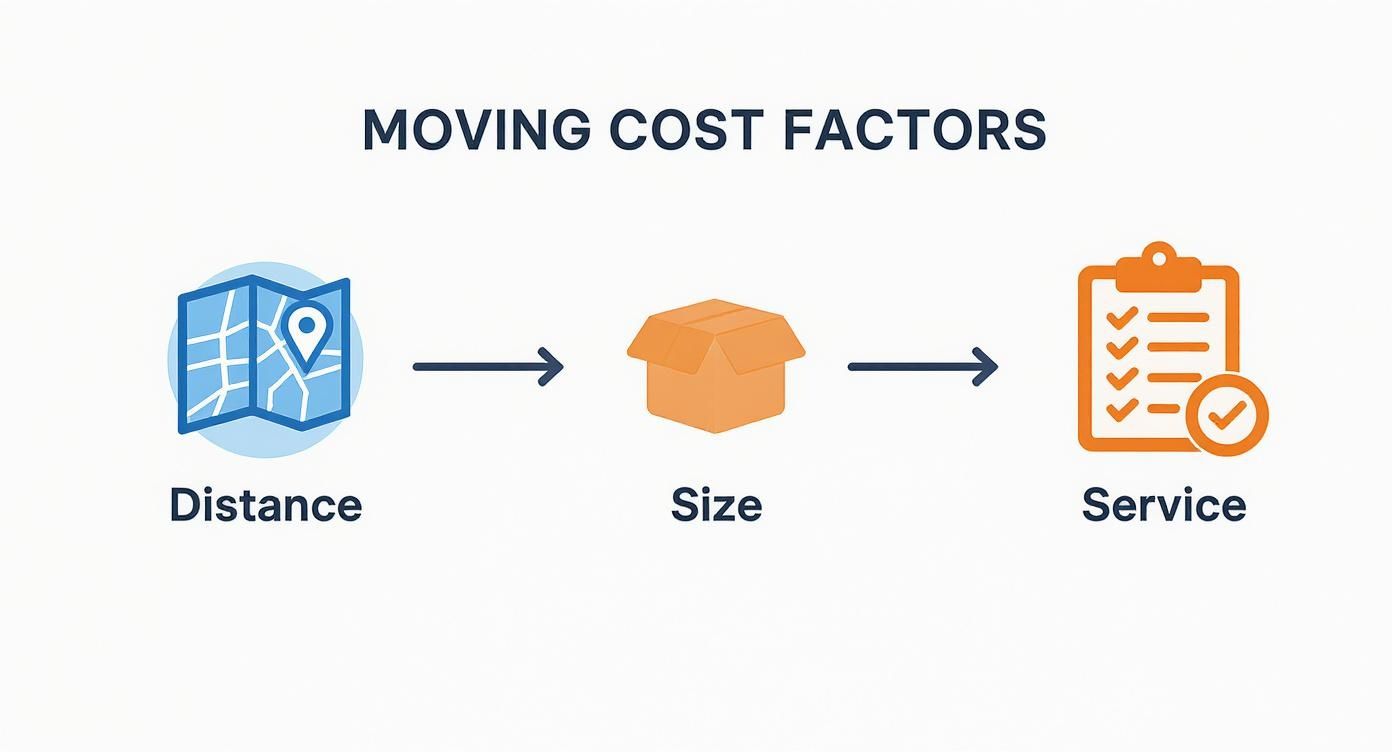
As you can see, a solid moving budget isn’t just about one or two things. It’s about understanding how all these core components interact and influence that final number on your bill.
Another cost factor that flies under the radar for many people is how easy (or difficult) it is to get to your front door. If the moving truck can’t park right out front and the crew has to haul your couch down a long walkway, that’s what we call a long carry in the business. That extra distance adds up to more time and more labor, which will definitely show up on your invoice.
Other common access issues we run into include:
Pro Tip: Be completely honest and upfront about these potential challenges when you’re getting a quote. A good mover needs to know about the long carry or the tight staircase to give you an accurate estimate. It’s the best way to prevent surprise fees when the crew shows up.
Let’s face it, not everything you own can be neatly packed into a standard cardboard box. Anything that’s exceptionally heavy, oversized, or super fragile is going to require special handling—and that almost always means extra charges.
Some of the usual suspects include:
Beyond those specialty items, you might opt for other services that will adjust your quote. For instance, what if your new home isn’t quite ready when your stuff arrives? You’ll likely need temporary storage. It’s a lifesaver, but it comes with its own cost. The same goes for valuation coverage (what most people call moving insurance). Choosing a higher level of protection for your belongings will also affect the total price. A deeper dive into these factors can help you better understand the average moving costs and what to expect.
To see how much these choices can swing your final bill, let’s look at a quick comparison for a hypothetical 3-bedroom home move.
| Factor | Low-Cost Scenario (e.g., Winter, DIY Packing) | High-Cost Scenario (e.g., Summer, Full-Service Packing) |
|---|---|---|
| Season | $3,500 (Off-peak, winter move) | $4,800 (Peak season, summer move) |
| Packing | $0 (You pack everything yourself) | +$1,200 (Full-service packing by movers) |
| Storage | $0 (Direct move-in) | +$450 (One month of storage-in-transit) |
| Specialty Item | $0 (No specialty items) | +$300 (Moving a large, upright piano) |
| Estimated Total | ~$3,500 | ~$6,750 |
As you can see, the exact same move can have dramatically different costs depending on when you schedule it and what services you add. This is why a one-size-fits-all estimate just doesn’t work.
The numbers back this up. Recent industry data shows that while a typical local move might hover around $1,489, a long-distance move is closer to $3,129. But these are just averages. That long-distance number can easily jump during the summer. For a move that crosses more than 1,700 miles, you could be looking at an average of $3,945, especially if you have a larger home. This really drives home why any good moving company cost calculator has to factor in the season, the distance, and the size of your shipment to give you a number you can actually trust. You can see more data on how moving costs are calculated over at Moving.com.
Knowing the theory behind moving estimates is one thing, but seeing the numbers come to life is where it all clicks. To really get a feel for how a moving company cost calculator works, let’s walk through two common, real-world moves. Applying all those cost factors we just talked about will show you exactly how a final quote starts to take shape.
These examples are perfect for highlighting the huge difference between local moves, which are all about time, and long-distance moves, where weight and mileage are king. This hands-on look will give you a much clearer picture of what to expect for your own relocation.
Let’s picture a family moving from a three-bedroom house in Orlando, Florida, to a new home just 25 miles away in a neighboring suburb. Since this is a local move, time is the name of the game.
Here’s how a calculator would probably break down their estimate:
The math is pretty straightforward: (5 hours of work + 1 hour of travel) x $150/hour = $900. Now, if the family decides they want the crew to pack up the kitchen, that might add another two hours of labor, bumping the total up to $1,200.
This is a perfect example of the direct link between time and money in a local move. Every extra hour—whether it’s for packing, taking apart a tricky piece of furniture, or dealing with a narrow staircase—goes straight onto the final bill.
Now for a different scenario. Imagine a recent graduate moving from a one-bedroom apartment in Raleigh, North Carolina, all the way to Nashville, Tennessee—a journey of about 520 miles. For an interstate move like this, the pricing model flips entirely. It’s all about weight and distance.
Here are the key pieces of their long-distance estimate:
A moving company might charge around $0.70 per pound plus a base transportation fee for a move of this distance. So, the calculation looks something like this: (3,000 lbs x $0.70/lb) + Base transportation/fuel surcharges. This would likely land them with an estimate somewhere in the $2,500 – $3,200 range.
But what if they had a heavy specialty item, like an antique piano that weighs 500 pounds? That would increase the shipment weight and also require a separate specialty handling fee. That one change could easily push the estimate up by $500 or more. To see how these variables play out for your own situation, it’s a great idea to plug some numbers into a dedicated long-distance moving cost calculator and experiment.
A moving company cost calculator can be an amazing tool, but it’s only as smart as the information you feed it. Think of it like a GPS: if you type in a vague or wrong address, you’re not going to end up where you planned. It’s the exact same deal here—the more precise your details are, the more solid your initial estimate will be.
The old saying “garbage in, garbage out” is the golden rule. To steer clear of this trap, you need to start with a brutally honest inventory of your home. It’s a common mistake to just count the big, obvious stuff in each room and completely forget about entire sections of the house.
Before you even think about clicking on a calculator, grab a notepad or open a spreadsheet and take a walk. Go through every single room, nook, and cranny of your home. Be meticulous. This isn’t the time for wishful thinking about all the decluttering you plan to do—list what you have sitting there right now.
Pay special attention to these often-forgotten zones:
Forgetting these spots is probably the number one reason an online estimate doesn’t line up with the final quote. A tiny oversight can easily turn into a big surprise on your final bill.
An online calculator gives you a strong starting point, but it can’t see the antique armoire tucked away in your basement. A thorough personal inventory is what closes the gap between a wild guess and a realistic budget, letting you use the calculator the way it’s meant to be used.
Once you graduate from the online calculator and start getting official quotes from movers, you’ll run into a few different types of estimates. Knowing what they mean is your best defense for managing your budget and avoiding any nasty surprises.
Getting a handle on these terms takes you from a casual planner to a savvy consumer. It lets you compare offers from different moving companies on an apples-to-apples basis and pick the one that truly protects your wallet. When you combine a detailed inventory with a clear understanding of your quote, you can use a moving company cost calculator as the perfect first step toward a predictable and much less stressful move.

Alright, you’ve seen what goes into the price of a move. Now for the fun part: taking control of that price tag. A moving company cost calculator is more than just a tool for getting a ballpark figure—it’s your secret weapon for spotting where you can save the most money.
With a few smart moves before the moving truck even shows up, you can shave a surprising amount off your final bill without cutting corners on quality service.
The single biggest money-saver? It starts weeks, or even months, before your move date. It’s all about decluttering. Especially for long-distance moves where every pound counts, anything you sell, donate, or toss is cash that stays in your wallet.
Before a single item goes into a box, it’s time to get a little ruthless. Go through every room, every closet, and that garage you’ve been avoiding. If you haven’t used it, worn it, or even thought about it in the last year, it’s a candidate to go. This one step has the biggest impact on your shipment’s weight and volume, which directly slashes your quote.
You can also find huge savings on packing supplies. Instead of dropping a couple hundred bucks on new boxes, start hunting for free ones. Local grocery stores, online marketplaces, and neighborhood groups are goldmines for sturdy, free boxes.
When you’re comparing quotes, don’t just fixate on the bottom-line number. A quote that seems a bit higher but comes from a mover with stellar reviews and includes solid valuation coverage might actually be the better deal than a rock-bottom price from a company nobody’s ever heard of.
Got some wiggle room in your schedule? That flexibility is another powerful way to save. The peak moving season—summer and weekends—is when demand and prices are highest. If you can swing a move on a weekday in the fall, winter, or spring, you’ll often snag a much better rate.
Another great strategy is to take a hybrid approach to packing. You’re more than capable of packing up clothes, books, and linens. But for the fragile stuff like your grandmother’s china or that new TV, letting the pros handle it is a smart investment. This partial DIY method gives you the perfect balance of saving cash and protecting your most prized possessions.
A few key takeaways:
Putting these tactics into practice can turn your moving budget from a rigid number into something you have real control over. For an even deeper dive, check out our guide on the top 6 tips for saving money during a move to make sure you keep your costs as low as possible.
Even with a great tool right in front of you, it’s natural to have questions. When it comes to using a moving company cost calculator, a few key things tend to pop up again and again. Getting those cleared up is the first step in turning a rough number into a solid financial plan for your move.
Let’s dive into the most common questions we hear. This will help you use these tools like a pro and set the right expectations for your moving budget.
Think of an online calculator as a fantastic starting point for your budget. It gives you an excellent ballpark figure by crunching the numbers on the most important parts of your move, like the distance you’re going and the size of your home. But you should treat that first number as a really well-educated guess, not a final, set-in-stone price.
The final accuracy really boils down to the nitty-gritty details. A truly precise quote only comes after a moving company gets a full inventory of your stuff, either through a virtual walkthrough or an in-person visit. That professional assessment takes everything into account—from the boxes stacked in your garage to how tricky it is to get a couch out of your third-floor apartment—to give you a firm price.
Absolutely not. Reputable moving companies offer free estimates as a core part of their service. This goes for both the instant online calculation and any follow-up survey, whether it’s in-home or virtual.
Heads up: A company asking you to pay for an estimate is a huge red flag. Your initial quote is a no-obligation tool to help you plan, and you should never feel pressured to open your wallet for that basic information.
By far, the most common pitfall is underestimating how much stuff you actually have. It’s one thing to glance around and count the big furniture, but it’s the packed closets, the forgotten items in the attic, and everything in the shed that people usually miss. This is the #1 reason why an initial online estimate can sometimes look pretty different from the final quote.
Another classic mistake is forgetting to budget for the extras. Services like packing delicate china, needing short-term storage, or moving a specialty item like a piano can add up, so it’s best to think about them from the start.
Yes, almost always. The moving industry runs on supply and demand, just like airlines and hotels. Weekends are prime time, especially during the busy season from May to September, and that high demand drives prices up.
If you have some wiggle room in your schedule, booking your move for a Monday through Thursday can lead to some serious savings. If you can also move during the off-season (that’s October through April), you’ll likely see even better pricing.
Ready to go from a rough guess to a real quote built just for you? The team at Family Movers Express LLC is here to give you a clear, accurate, and no-obligation price for your move. Use our online tools or give one of our moving coordinators a call today.
Ready to protect your upcoming move?
Click Here to Fill Out Our Quick Form & Secure Your Instant Quote!