
Trying to pin down the cost of a long-distance move can feel like nailing jelly to a wall. That’s where a long-distance moving cost calculator comes in. Think of it as an online tool that gives you an immediate, personalized budget forecast for your move. You plug in a few key details—where you’re coming from, where you’re going, and the size of your home—and it gives you a solid estimate to start planning with. It’s the first step to turning a complicated process into something manageable.
Let’s be honest, planning a big move feels like trying to solve a puzzle with half the pieces missing, especially when it comes to money. A long distance moving cost calculator is your best friend here. It acts as a financial guide, taking all the chaotic variables of your relocation and translating them into a clear, understandable estimate. It’s the best way to get a grip on your expenses right from the start.
It’s essentially a sophisticated forecasting tool. You feed it the basic, but crucial, data points:
The calculator then crunches these numbers against industry averages and real-world logistics data to give you an initial figure. This isn’t just a number pulled from thin air; it’s a data-driven projection based on what thousands of moves just like yours have cost.
This infographic breaks down how your unique location and shipment details get translated directly into a cost estimate.
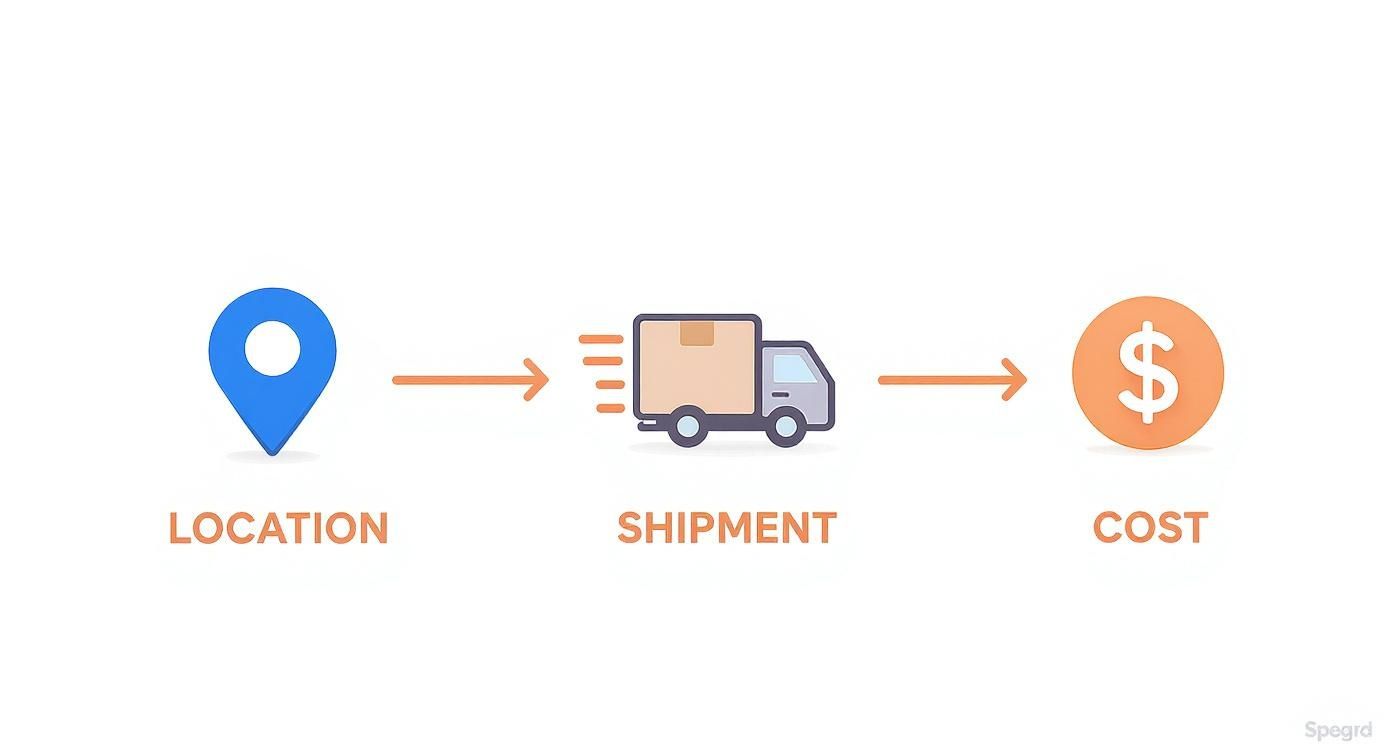
As you can see, every piece of information you provide is a critical building block for your final price.
While an online tool provides a fantastic starting point, it’s good to have some real-world context. The national average cost for a long-distance move usually falls somewhere between $2,200 and $5,700, with the overall average hovering around $4,000.
If you’re moving over 1,000 miles with a 2-3 bedroom home’s worth of belongings, that average bumps up to about $4,300. Knowing these benchmarks helps you understand not just what you might pay, but why. If you’re curious about the specifics, you can find out more about how these moving costs are calculated to see exactly where your estimate fits in.
To give you a clearer picture, here’s a quick look at some average costs based on home size and distance.
This table provides a quick overview of average moving costs based on the size of the home and the distance of the move, giving you a baseline understanding before you use a calculator.
| Home Size | Average Cost (Under 500 Miles) | Average Cost (1,000+ Miles) |
|---|---|---|
| 1 Bedroom | $1,500 – $2,500 | $2,000 – $3,500 |
| 2-3 Bedrooms | $2,500 – $4,500 | $3,500 – $5,500 |
| 4+ Bedrooms | $4,000 – $6,000+ | $5,000 – $7,500+ |
Keep in mind, these are just ballpark figures. Your actual cost will depend on the specifics of your move, which is why a personalized calculator is so valuable.
A long-distance moving cost calculator is an amazing starting point, but its estimate is only as good as the information you feed it. Think of it like a recipe: the better your ingredients, the tastier the final dish. To get a quote you can actually count on, you need to understand the three main pillars every moving company uses to piece together a price.
These are the big ones: how far you’re going, how much stuff you have, and when you plan to move. Nailing these details from the get-go is the absolute best way to dodge any nasty budget surprises later on.
The first piece of the puzzle is the most obvious: the distance of your move. A longer trip means more fuel for the truck, more hours on the road for the crew, and more wear and tear on the equipment. It’s a pretty simple equation—the farther the truck has to drive, the more it’s going to cost.
But it’s not just about the total mileage. Your specific zip codes play a huge role, too. Moving from a bustling city center to a quiet, rural town can shift the price because of different local labor rates or challenges getting a massive moving truck down a narrow country road.
Here’s one of the biggest myths in the moving world: that the cost is all about the number of rooms. The truth is, movers are really concerned with the total weight and volume of everything you own. A minimalist two-bedroom apartment could easily cost less to move than a one-bedroom place that’s packed to the gills.
This is where a quick home inventory is worth its weight in gold. You don’t have to count every fork and spoon, but jotting down the big-ticket items—sofas, beds, appliances—helps the calculator spit out a much more accurate number.
Key Insight: As a rule of thumb, movers often figure that a typical room holds about 1,000 to 1,500 pounds of stuff. This benchmark helps everyone get a quick preliminary weight, which leads to a faster and more reliable quote.
Of course, the size of your home is still a great starting point. A one-bedroom apartment usually weighs in around 3,500 pounds, which can cost anywhere from $1,750 to $2,800 for a long-distance move. A two-bedroom home, on the other hand, is closer to 5,000 pounds and might range from $2,500 to $4,000.
Your move-out date can have a surprisingly big impact on the final bill. The moving industry has a very clear peak season that runs from May through September. Everybody wants to move when the weather is nice and the kids are out of school, so demand skyrockets. Moving during this busy window can easily bump up your costs by 20-30%.
The same goes for the day of the week. Moving on a weekend is almost always pricier than on a weekday. If you have some wiggle room in your schedule, picking a date in the off-season or a slot in the middle of the week is one of the simplest ways to keep some cash in your pocket.
For a deeper dive, check out our guide on the five essential things to know about cross-country moving costs.
While a long-distance moving cost calculator gives you a solid starting point, the initial estimate rarely tells the whole story. Several less obvious factors can creep into your final bill, turning a comfortable budget into a source of stress. Knowing what these hidden cost drivers are ahead of time is the real key to planning a move without any nasty financial surprises.
One of the most common variables is the fuel surcharge. This isn’t some fixed fee; it moves up and down with the price of diesel. When gas prices spike, that extra cost gets passed on to the customer, and believe me, it can add a noticeable amount to a cross-country haul.
Beyond fuel, labor costs aren’t one-size-fits-all. The complexity of your home’s layout and where it’s located has a direct impact on the price tag.
Think about the sheer physical effort required for your specific move. A crew hauling a heavy sofa up five flights of stairs in a walk-up apartment is going to spend way more time and energy than a team moving items from a simple ground-floor home. That extra difficulty is absolutely reflected in your quote.
Common access challenges that drive up labor costs include:
A professional mover’s pricing model is built to account for every little variable, from the price of gas to how hard the job will be. The industry averages for local moves (under 50 miles) hover around $1,400, while longer moves (50-400 miles) average $3,500 because of these complex calculations.
Another critical area people often overlook is valuation coverage—that’s the moving industry’s term for insurance. By law, movers have to provide basic, minimal coverage at no extra charge. But here’s the catch: this standard option, called Released Value Protection, only covers your items at 60 cents per pound.
Let that sink in. A 100-pound flat-screen TV would only be covered for $60, no matter what you actually paid for it.
For real peace of mind, you’ll want to opt for Full Value Protection. Yes, it costs extra, but it ensures that if an item is lost or damaged, the mover will either repair it, replace it with a similar item, or give you a cash settlement for its current market value. Skipping this upgrade is a gamble that can turn into a very costly mistake.
Finally, think about whether you might need temporary storage. If your new home isn’t quite ready when your belongings arrive, you’ll need a safe place to keep them. Storage-in-transit can add a significant expense, so it’s smart to factor this possibility into your plan from the get-go. To get a better handle on these variables, check out our guide on the average moving costs and how they all come together.

After you’ve played around with a long-distance moving cost calculator and have a ballpark number, it’s time for the big question: how exactly do you want your stuff to get from here to there? The answer you choose is the single biggest lever you can pull to control your moving budget.
Think of it as a spectrum. On one end, you have the completely hands-off, “white-glove” experience of hiring full-service movers. At the other extreme is the budget-friendly, sweat-equity path of renting a truck and doing it all yourself. And sitting right in the middle, you’ll find hybrid options like moving containers.
Each one involves a trade-off between cost, convenience, and how much heavy lifting you’re willing to do.
This is the classic, stress-free way to move. Professional movers show up and handle literally everything—wrapping your furniture, packing boxes, loading the truck, driving it across the country, and unloading it all into your new home. Some companies will even unpack and reassemble your furniture for you.
Of course, this premium service comes with the highest price tag. But what you’re buying is an incredible amount of saved time and a complete break from the back-breaking labor of moving. It’s the perfect choice if you’re prioritizing a smooth, hands-off transition, especially for a large family home or a complicated move.
Renting a truck and handling the move yourself is, without a doubt, the most affordable way to go. You’re the boss of the whole operation, from the timeline to the packing process. The flip side? You’re also responsible for all the heavy lifting. We mean all of it.
You’ll be packing, loading, navigating a huge truck on the highway for hundreds of miles, and then unloading at the other end. While the rental fee itself looks low, don’t forget to budget for extras like fuel, insurance, and renting equipment like dollies and moving blankets. It takes a ton of physical effort, but the savings can be massive.
Important Takeaway: Choosing the right service isn’t just about the price tag; it’s about the value. You have to consider the cost of your own time, the physical toll of moving, and the risk of accidentally damaging your belongings when deciding what makes the most sense for you.
Moving containers have become a super popular middle ground, and for good reason. A company drops a big container at your house, you pack and load it at your own pace, and then they pick it up and drive it to your new place. Once it arrives, you handle the unloading.
This hybrid model gives you the cost savings of packing yourself combined with the convenience of letting a professional handle the long-haul driving. It’s a great way to avoid the stress of maneuvering a giant truck across state lines while still keeping control over how your belongings are packed.
To help you visualize the trade-offs, here’s a quick comparison based on a move from Chicago to Austin for a typical 2-bedroom home:
| Service Type | Estimated Cost (Chicago to Austin) | Your Labor Involvement | Best For |
|---|---|---|---|
| Full-Service Movers | $4,000 – $6,500 | Minimal (just supervision) | Those prioritizing convenience and a stress-free move, especially for large homes. |
| Moving Containers | $2,500 – $4,000 | Moderate (packing, loading/unloading) | People who want to save money by packing themselves but don’t want to drive a truck. |
| DIY Truck Rental | $1,500 – $2,500 | Maximum (packing, loading, driving, unloading) | Budget-focused movers who are physically able and willing to handle the entire process. |
As you can see, the best option really depends on what you value most—your time, your money, or your back!
Making the right choice here is a huge step in planning your move. For a much deeper dive into vetting potential companies, be sure to check out our guide on how to choose a moving company that’s the perfect fit for your situation.

The number you get from a long distance moving cost calculator isn’t the final word on what you’ll pay. Far from it. Think of that initial estimate as your starting line, a baseline figure you can actively shrink with some smart, upfront planning. A few proactive steps can put you in the driver’s seat, giving you real control over your final moving bill.
Honestly, the single most effective thing you can do is to declutter relentlessly. It’s simple math: every single item you decide not to move is an item you don’t pay to ship. Since long-distance moves are priced mostly by weight and volume, letting go of stuff directly slashes your costs.
Start sorting everything into piles: keep, donate, sell, and toss. That old sofa sitting in the basement or those boxes of books you know you’ll never read again? Right now, they’re just dead weight costing you real money to transport.
Timing is another secret weapon in your cost-cutting arsenal. The moving industry has a very clear peak season that runs from May all the way through September. Demand absolutely skyrockets during these months, and you can expect prices to jump by 20-30% or even more. It’s just supply and demand.
If your schedule has any wiggle room, try to plan your move during the off-season—generally from October through April. You can find even deeper savings by booking your move on a weekday (Monday-Thursday) instead of a weekend, when everyone else is trying to move. This simple tweak to your calendar can literally save you hundreds of dollars.
How you pack and who you hire also offer huge opportunities to save cash. Instead of paying top dollar for full-service packing for every room, why not take a hybrid approach? You can easily handle packing non-fragile things like clothes, books, and linens yourself.
Pro Tip: When you have a few competing quotes in hand, don’t be afraid to ask your preferred mover if they can match a lower bid. A little friendly competition always works in your favor.
By combining these tactics—ruthless decluttering, strategic timing, and smart packing—you can transform that initial estimate into a much more manageable final cost. For a complete deep dive into budget-friendly techniques, check out our guide on how to move long distance cheap.
You’ve got a solid grasp now on what goes into the cost of a long-distance move, from the mileage to those pesky hidden fees. It’s time to take that knowledge and turn it into a real number you can work with. Using an online tool is, without a doubt, the fastest way to get a personalized estimate that gives your budget a strong starting point.
The Family Movers Express long distance moving cost calculator is designed to be as simple as it gets. We want to take the specifics of your move and give you a clear, preliminary figure in just a few minutes, cutting through the guesswork right from the start.
Getting your initial quote is a quick, step-by-step process. First off, you’ll pop in your origin and destination zip codes. This is how we calculate the exact mileage for your journey. Next, you’ll select your move date and the size of your home—think a one-bedroom apartment versus a three-bedroom house. This basic info gives us the core data we need for an accurate first look.
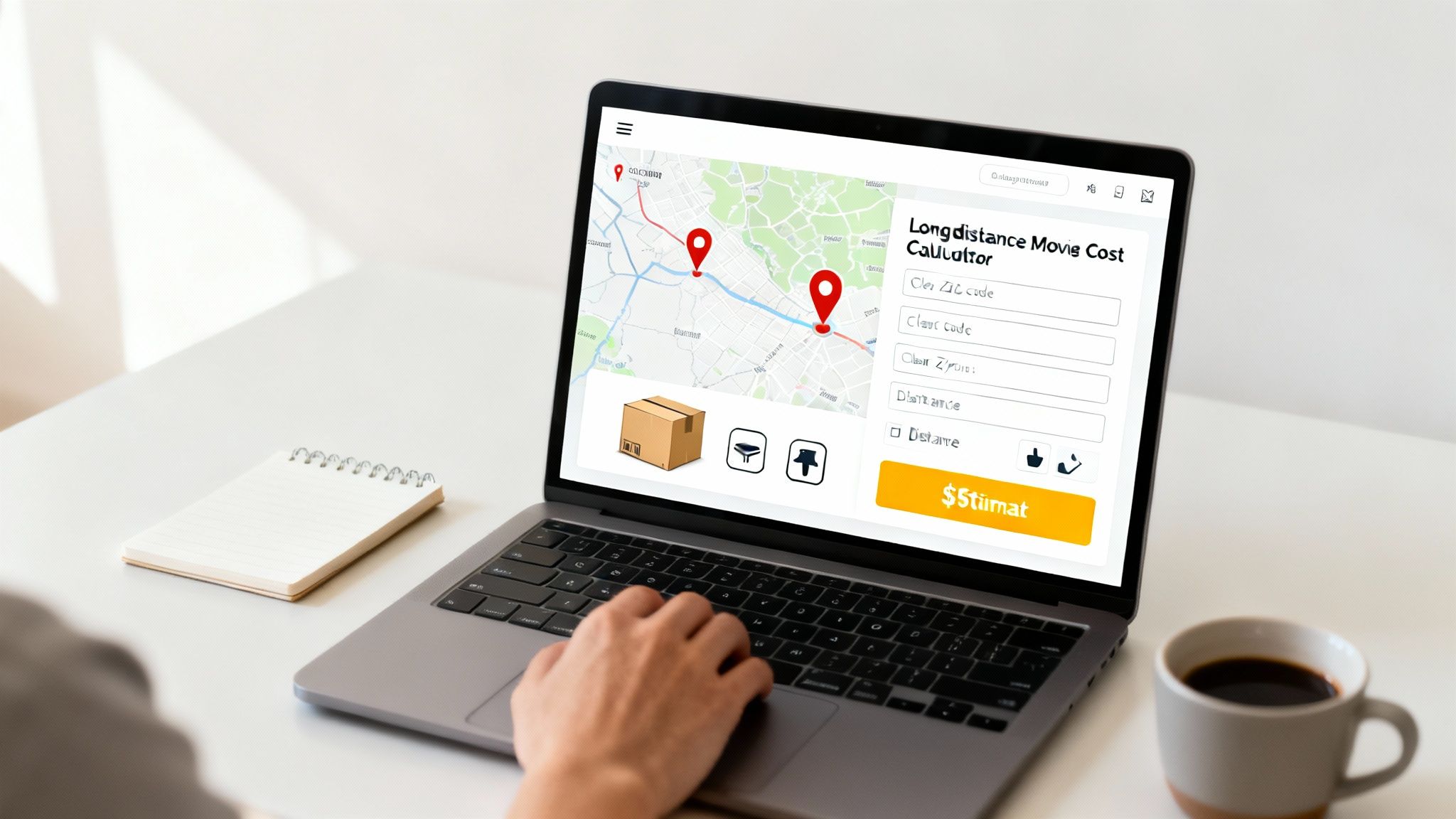
Here’s an idea of what the form looks like when you get started.
As you can see, the layout is clean and asks for the most critical details right away to generate your quote.
After you’ve entered these basics, you can get a little more specific. This is your chance to add any extra services you might need, like having our pros pack up your fragile items or arranging for temporary storage. If you have specialty items, like a piano or some oversized artwork, make sure you note them here. This is key to getting the most precise estimate possible.
Key Takeaway: The more accurate you are with what you tell us, the more reliable your quote will be. It really pays to spend a moment thinking through your inventory and what help you’ll need before you start—you’ll get a much more useful number in return.
Once you hit submit, you’ll receive an instant quote that breaks down the potential costs. Think of this number as the perfect launching pad for your financial planning. To flesh out your budget even further, you can use our specialized moving budget calculator to account for every single relocation expense.
From there, the next step is to connect with our team. We can schedule a virtual or in-home survey to lock in a guaranteed, binding quote.
When you’re looking at a relocation budget, it’s only natural for a million questions to start popping into your head. Using a long-distance moving cost calculator is a fantastic starting point, but that first number often leads to wanting more specific details. Let’s clear up some of the most common questions people have when they’re planning and budgeting for a big move.
Think of an online calculator as a really good ballpark estimate. It’s a powerful tool for initial budgeting because it’s built on solid industry averages and the information you punch in. But it can’t be a binding quote. Why? Because a simple form can’t see the tricky staircase in your building, know about the narrow driveway, or understand that your antique piano needs special handling.
It’s best to view a calculator’s result as a well-informed forecast. To get a guaranteed, locked-in price, you’ll always need an in-home or virtual survey where a professional can see exactly what the job entails.
For a tiny move, like a studio apartment across town, renting a truck yourself can look cheaper on the surface. But once you start adding up the real costs—fuel, insurance, renting dollies and pads, and the value of your own time (and back!)—those savings start to shrink pretty fast. You also have to factor in the physical exhaustion and the very real risk of damaging your furniture without the right experience.
Once you’re moving a two-bedroom home or more, the scales almost always tip in favor of the pros. The efficiency, safety, and massive reduction in stress that professional movers provide often make them the more practical and cost-effective choice in the long run.
The moving industry has a clear off-season that generally runs from October through April. Because demand is way down during these cooler months, you’ll find much more competitive pricing and way more flexibility when booking your date. If you have any wiggle room in your timeline, avoiding the peak summer rush from May to September can lead to some serious savings.
You can slice your costs even more by picking the right day of the week:
Booking your move mid-week during the off-season is hands-down one of the smartest strategies for keeping your budget in check.
Ready to turn that ballpark estimate into a solid, actionable plan? The team at Family Movers Express LLC is here to give you a transparent, no-obligation quote that’s built around your specific move. Get your instant estimate and start your stress-free move today.
Ready to protect your upcoming move?
Click Here to Fill Out Our Quick Form & Secure Your Instant Quote!