A detailed moving budget calculator is your best friend when it comes to avoiding surprise costs. Think of it as your financial roadmap for the entire move, turning what feels like a chaotic process into a manageable plan. It’s all about accounting for every single expense—from the big stuff like the truck rental down to the tiny hidden fees—before they ever hit your wallet. That control is the secret sauce to keeping moving anxiety at bay.
Why a Moving Budget Is Your Best Defense Against Stress
Let’s be honest: the single biggest source of moving anxiety isn’t the thought of lifting that ridiculously heavy sofa. It’s the fear of the unknown cost.
When you don’t have a clear financial plan, every decision feels like a high-stakes gamble. A solid moving budget completely flips that script. It replaces uncertainty with confidence, giving you a powerful tool to sidestep any last-minute financial panic. It’s less of a restrictive document and more of a strategic guide, empowering you to make smart, informed decisions from start to finish.
Gaining Control Over the Chaos
A move is made up of dozens of small, easy-to-forget expenses that can sneak up on you and completely derail your plans. These are the “financial leaks” that bust budgets and pile on the stress. A comprehensive budget helps you get ahead of them.
No More Surprise Fees: Utility setup charges, unexpected insurance costs, that weird fee the building charges for using the service elevator… a good budget forces you to think about these things ahead of time.
Make Smart Trade-offs: See a shockingly high quote for professional packing? Your budget makes it crystal clear whether the DIY approach is actually worth the savings in time and energy.
Genuine Peace of Mind: Knowing you have a contingency fund for those inevitable hiccups (like needing the rental truck for an extra day) removes a massive layer of worry. It’s a game-changer.
A proactive budget is all about taking back control. When you list out every potential expense, you’re not just crunching numbers—you’re building a predictable, manageable game plan where you are firmly in the driver’s seat.
Ultimately, using a moving budget calculator is the first and most critical step toward a smooth transition. It shifts your focus from worrying about money to actively managing it. This frees you up to concentrate on what really matters: getting settled and starting the next chapter in your new home. For a deeper dive, you can explore our resources to help you plan your move from A to Z.
Unpacking Every Potential Moving Expense
If you want to build a moving budget that doesn’t fall apart halfway through, you have to dig into every potential cost hiding in the corners. A simple checklist just won’t cut it. The best way to tackle this is by sorting every single expense into clear categories. This approach turns your moving budget calculator from a basic spreadsheet into a serious financial planning tool.
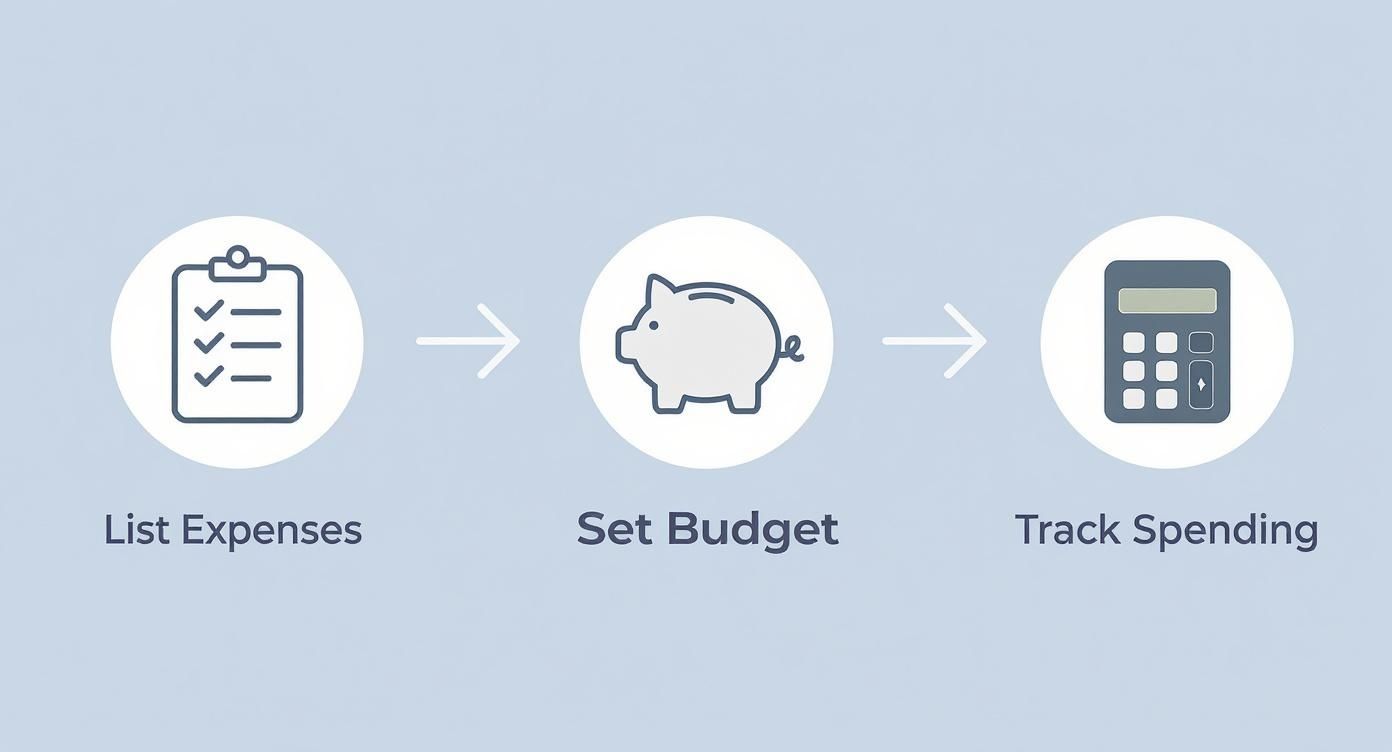
This isn’t just about listing numbers; it’s about gaining control. You identify all the expenses, set a realistic budget based on those numbers, and then track what you’re actually spending. This simple three-part strategy—listing, budgeting, and tracking—is the bedrock of a stress-free move. It’s how you prevent those nasty surprise costs and keep your finances on track from start to finish.
Professional Moving Services
Let’s be honest: hiring professional movers is usually the biggest chunk of your moving budget. The final price tag depends on the size of your home, how far you’re going, and exactly what you need them to do.
Full-Service Movers: This is the classic option—a crew loads the truck, drives it to your new place, and unloads everything. For local moves, you’ll typically pay an hourly rate. Long-distance moves? Those are usually priced based on the weight of your stuff and the mileage.
Specialty Item Handling: Got a piano, a hefty pool table, or a priceless piece of art? Movers will charge extra for these. It takes special equipment, more muscle, and a specific skill set to move them safely, and the price reflects that.
Packing Services: You can have the pros pack your entire house, just the kitchen, or nothing at all. Going for the full packing service can add 25% or more to your total bill, but it’s a massive time and sanity saver.
Getting a realistic idea of these costs is key. Our deep dive into the average moving costs breaks down the numbers so you can set a solid baseline for your own budget.
DIY Moving Costs
Going the DIY route can definitely save you cash, but “cheaper” doesn’t mean “free.” These costs can sneak up on you if you aren’t paying close attention.
Your main expense is the truck rental. The price tag will swing based on the truck’s size, how long you need it, and even the time of year. Don’t forget that weekends and the summer months are prime time for moving, which means higher rates.
Beyond the truck itself, you’ll need to budget for:
Fuel: Moving trucks are thirsty beasts. You’re lucky to get 6-10 miles per gallon. For a long-distance move, this can become a major expense you didn’t see coming.
Equipment Rentals: You’ll need dollies for the heavy stuff and furniture pads to prevent scratches. While some basics might be included, you’ll often pay extra for the good stuff.
Mileage Fees: Most local rentals give you a certain number of miles. Go over that, and they’ll charge you for every additional mile.
A classic mistake is lowballing the fuel budget. A cross-country trip in a big moving truck can easily guzzle several hundred dollars in gas alone. That’s a detail that can blow up an otherwise carefully planned DIY budget.
Packing And Supplies
Whether you’re doing the whole move yourself or just packing your own boxes, you’re going to need supplies. It’s surprisingly easy to spend $150-$400, or even more, on materials for an average-sized home.
Here’s what your shopping list will look like:
Boxes: You’ll want a good mix of small, medium, and large sizes. Don’t cheap out on specialty boxes like wardrobe or dish-pack cartons—they cost more but offer way better protection.
Tape: You will use a shocking amount of packing tape. Seriously. Plan on needing at least one roll for every 5-10 boxes you pack.
Protective Wrap: Bubble wrap, packing paper, and foam pouches are non-negotiable for keeping your fragile items in one piece.
Often Overlooked Expenses
In the end, it’s the little things—the costs you completely forget about—that cause the most budget headaches. These are the expenses that most people never even think to plug into their moving budget calculator.
Make sure you set aside a little extra for these common incidentals:
Utility Setup Fees: Your new gas, electric, and internet providers will likely hit you with activation or transfer fees.
New Driver’s Licenses: Moving to a new state means a fun trip to the DMV. Expect to pay fees for a new license and to register your vehicle.
Professional Cleaning: Many landlords won’t give you back your full security deposit unless the place has been professionally cleaned.
Tips for Your Crew: If you hired movers and they did a great job, a tip of 15-20% of the total bill is the standard way to say thanks.
How Local and Long-Distance Moves Affect Your Budget
Without a doubt, the single biggest factor that will shape your moving budget is distance. There’s a world of difference between moving a few miles across town and relocating to another state. They’re two completely different financial ballgames, each with its own rulebook and cost drivers. Getting this right is the first step to creating an accurate moving budget calculator.
For local moves, which are usually anything under 50 miles, the game is all about time. Movers will almost always charge an hourly rate that bundles the truck, the crew, and the basic gear. Your final bill is a direct result of how many hours it takes them to load up, drive over, and unload everything.
The Local Move Scenario
When you’re budgeting for a move down the street, your mantra should be efficiency. Every minute the clock is ticking adds to your final cost.
A few key variables will directly impact how many hours you’re billed for:
Your Home’s Size: A two-person crew can probably knock out a one-bedroom apartment in about 3-5 hours. But for a three-bedroom house? You could easily be looking at 7-10 hours, sometimes more.
Accessibility Issues: Does your apartment have three flights of stairs? Is it a long walk from the curb to your front door? Every obstacle like this adds time—and money—to the job.
How Prepared You Are: If your boxes are all packed, sealed, and stacked by the door, the crew can get right to work. If you’re still scrambling to pack things when they arrive, you’re paying them to wait.
For a local move, just remember this: time equals money. Your main goal is to do everything you can to minimize the hours that moving crew is on the clock. Be ready.
The Long-Distance Move Equation
The moment your move crosses state lines or a certain mileage threshold (usually 50-100 miles), the entire pricing model flips. Forget about time. The two factors that matter now are shipment weight and distance. Moving companies use complex formulas based on how heavy your stuff is and how many miles they have to haul it.
This brings a whole new set of costs into the picture that you just don’t see with local moves:
Weight-Based Pricing: This is exactly why decluttering is non-negotiable for a long-distance move. Tossing that ancient, heavy sofa doesn’t just clear out space; it directly reduces the weight and, therefore, your final bill.
Fuel Surcharges: When you’re covering hundreds or even thousands of miles, fuel is a massive expense, and that cost gets passed on to you.
Shuttle Services: If a giant 18-wheeler can’t get down the narrow streets to your new home, the company has to use a smaller “shuttle” truck to ferry your belongings. That’s an extra service with an extra fee.
Storage-in-Transit: What if your new house isn’t quite ready when the truck shows up? You might have to pay for the movers to temporarily store your items until you can actually take delivery.
The price difference is pretty stark. Recent data for 2025 projects the average local move to cost between $850 and $1,600. In sharp contrast, long-distance moves are estimated to land somewhere between $3,200 and $6,000. That jump reflects all the added complexity of weight, mileage, and logistics. For more details, you can check out the full report on these moving cost trends.
Figuring all this out is much easier when you know what to expect. For a complete rundown, take a look at our guide on moving long-distance for more specific tips and strategies.
Budgeting for Corporate and International Moves
When your move is backed by an employer or is taking you across international borders, the financial game changes completely. That standard moving budget calculator you’ve been using? It probably won’t cut it. These moves have layers of cost and complexity that a simple domestic relocation just doesn’t.
Understanding these differences is the key to a smooth transition, whether it’s your company footing the bill or you’re embarking on a global adventure.
Navigating Corporate Relocation Packages
So, your company is helping you move. That’s fantastic! But don’t assume they’ve handed you a blank check. The first thing you need to do is get a detailed, written breakdown of what your relocation package actually covers. Some companies offer a lump-sum payment to use as you see fit, while others will only reimburse specific, approved expenses.
Your first step is to clarify every single detail. Does the package cover the full cost of professional movers? Will it pay for temporary housing if your new home isn’t quite ready? You might find the company happily pays for the big-ticket items but leaves you on the hook for smaller things like utility setup fees or vehicle registration in the new state.
What’s Usually Covered: Most packages will handle the movers, transportation of your belongings, and maybe a trip out to find a place to live.
What You Might Pay For: Be prepared for potential out-of-pocket costs like lease-breaking fees, new driver’s licenses, or specialized pet transportation services.
Figuring this out is also a huge part of managing the logistics. For a deeper look into the operational side of a company move, our guide on planning an office relocation has some great insights that apply here, too.
The High Cost of International Moves
Moving to another country isn’t just a bigger move—it’s in a completely different financial league. The expenses balloon far beyond just shipping your stuff, and a standard moving budget calculator will miss almost all of them.
An international move is a complex logistical and administrative project. You’re not just moving boxes and furniture; you’re moving your entire life through customs, new legal systems, and unfamiliar cultures.
The costs can be absolutely staggering. In fact, recent data shows that the average cost for an international employee relocation hovers around $77,000 per person.
That eye-watering figure breaks down into major chunks: about $25,000 for shipping household goods, $15,000 for temporary housing, $7,500 for a home-finding trip, and another $5,000 just for visa and immigration processing. You can see more details on these global mobility costs to get a better sense of the scale.
When you’re budgeting for an international move, you have to account for things that wouldn’t even be on your radar for a domestic one:
Visas and Immigration Fees: These aren’t optional, and the legal costs can easily run into thousands of dollars.
Customs, Duties, and Taxes: You might have to pay significant taxes just to import your own household goods into the new country.
International Shipping and Insurance: This is far more expensive than domestic transit and comes with specialized, and often mandatory, insurance requirements.
Temporary Housing: You’ll likely need a place to live for several weeks (or even months) while you search for a permanent home, and this is a major expense.
Proven Tactics to Lower Your Moving Costs
Once you’ve run the numbers through a moving budget calculator, you’ll have a ballpark figure. The fun part? Seeing how much you can shrink it. Finding smart savings doesn’t mean you have to sacrifice a smooth move; it’s all about making strategic choices that keep more cash in your wallet.
Honestly, some of the simplest tweaks can have the biggest impact on your bottom line.
One of the most powerful tools at your disposal is timing. Moving is a business of supply and demand, and everyone wants to move on weekends, holidays, and during the summer. If you can swing it, booking your move for a Tuesday in October instead of a Saturday in July can get you quotes that are 10-30% lower.
Be Strategic with Your Stuff
Every single item you own, especially on a long-distance move, adds to the final bill. The less you have to haul, the less you pay—it’s that simple. Think of this as your golden opportunity to declutter with a clear purpose.
Sort Ruthlessly: Get three piles going—keep, donate, and sell. If you haven’t touched something in over a year, it’s a prime candidate to go.
Sell Valuable Items: That old couch or the extra TV in the guest room can be sold online. Not only does the cash you make go straight into your moving fund, but you also save by not having to pay to transport it.
Weigh the Cost: For long-distance moves that are priced by weight, get practical. Is it really cheaper to move that bulky, inexpensive bookshelf, or could you just buy a new one after you arrive?
Remember, every pound you shed from your shipment directly reduces your cost. Getting rid of 500 pounds of stuff you don’t truly need can save you hundreds of dollars on a cross-country move.
Source Supplies and Handle Tasks Smartly
Don’t let packing materials sneak up on you—they can become a major expense before you know it. Before you go out and buy a mountain of new boxes, get a little creative.
Pop into local grocery or liquor stores; they often have sturdy boxes they’re more than happy to give away for free. You should also put your own stuff to work. Use towels, linens, and even clothing to wrap fragile items. It’s a great way to cut down on the bubble wrap bill.
Figuring out what to DIY versus what to hire out is another crucial area for savings. Maybe you can tackle all the packing yourself but bring in the pros for just a couple of hours to load the heavy furniture. This kind of “hybrid” approach often strikes the perfect balance between saving money and saving your back. For more ideas, check out these 6 tips for saving money during a move.
Finally, don’t just skim over your moving insurance options. While the basic liability coverage movers offer is free, it provides very minimal protection. Upgrading might feel like just another expense, but it’s a small price to pay to avoid the massive financial hit of replacing a damaged, high-value item out of your own pocket. Think of it as an investment in your financial security.
Still Have Questions About Your Moving Budget?
Even with the best plan in place, a few questions always pop up when you’re trying to nail down a moving budget. I’ve been in this business a long time, and I’ve seen where people get stuck. Let’s clear up some of the most common uncertainties so you can build a budget that actually works.
How Accurate Are Online Calculators, Really?
Online moving calculators are a fantastic starting point. Seriously, they give you a great ballpark figure to work with, especially when you plug in accurate details about your home size, move distance, and the services you think you’ll need. Think of them as your first draft—a guide, not the final bill.
But here’s the thing: they’re just estimates. A calculator can’t see the real-world quirks of your move that can nudge the final price up or down.
Access Issues: Got a narrow hallway, three flights of stairs, or a super long walk from the curb to your front door? That extra time and effort can add to the labor cost.
Specialty Items: Things like pianos, antique armoires, or that massive piece of modern art need special handling, and that usually comes with an extra charge.
Final Shipment Weight: For long-distance moves, what really matters is the certified weight of your shipment on moving day. An estimate is just that—an estimate.
Use an online calculator to get your initial numbers straight. But then, you absolutely must get binding, in-home or virtual quotes from at least three reputable movers. That’s the only way you’ll get a figure you can actually take to the bank.
When Is the Best Time to Start Budgeting for a Move?
If you can, start mapping out your moving budget at least two to three months before you plan to move. I know it sounds early, but this is the sweet spot. It gives you enough breathing room to make smart, un-rushed decisions instead of frantic, expensive ones.
Starting early lets you properly research moving companies and compare quotes without feeling the pressure of a looming deadline. It also gives you time to set money aside and, just as importantly, find ways to save. You’ll have time to declutter and sell things you don’t want to move, which is a double win—it lowers your moving weight and pads your moving fund.
How Much Should I Pad My Budget for Unexpected Costs?
This is a big one. My rule of thumb, based on years of experience, is to add a contingency fund of 10-15% on top of your total estimated cost. This isn’t just being pessimistic; it’s being realistic. Almost every move has a few surprises, and this buffer is your financial safety net.
What does this “surprise fund” cover?
That last-minute run to the store for more boxes or tape.
Ordering pizza for a few nights because your kitchen is packed to the gills.
Needing an unexpected hotel room if your closing gets delayed by a day.
Small fees you might have forgotten about in your initial plan.
Having that cushion means a small hiccup won’t throw your entire budget into chaos. It’s a simple step that buys you a ton of peace of mind. Ready to turn that budget into a solid plan? The team at Family Movers Express LLC is all about transparent pricing and reliable service. We’ll help make your move smooth and predictable. Get your free moving quote today!