
Moving day is a high-stakes game of Tetris, but with your most valuable possessions. The difference between a smooth transition and a chaotic ordeal often comes down to one crucial skill: how you load the moving truck. A poorly loaded truck can lead to damaged furniture, broken heirlooms, and even dangerous driving conditions due to unbalanced weight. But with a strategic approach, you can transform that empty cargo space into a secure, perfectly balanced puzzle of your belongings.
This guide provides a comprehensive collection of actionable moving truck loading tips used by professional movers. We will move beyond common sense and dive into the specific techniques that protect your items and maximize every square inch of space. You will learn the correct order for loading heavy appliances, how to create stable tiers of boxes, and the best ways to secure everything for transit.
Whether you’re tackling a studio apartment move across Orlando or relocating a large family home up the East Coast, mastering these methods will ensure your possessions arrive safely. Forget the stress and guesswork. This checklist is your blueprint for a successful, damage-free move. Let’s get you loaded up and on the road.
The single most important rule of truck loading is to create a stable foundation. This is achieved by loading your heaviest items first and placing them directly on the truck’s floor, primarily against the front wall (the cab end). This technique, often called building a “base layer,” is a cornerstone of professional moving truck loading tips because it establishes a low center of gravity. A low center of gravity prevents the truck from swaying dangerously during turns and keeps your belongings from shifting.
Placing dense, heavy items on the bottom ensures they won’t crush lighter, more fragile possessions stacked on top. Think of it like packing a grocery bag: you would never put a watermelon on top of your eggs. The same logic applies here, but on a much larger scale.
Start by identifying your heaviest belongings. These typically include appliances, solid wood furniture, and large, packed boxes.
Key Insight: The goal is to distribute the weight as evenly as possible from left to right across the front of the truck. Avoid loading all heavy items on one side, as this can unbalance the vehicle and impact its handling. For a deeper dive into safe loading practices, you can review these 5 keys to safe and effective truck loading. Following this fundamental principle not only protects your belongings but also makes the entire moving process safer.
Beyond simply loading heavy items first, professional movers employ a systematic approach known as layering. This strategy involves building distinct, organized tiers of belongings from floor to ceiling, which maximizes every cubic foot of space while maintaining the structural integrity of your load. This is one of the most effective moving truck loading tips because it prevents items from collapsing into each other and creates a solid, tightly packed truck.
Instead of randomly placing items, you create deliberate sections. Each layer is built upon the last, often alternating between heavy furniture and sturdy boxes to create interlocking walls. This methodical process ensures that weight remains distributed and that lighter items have a stable surface to rest on, preventing damage during transit.
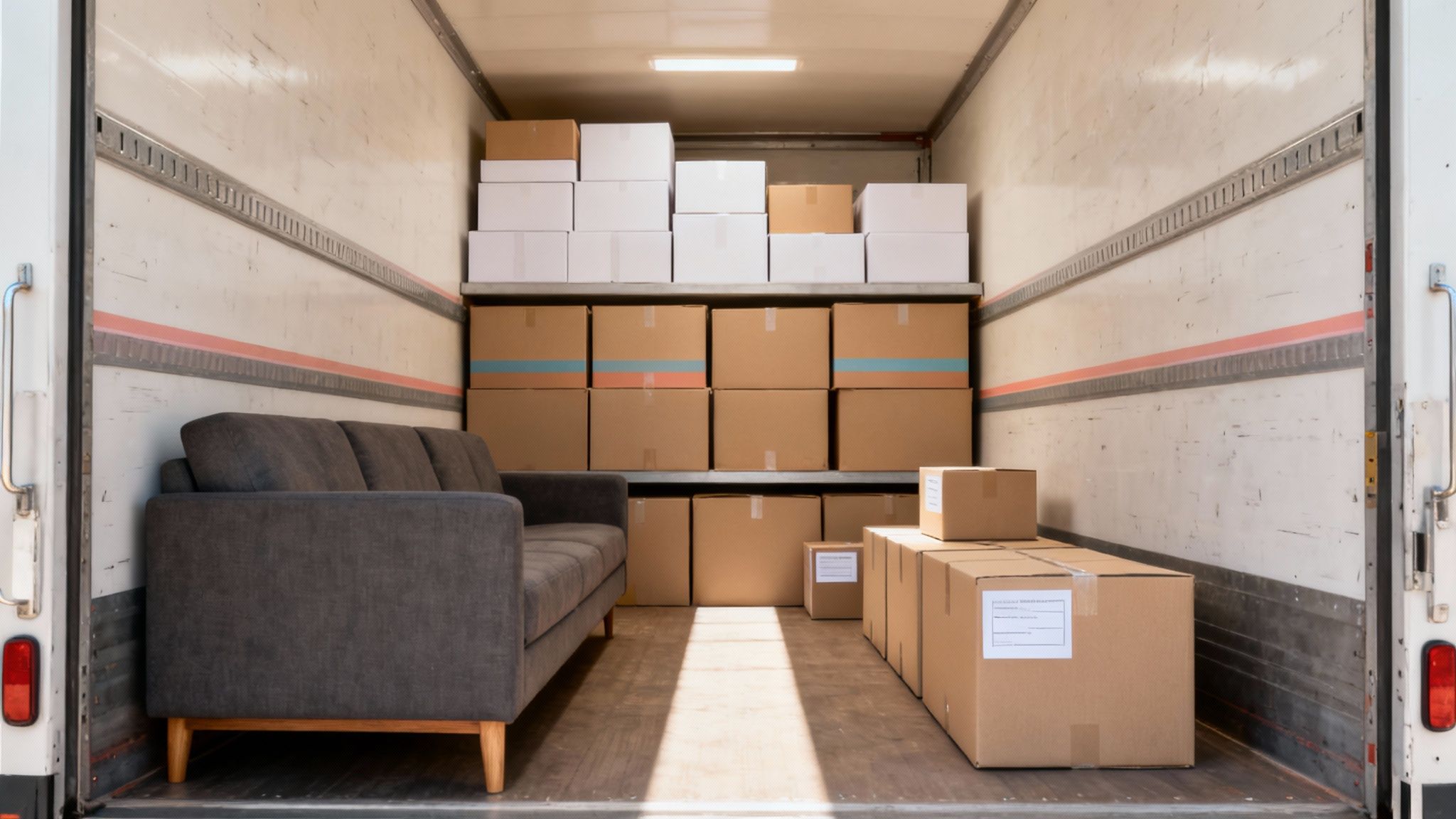
Think of loading the truck like a game of Tetris. Your goal is to create solid, vertical tiers that fit together snugly, working from the back of the truck towards the door.
Key Insight: The most efficient way to use space is to think vertically. Aim to build complete floor-to-ceiling “walls” of items before moving on to the next section. This technique, used by professional movers everywhere, ensures a tight, secure load that won’t shift, which is crucial for protecting your belongings on any journey.
One of the most common mistakes in a DIY move is underutilizing the truck’s height, which wastes valuable space and can require a second trip. A key component of professional moving truck loading tips is to think vertically, not just horizontally. By strategically stacking your belongings from the floor to as close to the ceiling as is safe, you maximize every cubic foot of the truck, ensuring a tight, secure pack that minimizes shifting during transit.
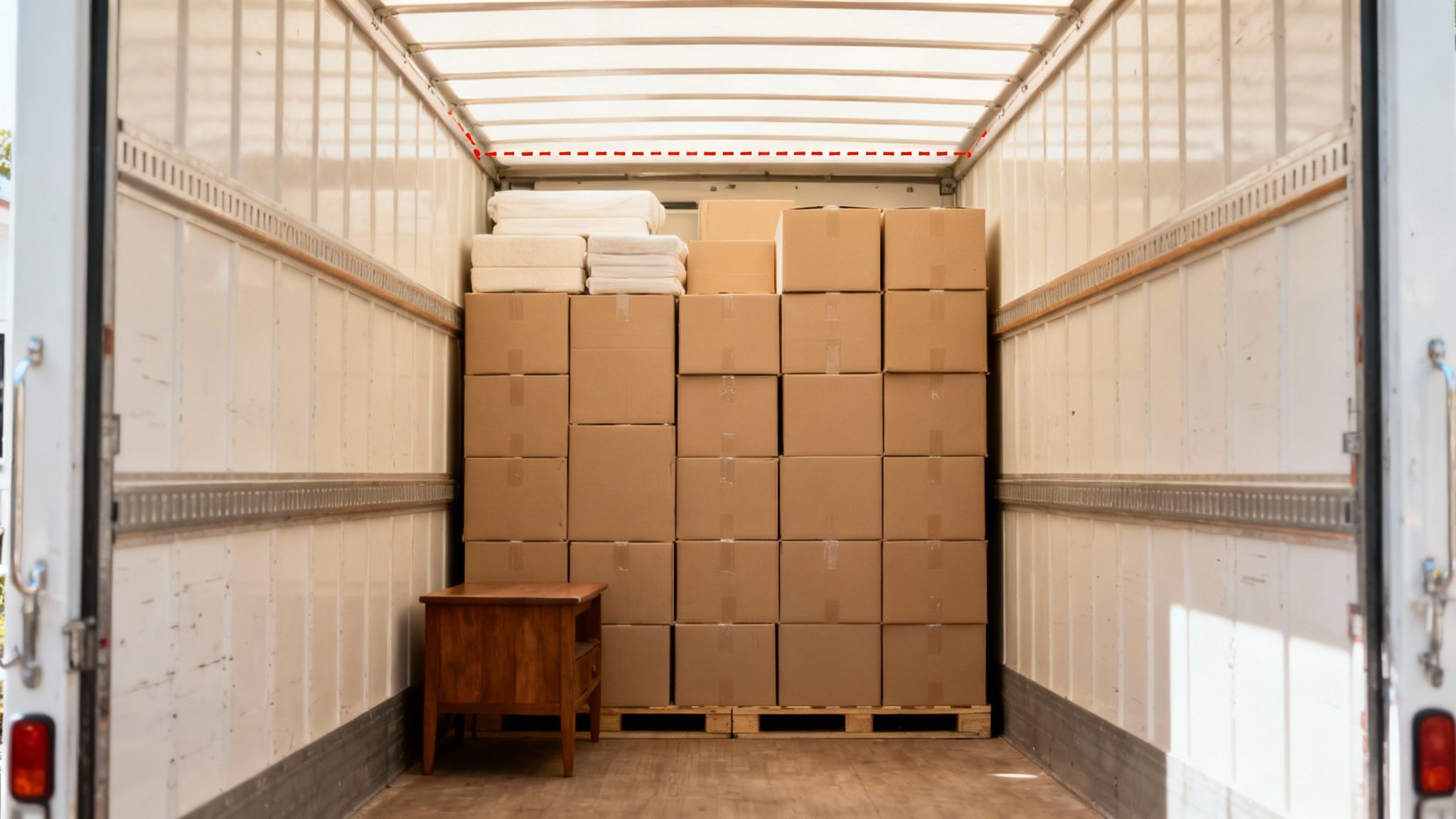
This method involves creating stable columns or “tiers” of boxes and other items. It’s about building upwards from the solid base you created in the first step, much like constructing a well-organized warehouse shelf. Properly executed, this technique allows you to fit more into the truck while also creating interlocking walls of goods that support each other.
Once your heavy base layer is in place, begin building upwards with medium-weight boxes and then lighter items. The goal is to create stable, floor-to-ceiling columns.
Key Insight: Always stack with a “pyramid” mindset: the heaviest items must be at the bottom of any stack, with progressively lighter items as you go up. Never place a heavy box on top of a lighter one, as it will compress and potentially damage the contents below and destabilize the entire column. A well-stacked truck is a safer truck.
A successful move begins long before you load the truck, and one of the most effective moving truck loading tips is rooted in organization. Packing boxes by the room they belong in and labeling them clearly turns a chaotic process into a streamlined system. This strategy ensures that when you’re unloading, you know exactly where each box goes, saving immense time and preventing the common “where does this go?” frustration.
Grouping items by their room of origin simplifies not only unpacking but also loading. It allows you to load the truck in logical sections, placing boxes from less essential rooms (like a guest bedroom) deeper in the truck, while keeping priority boxes (like kitchen essentials) more accessible. This methodical approach transforms your moving truck into a well-organized, mobile inventory system.
The key is consistency. Decide on a labeling system and apply it to every single box you pack. This small investment of time upfront pays huge dividends on moving day and beyond.
Key Insight: This organizational system is about more than just unpacking convenience; it’s about loading intelligence. By knowing exactly what is in each box and where it belongs, you can make smarter decisions about placement inside the truck, ensuring heavy boxes form the base and fragile items are protected. For specialized advice on protecting delicate items, see our guide on how to pack dishes for your move. A well-labeled box is the foundation of a smooth and damage-free relocation.
Attempting to load a moving truck without the right equipment is not only inefficient but also dangerous. Professional moving truck loading tips always emphasize the use of proper tools because they act as force multipliers, allowing you to lift heavier items with less strain, move them more securely, and prevent costly damage to your belongings and property. Using equipment like dollies, hand trucks, and moving straps is the difference between a smooth, systematic load-in and a day filled with back pain and broken furniture.
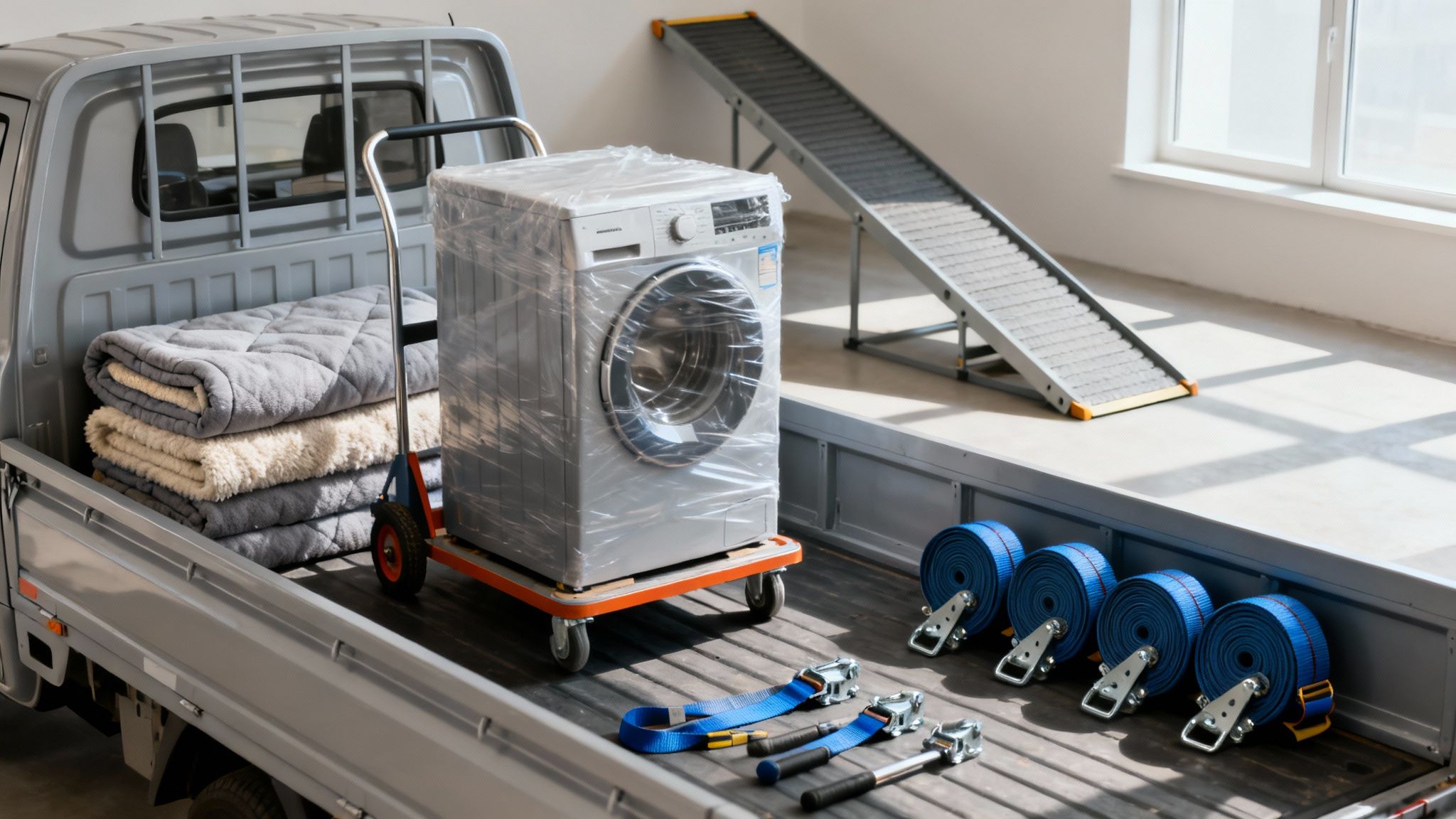
This equipment is designed to do the heavy lifting for you, reducing the risk of personal injury and making the entire process faster. A ramp, for instance, eliminates the need to awkwardly lift a heavy dresser up into the truck, while a furniture dolly allows one person to easily maneuver an item that would otherwise require two or three people.
Before moving day, take an inventory of your belongings and rent or purchase the necessary equipment. Most truck rental companies like U-Haul and Penske offer these items as add-ons, making it convenient to get everything you need in one place.
Key Insight: Don’t try to be a hero by lifting everything manually. The small cost of renting proper moving equipment is a worthwhile investment when compared to the potential cost of replacing damaged valuables or paying for medical bills from an injury. Planning ahead and having the right tools on hand streamlines the entire loading process.
Loading your items correctly is only half the battle; keeping them in place during transit is just as crucial. Using professional-grade ratchet straps, ropes, and tie-downs is an essential moving truck loading tip that prevents shifting, which is the primary cause of damage. Gravity and momentum can turn unsecured items into projectiles, risking breakage, scratches, and even creating unsafe driving conditions.
Properly securing your load transforms the entire truck’s contents into a single, solid unit. This unified mass is far more stable than a collection of individual items that can slide, topple, or rub against each other. By immobilizing everything, you protect your belongings and ensure the truck remains balanced and predictable on the road.
As you build layers of boxes and furniture, you should secure each section before starting the next. This is not a final step, but an ongoing process throughout the entire loading phase.
Key Insight: Don’t overtighten the straps. The goal is to make the load snug and immobile, not to apply so much pressure that you damage furniture or crush boxes. Check the tension periodically; straps should be taut with no slack, but not strained to their limit. For more details on protecting specific pieces, review our guide on moving heavy furniture safely.
A common mistake that wastes valuable space and creates an unstable load is placing long items like sofas or mattresses horizontally across the truck’s width. The correct, professional technique is to load these items lengthwise, parallel to the walls of the truck. This strategy maximizes your usable floor space, allowing you to fit more belongings efficiently, and plays a crucial role in maintaining the vehicle’s balance.
This approach is one of the most effective moving truck loading tips because it treats long furniture like building blocks for each vertical tier. By placing a sofa lengthwise along one wall, you create a long, stable base upon which you can stack lighter boxes and other items, forming a solid, self-supporting column. This prevents items from toppling over during transit and ensures the overall weight is distributed evenly from front to back.
Begin by identifying your longest items, such as sofas, bed frames, mattresses, and dining tables. These should be loaded after your heavy base layer of appliances is in place.
Key Insight: The primary goal is to prevent the truck from becoming top-heavy or biased to one side. A balanced load is a safe load. Properly distributing weight is especially critical when moving exceptionally heavy and cumbersome items. For a closer look at handling specialty objects, you can explore these expert tips on how to move a grand piano. By applying this principle of even distribution, you enhance safety and protect your belongings from damage.
One of the most overlooked yet critical moving truck loading tips is the strategic creation of access pathways. While the goal is to maximize space, completely walling off sections of the truck can be impractical and unsafe. Deliberately leaving an access aisle allows you to retrieve an essential item during a long-distance stop, adjust a shifted load, or simply reach the front of the truck without unloading everything behind you.
This practice prioritizes safety and accessibility over cramming every last inch with boxes. It prevents you from being trapped by your own belongings and ensures that in an emergency, you or professional movers can navigate the space. It’s a proactive measure that adds a layer of control and flexibility to what can often be a chaotic process.
The key is to plan your access points before you begin loading, treating pathways as a non-negotiable part of the truck’s layout. This requires thinking about the entire journey, not just the initial pack.
Key Insight: Planning for access is a fundamental component of a safe and efficient move. It’s not about wasted space; it’s about smart space management that prepares you for the unexpected. Integrating this strategy is a key part of how you can plan your move with professional foresight. This simple but effective tip ensures you maintain control over your cargo from the moment you start loading until the last box is unloaded.
| Strategy | 🔄 Implementation Complexity | Resources Required | ⚡ Efficiency/Speed | 📊 Expected Outcomes ⭐ | 💡 Key Tips |
|---|---|---|---|---|---|
| Load Heavy Items First on the Truck Floor | Medium — planning + heavy lifting | Dolly/hand truck, straps, measuring tape, helpers | ⚡ Medium — improves unloading & stability | 📊 ⭐⭐⭐⭐ Stable base, less crushing of fragile items; safer transit (best for appliances/furniture) | 💡 Measure items, use a dolly, place heavy pieces against the cab |
| Create an Organized Layering System | High — sequencing, time and adjustments | Sorted boxes by weight, straps, blankets, inventory list | ⚡ High — maximizes capacity but time‑consuming to set up | 📊 ⭐⭐⭐⭐⭐ Maximized space, orderly unload, reduced damage (ideal for full-house/commercial moves) | 💡 Plan layer order, secure each layer, photograph/track inventory |
| Utilize Vertical Space Efficiently | Medium‑High — balance and safety considerations | Uniform boxes, straps, step stool/dolly, blankets | ⚡ High — increases capacity ~30–50% | 📊 ⭐⭐⭐⭐ More items per trip; access to upper items harder; requires secure stacking | 💡 Keep heavy items low, leave ~12″ gap to ceiling, secure tall stacks |
| Pack Boxes by Room and Label Strategically | Medium — disciplined packing and labeling | Labels/markers, colored tape, inventory spreadsheet, packing materials | ⚡ High for unloading — speeds unpacking and placement | 📊 ⭐⭐⭐⭐ Faster unloading, clearer unpacking priorities, easier claims (best for multi‑room moves) | 💡 Label at least 3 sides, number boxes (e.g., Kitchen 1/5), color‑code by room |
| Use Proper Equipment and Tools | Low‑Medium — training on tools needed | Dollies, ramps, moving blankets, ratchet straps, rental fees | ⚡ Very High — can speed loading 40–60% | 📊 ⭐⭐⭐⭐⭐ Reduces injuries, prevents damage, much faster loading | 💡 Rent quality gear, practice dollies before moving, keep pads and straps accessible |
| Secure and Stabilize Loads with Straps and Tie‑Downs | Medium — technique and time to secure properly | Ratchet straps, E‑track, corner protectors, blankets | ⚡ Medium — adds time but prevents costly shifting/rework | 📊 ⭐⭐⭐⭐⭐ Prevents movement, protects cargo, meets DOT safety standards (critical for long trips) | 💡 Use straps rated above load, secure multiple points, avoid overtightening |
| Load Long Items Lengthwise and Distribute Weight Evenly | Medium — measurement and placement planning | Measuring tape, helpers, straps, possibly disassembly tools | ⚡ Medium — optimizes space and vehicle handling | 📊 ⭐⭐⭐⭐ Better vehicle stability and space use; reduces tipping/sway (best for sofas, beds, tables) | 💡 Measure truck interior, load largest items first, balance weight left‑to‑right |
| Leave Access Space and Plan for Emergency Access | Medium — requires space tradeoffs and planning | Planning tools, marking tape, designated space allocation | ⚡ Low‑Medium — reduces packing density but saves retrieval time | 📊 ⭐⭐⭐ Safe access for emergencies/stops; easier retrieval; meets safety regs | 💡 Maintain a ~3‑ft aisle, never block exits, brief helpers on access routes |
You have now navigated the essential playbook for loading a moving truck, transforming what can be a chaotic task into a structured, strategic process. The journey from a cluttered room to a perfectly packed truck is no longer a mystery. By implementing these professional-grade moving truck loading tips, you are equipped to protect your belongings, maximize space, and minimize the physical and mental strain of moving day.
The core of a successful load lies in a few foundational principles we’ve covered. Always begin with your heaviest and bulkiest items, like appliances and solid furniture, to create a stable base against the cab wall. This isn’t just a suggestion; it’s a non-negotiable rule for a safe, balanced truck that handles predictably on the road. From there, your success hinges on the layering system you build, creating sturdy tiers of boxes and furniture that distribute weight evenly from side to side and front to back.
Let’s recap the most critical takeaways that will make the biggest difference:
Mastering these concepts transforms you from an amateur mover into a logistics-savvy coordinator of your own relocation. You’re not just throwing boxes into a truck; you are engineering a secure mobile storage unit designed to protect your life’s possessions over miles of highway. The value here extends beyond preventing a broken lamp. It’s about preserving sentimental items, protecting expensive electronics, and ensuring your furniture arrives at your new home in the same condition it left. It’s about starting the next chapter of your life on a positive, stress-free note.
While this guide provides a comprehensive blueprint for the ambitious DIY mover, remember that knowledge is only half the battle. The other half is execution, which requires time, physical effort, and a great deal of patience. If the scale of the task feels daunting, or if you simply prefer to delegate the heavy lifting to seasoned professionals, that’s not just an option; it’s a smart strategic decision.
Ready to skip the stress and ensure a perfect load every time? The expert crews at Family Movers Express LLC live and breathe these moving truck loading tips daily, executing flawless moves across the East Coast. Visit Family Movers Express LLC to get a free quote and let our professionals handle the heavy lifting with the care and precision your belongings deserve.
Ready to protect your upcoming move?
Click Here to Fill Out Our Quick Form & Secure Your Instant Quote!