
Finding the right moving company is a bit like detective work. It starts with some solid, upfront research to build a list of companies you can actually trust. The idea is to narrow down the sea of options to a solid shortlist of 3-5 reliable movers before you even think about asking for a quote.

Before you even tape up a single box, the most critical step is putting together a solid list of potential movers. Seriously, this initial legwork is what separates a smooth, predictable move from a chaotic nightmare. Don’t just go with the first company that pops up in a search—a little due diligence now saves a mountain of headaches later.
Your goal here is simple: go from an overwhelming number of choices to a hand-picked list of three to five companies you’d feel genuinely good about hiring. This isn’t just about grabbing names; it’s about pre-qualifying them so you can compare their quotes with total peace of mind.
Honestly, the best leads often come from people you already know. Start by asking friends, family, or coworkers who’ve moved recently. Get the real story from them—the good, the bad, and the ugly. A personal recommendation gives you an inside scoop you just can’t find in an online ad.
Beyond your immediate circle, here are a few other places to look:
Once you’ve got a few promising names, it’s time to make sure they’re legit. This is the one step you absolutely cannot skip. It’s your best defense against rogue operators and moving scams.
Every legitimate interstate moving company must have a U.S. Department of Transportation (DOT) number. You can look this up right in the Federal Motor Carrier Safety Administration (FMCSA) database. It’ll tell you their operating status and confirm they have insurance.
For moves that stay within one state, you’ll want to check for the required state-level license. If a company is hesitant to provide this info, that’s a massive red flag. This quick check confirms you’re dealing with a real, accountable business. Getting organized is half the battle, and our detailed checklist on how to plan your move can help keep you on track.
The moving industry is huge. It’s projected to be a $23.4 billion market in the U.S. by 2025, with over 9,114 different businesses out there. With that many options, it’s more important than ever to do your homework—check those credentials, verify their insurance, and read the reviews to make sure you’re in safe hands. You can dig into more industry stats from sources like IBISWorld.

You’ve got your shortlist of movers. Now for the moment of truth: getting quotes. But hold on—not all estimates are created equal. The price you see on paper isn’t always the price you’ll pay, especially if you don’t know what you’re signing.
Think of the estimate as more than just a number. It’s a direct reflection of a company’s professionalism. A mover who insists on a detailed inventory before giving you a quote is already miles ahead of one who just throws out a number over the phone. A thorough inventory is your best defense against those dreaded surprise charges on moving day.
When a quote lands in your inbox, it will almost certainly fall into one of three categories. Getting this choice right is absolutely key to protecting your wallet and learning how to choose a moving company that has your back.
Let’s break down the three main types of moving quotes. Understanding how each one works is crucial because it directly impacts your final cost and financial risk.
| Estimate Type | How It Works | Pros | Cons |
|---|---|---|---|
| Non-Binding | This is a rough guess based on the estimated weight of your belongings. | The initial quote might look attractively low. | Offers zero price protection. If your stuff weighs more, you pay more. Simple as that. |
| Binding | A fixed, guaranteed price based on a specific, agreed-upon inventory list. | Provides complete certainty. You know the exact cost upfront. | No potential for savings. If your shipment is lighter, you still pay the full quoted price. |
| Binding Not-To-Exceed | A guaranteed price that acts as a ceiling. You will not pay more than this amount. | The best of both worlds. Price is capped, but you pay less if your items weigh less. | Can sometimes be slightly higher initially than other estimate types. |
As you can see, each option has its place, but one stands out for consumer protection.
A binding not-to-exceed estimate is the gold standard. It gives you the security of a fixed price with the potential bonus of paying less. If a mover offers this, it’s a great sign.
A mover who gives you a quote over the phone without ever seeing your stuff? That’s a massive red flag. A truly accurate estimate is impossible without a detailed inventory.
This is why reputable companies will always insist on either an in-home survey or a virtual walkthrough using a video call. This lets them see everything—from the jam-packed closets to that awkward treadmill in the basement. It also helps them spot logistical hurdles like tight staircases or tricky parking, all of which affect the cost. Without that step, any quote you get is just a wild guess, leaving you wide open for a last-minute price hike.
If you want to get a head start on budgeting before the quotes even roll in, a good moving company cost calculator can give you a solid baseline.
https://familymoonsxpress.com/moving-company-cost-calculator/
Finally, the single most important document in this whole process is your contract, officially known as the Bill of Lading. This is the legally binding agreement that details everything: the services, dates, final cost, and liability coverage.
Read every single word before you sign. Seriously. Make sure all your items are listed correctly, the price matches your estimate, and there are no blank spaces for someone to fill in later. This document is your ultimate protection. Treat it like gold.

Once you’ve got a few quotes in hand, your role shifts from researcher to interviewer. This is where you separate the pros from the rest. The way a company answers your questions tells you everything you need to know about their professionalism and transparency.
Think of it as a friendly conversation, not an interrogation. You’re trying to uncover the details that matter most when you’re figuring out how to choose a moving company.
After all, a low price means absolutely nothing if they subcontract your move to a questionable third party or offer lousy liability coverage. These questions will help you look beyond the price tag and see the real value you’re getting.
Your top priority is making sure your stuff is protected. Never assume anything; get total clarity on their liability options before you even think about signing a contract.
“What are my liability coverage options?” By law, movers have to offer two types of protection. The first is Released Value Protection, which is the basic, no-cost option that covers your things at a mere 60 cents per pound. The other is Full Value Protection, where the mover is responsible for the full replacement value of anything lost or damaged. For real peace of mind, this is the one you want.
“Can you walk me through your claims process?” Knowing this before something goes wrong is just plain smart. A professional mover will have a clear, simple process for filing and resolving claims. If they sound vague or dismissive about it, that’s a huge red flag.
A quick heads-up: A mover’s liability coverage is not the same thing as moving insurance. If you have high-value items, you might want to buy a separate policy from a third-party provider for complete protection.
Who actually shows up on moving day—and how they work—is just as important as the price you pay. The wrong crew can turn a well-laid plan into total chaos.
“Will my move be handled by your employees or will it be subcontracted?” This is a deal-breaker question. When a company uses its own trained, full-time employees, you have a direct line of accountability. Subcontracting often leads to communication disasters and a lot of finger-pointing if issues pop up.
“Have you handled a move like mine before?” Be specific here. Mention your high-rise building with the tricky service elevator, the narrow street with no parking, or that antique piano you inherited from your grandmother. An experienced mover will have a solid plan for these challenges. For instance, if you’re leaving a dense urban area, you’ll want to find movers and moving companies in Raleigh NC that have proven they know how to navigate those environments.
“What is your cancellation policy?” Life happens. A closing date gets pushed back, or something unexpected comes up. A reputable company will have a fair and transparent cancellation policy they’re happy to explain. The best movers offer flexibility without hitting you with harsh penalties because they understand that plans can change. This kind of customer service usually says a lot about their overall approach to business.
Most moving companies are run by hardworking, honest people. But just like in any industry, there are a few bad apples out there ready to turn your move into an absolute nightmare. The trick to picking the right mover is learning to spot the warning signs before you’ve signed anything or handed over a dime.
Honestly, a lot of it comes down to trusting your gut. If a deal sounds way too good to be true, it almost always is. A professional, legitimate business operates with a certain level of transparency from the moment you first call them. Anything less should set off alarm bells.
Money is where the most common scams happen. A rogue mover’s classic move is to lure you in with a suspiciously low quote, only to jack up the price later. Sometimes, they’ll even hold your belongings hostage until you pay their inflated bill.
Here are the financial red flags to watch out for:
You can tell a lot about a company by how it presents itself. Real pros invest in their brand—their trucks, their uniforms, and their customer service. Scammers, on the other hand, usually cut corners in ways that are pretty obvious if you’re paying attention.
One of the biggest red flags I’ve seen is when the “movers” show up in a generic, unmarked rental truck. A legitimate company’s vehicle will be clearly branded with their name and U.S. DOT number. An unmarked truck often means you’re dealing with a broker who farmed out your job to the lowest bidder, leaving you with zero accountability.
Pay attention to how they even answer the phone. Do they say their full, specific business name? Or is it a generic, “Movers!” or “Moving company!”? The latter is a huge warning sign they might be operating under several different names to dodge bad reviews and angry customers. If you do get into a bad spot, it’s vital to know how to file official moving company complaints.
While price is always a big deal, most people really value clear communication and a name they can trust. A recent moving customer survey confirmed this, showing brand recognition and transparency are top priorities. It just goes to show how critical it is to compare your quotes, dig into reviews, and double-check credentials. You can learn more from the full moving customer survey.
https://www.youtube.com/embed/OAv9KfoUbGU
Okay, you’ve done the legwork. You’ve gathered the quotes, you’ve asked the tough questions, and now you have a few solid options sitting in front of you. Time to make the final call.
Remember, this isn’t just about picking the cheapest price on the list. It’s about finding a true moving partner who will get your life from Point A to Point B without adding a mountain of stress. Peace of mind is the real goal here.
Look past the bottom-line number and really compare the value each company is offering. A mover who gives you a binding not-to-exceed estimate paired with full-value protection is worlds apart from one with a vague, non-binding quote, even if that first price tag looks a little higher. I’ve seen it time and time again: the cheapest option often ends up being the most expensive after all the hidden fees and broken heirlooms are tallied up.
Online reviews are your best glimpse into how a company actually performs when the rubber meets the road, but you have to know how to read between the lines. Don’t just glance at the star rating. You need to dig into the actual comments on sites like Google, Yelp, and the Better Business Bureau.
Your goal isn’t to find a mover with zero bad reviews—that’s a unicorn. The real goal is to find a company whose positive feedback consistently points to professionalism, punctuality, and a genuine respect for people’s belongings.
Ultimately, this decision comes down to weighing the quotes against the level of confidence you have in each mover. The U.S. moving industry is a crowded space, with 16,851 enterprises as of 2023. Recent industry consolidation means you have to be more diligent than ever.
With the corporate relocation market projected to hit $20.22 billion in 2025, the best companies are setting themselves apart with top-tier service, not just rock-bottom prices. This competitive landscape makes it crucial to look closely at a company’s track record. If you’re interested in the business side of things, you can explore more about commercial moving trends and what the latest data says.
This little decision tree highlights a couple of quick checks that can help you steer clear of the most common moving scams.
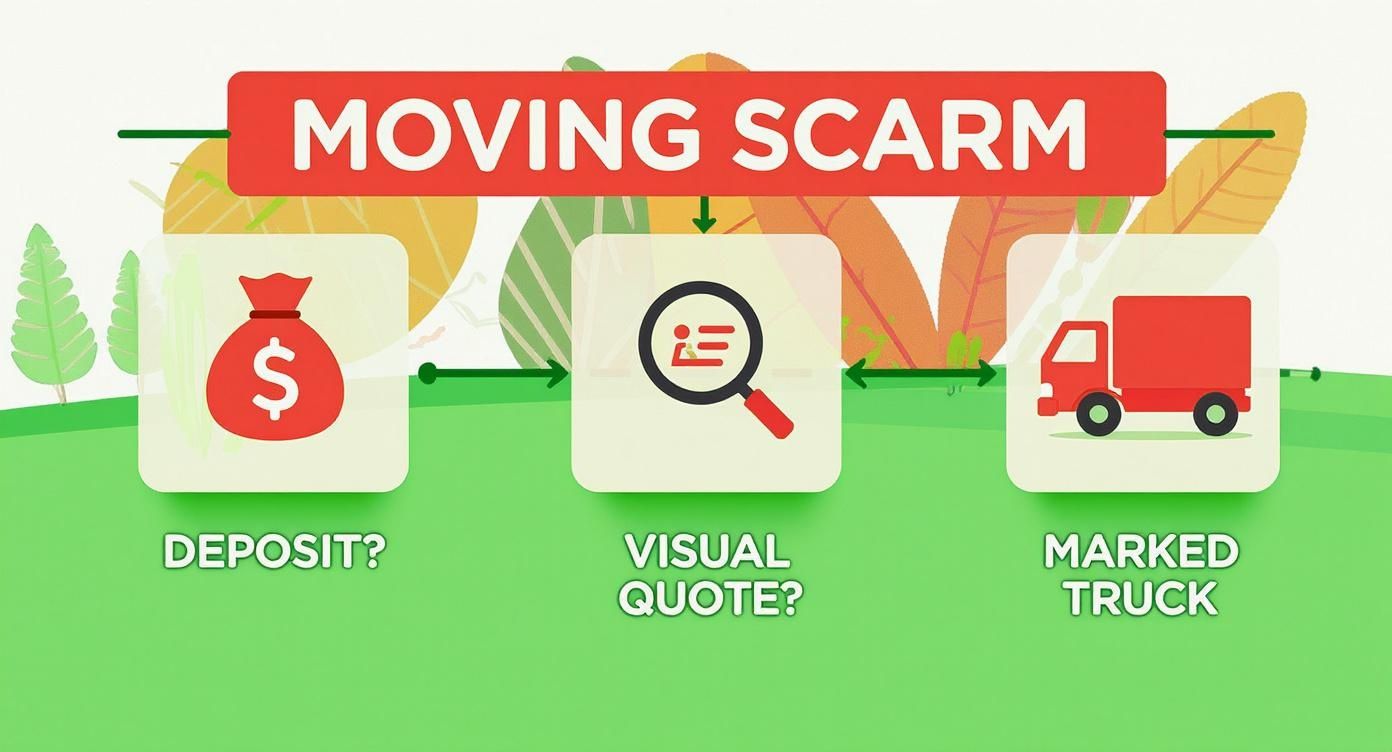
It really just reinforces the basics: always demand a visual quote (in-person or virtual) and run far away from anyone asking for a huge deposit upfront. Those are classic signs of a rogue operator.
When you’ve done your homework, it’s time to organize the details to make that final comparison.
Use this simple checklist to lay everything out side-by-side. Seeing the key details in black and white can make the right choice jump right off the page.
| Factor | Company A | Company B | Company C |
|---|---|---|---|
| Estimate Type (Binding, Non-Binding, etc.) | |||
| Total Quoted Cost | |||
| USDOT & MC License # | |||
| Insurance Coverage (Included & options) | |||
| Services Included (Packing, materials, etc.) | |||
| Key Red Flags? (Large deposit, vague info) | |||
| Online Review Vibe (Overall sentiment) | |||
| Gut Feeling (Professionalism, communication) |
Once you’ve filled this out, the decision often becomes much clearer.
In the end, trust your gut. Go with the company that was transparent from the start, answered your questions without hesitation, and gave you a detailed, professional quote. That’s how you find a mover who will get you to your new home without the headache.
Once you’ve narrowed down your choices, you’ll probably still have a few last-minute questions buzzing around. It’s totally normal. Getting these final details ironed out is the last hurdle in picking the right moving company, and it’s what gives you that final dose of confidence before signing on the dotted line.
Honestly, one of the biggest mistakes people make is waiting until the last minute. If you want the best choice of movers and the most reasonable prices, you should be booking your move at least eight weeks in advance.
This is non-negotiable if you’re planning a move during peak season, which is a mad dash from May through September. Weekends and the end of the month are also prime time for movers, so those slots fill up fast. Booking early doesn’t just secure your spot; it gives you the breathing room to get everything else in order without that frantic, rushed feeling. If you’re moving in the off-season, you might get away with four to six weeks’ notice, but trust me, more time is always your best friend when it comes to reducing stress.
This is a huge one, and it all comes down to who is actually responsible for your stuff. A mover, which the industry calls a carrier, is the company that owns the trucks, hires the crew, and physically shows up to move your belongings. You’re dealing with them directly, from the first call to the last box.
A moving broker, on the other hand, is basically a middleman. They’re a sales team that books your move and then sells that job to an actual moving company. While they can sometimes connect you with a carrier, you lose that direct connection and accountability. If something breaks or the truck is late, you can get stuck in a frustrating blame game between the broker and the carrier they hired. My advice? Always ask point-blank: “Are you a carrier or a broker?” Working directly with a carrier is almost always the simpler and more reliable path.
This really boils down to a classic trade-off: your money versus your time and sanity. A full-service pack can sound like an extravagant luxury, but the sheer amount of time and physical labor it saves is immense.
Professional packers know exactly how to wrap fragile items to prevent breakage, and they work with an efficiency that’s hard to match. For a lot of people, the peace of mind knowing their heirloom china or expensive electronics are properly protected is worth every penny.
If a full pack feels like too much of a stretch for your budget, don’t forget you have other options. Think about a partial packing service. You could have the pros tackle the most tedious and fragile room—like the kitchen with its endless plates and glassware—while you handle the easy stuff like clothes and books. Figuring out what services you need is a big part of creating an accurate moving budget. For a better idea of what to expect, check out our guide on average moving costs. It can help you figure out where your money is best spent to make your relocation as smooth as possible.
At Family Movers Express LLC, we believe in making your move clear and straightforward from the start. From transparent pricing to full-service packing, we’re the reliable team you can count on. Ready to get started with a mover you can trust? Get your free estimate today!
Ready to protect your upcoming move?
Click Here to Fill Out Our Quick Form & Secure Your Instant Quote!