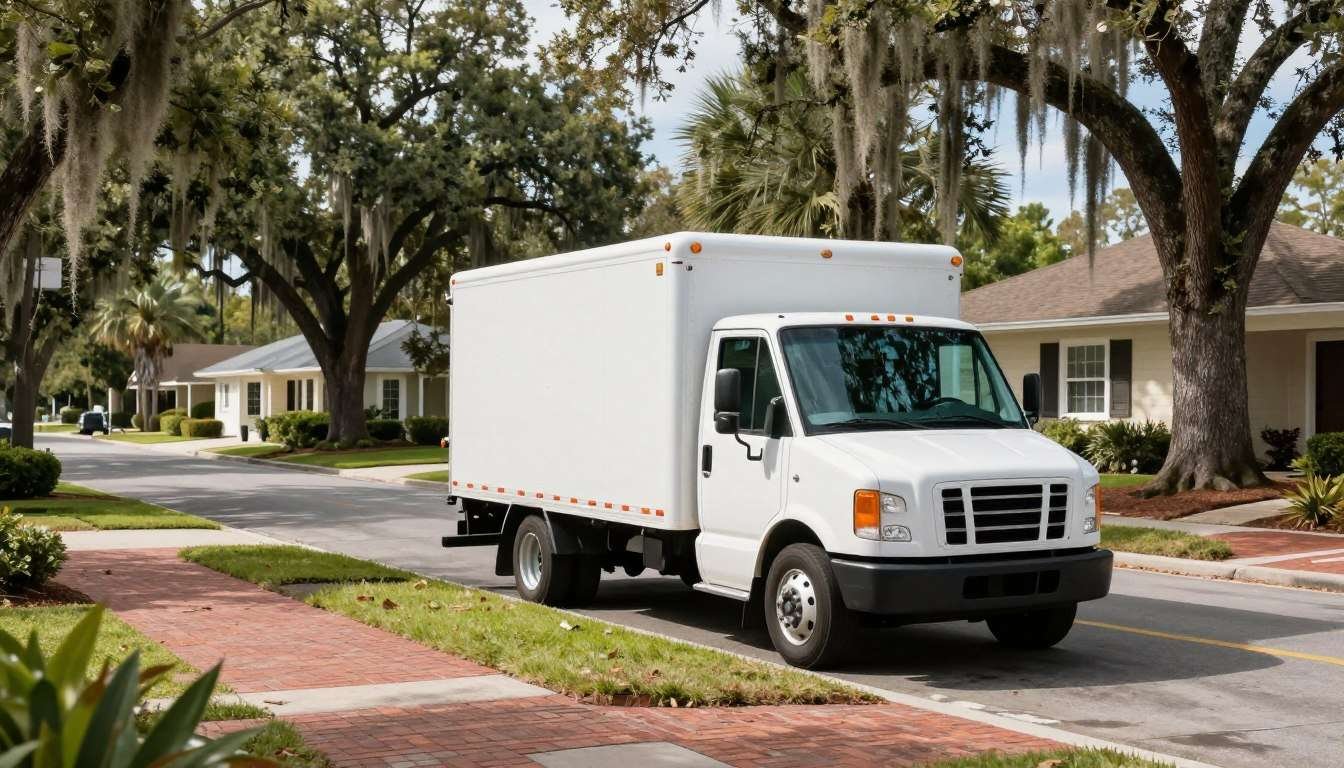
A move around Orlando gets easier to plan once you know what you need to haul and where the rental starts and ends. If you are moving across town, choosing a vehicle that fits your items can help keep the day manageable. A move to another city brings different route and timing needs, so your reservation should reflect the full trip.
Start with a rough inventory, then compare complete quotes for the date and route you expect to use. The right choice depends on what you are carrying, how far you are going, and where you plan to return the vehicle. Check the final terms before committing, since a displayed starting rate may not cover every part of your trip.
This page helps you sort out the practical choices, from truck size and local pricing to pickup details and return rules. You can use those details to prepare a reservation that fits your move rather than relying on a rate shown without trip information. Before reserving, have your move date, route, and a rough inventory of your items ready.
Key Takeaways
- Compare the complete quote, not only the daily base rate.
- Match the truck’s cargo space and weight limit to your load.
- Choose local or one-way service based on where you will return the rental truck.
- Include mileage, fuel, equipment, and any optional protection in your budget.
- Confirm the pickup point, return rules, and reservation details before travel.
Moving Truck Rental Orlando: What Does It Cost?
A one-day, 30-mile U-Haul rental estimate runs from $55.65 for a 10-foot truck to $85.65 for a 26-foot truck before the listed exclusions. The estimated trip cost is more useful than the advertised starting price when you are setting a moving budget.
U-Haul’s 2026 local box-truck base rates range from $19.95 to $49.95 per day, before mileage and fees. A mileage allowance is the number of miles included in a one-way rental quote before extra-mile charges apply. In-town rentals start at $19.95 plus a per-mile fee, and rates vary by location, season, and day of the week.
| Truck size | Daily base rate | Estimated pre-tax cost for one day and 30 miles | Exclusions |
|---|---|---|---|
| 10-foot | $19.95 | $55.65 | Optional coverage, fuel, environmental fees, and equipment rentals |
| 15-foot | $29.95 | $65.65 | Optional coverage, fuel, environmental fees, and equipment rentals |
| 20-foot | $39.95 | $75.65 | Optional coverage, fuel, environmental fees, and equipment rentals |
| 26-foot | $49.95 | $85.65 | Optional coverage, fuel, environmental fees, and equipment rentals |
Those estimates show how a low daily price can grow once mileage and trip details enter the quote. In-town mileage rates usually rise from April through August. They are lowest Sunday through Thursday, so your move day can affect the total even when the route stays the same.
Compare the final checkout total for your dates, not just the base rate shown first.
For a clearer comparison, check that each quote covers the same truck size, rental period, mileage, and equipment. An itemized estimate can help you spot costs that a lump sum might hide, such as fuel or moving supplies. See these tips for reviewing itemized moving estimates as a reminder to check what a quote includes.
U-Haul’s listed local starting rate is not the full bill, and the estimated figures above are pre-tax. Your checkout total can change with the date, location, mileage, and day of week. Compare the final checkout total for your dates, not just the base rate shown first.
Which Truck Size Fits Your Move?
A studio or one-bedroom apartment is the usual starting point for considering a 10-foot truck, while a larger household may need substantially more cargo space. Bedroom counts are guides, not guarantees, because furniture shape and the number of boxes also affect what fits.
Compare cargo volume and the truck’s weight limit alongside the home-size guidance. U-Haul offers a pickup truck, cargo van, and 10-, 15-, 20-, and 26-foot trucks as its six moving-truck options. The chart gives the listed interior dimensions and typical household fit for four box-truck sizes.
| Truck size | Interior dimensions | Cargo volume | Typical home fit |
|---|---|---|---|
| 10-foot | 9’11” × 6’4″ × 6’2″ | 402 cubic feet | Studio or one-bedroom apartment |
| 15-foot | 15′ × 7’8″ × 7’2″ | 764 cubic feet | One-bedroom home or two-bedroom apartment |
| 20-foot | 19’6″ × 7’8″ × 7’2″ | 1,016 cubic feet | Two-bedroom home or three-bedroom apartment |
| 26-foot | 26’2″ × 8’2″ × 8’3″ | 1,682 cubic feet | Three- to four-bedroom home |
Choose a 10-foot truck for a compact load
The 10-foot truck has 402 cubic feet of cargo space and is listed for a studio or one-bedroom apartment. It seats two adults, so account for that limit if you expect to ride with someone else. A compact load of boxes and smaller furniture may suit this vehicle, but a bulky sofa or large appliance can change the fit.
Think about the items that will take up space rather than relying only on the number of rooms. A few large pieces can fill the cargo area faster than many small boxes. If your furniture includes tall or wide pieces, measure those pieces before choosing this size.
Compare 15-foot and 20-foot capacity
The 15-foot truck holds 764 cubic feet, while the 20-foot truck holds 1,016 cubic feet. That difference can matter when your load includes several large furniture pieces or a larger number of boxes. Both sizes seat three adults, giving you one more passenger seat than the 10-foot option.
U-Haul lists the 15-foot truck for a one-bedroom home or two-bedroom apartment. It lists the 20-foot truck for a two-bedroom home or three-bedroom apartment, and also describes that size as suitable for a two- to three-bedroom home or large apartment. Use the descriptions as a starting point, then compare your actual belongings with the available space.
Reserve the largest listed size for a larger household
The 26-foot truck provides 1,682 cubic feet and is listed for a three- to four-bedroom home. That capacity can make sense when a large household has substantial furniture, stored belongings, or many boxes. It also seats three adults.
Gross vehicle weight is a separate limit from cargo volume. U-Haul lists maximum gross vehicle weights of 8,600 pounds for the 10-foot truck, 14,500 pounds for the 15- and 20-foot trucks, and 25,999 pounds for the 26-foot truck. The limit applies to the loaded vehicle, not just the space your belongings occupy. Measure bulky furniture and check the weight limit as well as the cubic-foot estimate before choosing.
Is a Local or One-Way Rental Better for Your Route?
An in-town rental suits a move that starts and ends nearby, while one-way service is designed for a move that ends somewhere else. Choose by destination: returning the rental truck near its pickup point and dropping it in another city are different rental plans.
Check the booked mileage allowance and rental period before taking a one-way trip. The mileage allowance is the number of miles included in a one-way rental quote before extra-mile charges apply. U-Haul charges $1.00 per additional mile after that allowance is exceeded and $40 for each additional day on a one-way truck rental.
- Return to the pickup area after a local move.
- Move to another city and leave the truck at a different destination.
- Travel one way with more miles or days than you booked.
Choose an in-town rental for a return trip
An in-town rental fits a route that brings you back to the pickup area. That arrangement can work for a move within Orlando when you plan to return the truck after unloading. Your quote should match the rental period and the trip you expect to make.
Think through the full route, including any extra driving between the old home, new home, and storage. A detour adds distance, and a long loading or unloading period can affect how much of the rental day you use. Leave a realistic time window rather than planning around an ideal drive alone.
Consider one-way service when the destination is elsewhere
One-way service can suit a move that ends in another city, since you do not need to return to the original pickup area. For a 1,200-mile move, U-Haul’s example one-way base rates are about $1,015 for a 10-foot truck, $1,249 for a 15-foot truck, $1,530 for a 20-foot truck, and $1,703 for a 26-foot truck, excluding fuel.
Estimated fuel for that 1,200-mile trip is about $350 for a 10-foot truck and about $420 for each of the 15-, 20-, and 26-foot trucks. These are separate trip costs, not a promise of the amount you will pay. A longer route or an extra rental day can also lead to added charges after the booked allowance.
Make sure your route and planned return match the one-way quote, especially if your schedule could shift. A vehicle, weather, or loading delay may change the time you need on the road. Leave room in the itinerary for mileage and rental days beyond the original one-way allowance.
Is U-Haul or Budget Cheaper for a Local Move?
Budget has the lower listed base and per-mile rates in this 2026 local comparison. That rate comparison is a useful starting point, but it does not settle which provider will cost less for your Orlando move.
Budget’s listed rate is lower for both the base charge and each mile in this comparison. The table keeps the listed figures together so you can compare them with a live quote for your own route.
| Provider | Listed local base rate | Listed per-mile charge |
|---|---|---|
| Budget | $27.61 | $0.47 |
| U-Haul | $38.70 | $0.99 |
| Your Orlando quote | Enter live quote, not an estimate | Enter live quote, not an estimate |
In the stated 2026 comparison, Budget’s base charge is $11.09 lower, and its per-mile charge is $0.52 lower. Those differences describe the listed rates, not a guaranteed total for every customer. Your route, rental period, selected truck, and protection choices can change the final checkout amount.
To compare fairly, use the same move date, truck size, mileage, and rental duration in both quote forms. Include the same protection choices and equipment, or the totals will not represent matching rentals. A smaller base rate can lose its advantage if the rental details differ.
U-Haul pricing and mileage terms should be checked against a same-route Budget quote before reserving. Confirm that the quote covers the same start and return points and the full rental period you need. This helps you judge the actual total rather than relying on a single rate line.
A local quote is useful only when it reflects the conditions of your move. If one provider prices a shorter rental or a different mileage amount, adjust the details before comparing. Use the same move details in both quote forms before deciding which total is lower.
When Are Enterprise, Penske, or Ryder Alternatives?
Enterprise’s May 2026 three-day 15-foot quote had a higher base charge than U-Haul’s, but a lower per-mile charge. The route matters when you compare those charges, because mileage changes how much each rate contributes to your total.
The quoted base was $239.33 for Enterprise and $97.49 for U-Haul, while the per-mile charges were $0.18 and $0.99. Both quotes excluded insurance and other services, so they do not show every possible cost.
Compare Enterprise for a local rental
The May 2026 U-Haul quote was $97.49 plus $0.99 per mile for a three-day, in-town 15-foot rental. The Enterprise quote for the same stated rental period and truck size was $239.33 plus $0.18 per mile. Enterprise’s lower per-mile charge does not cancel its higher quoted base; the mileage total affects the comparison.
Use these amounts as a comparison example, not a guarantee for a later reservation. The final amount depends on the route’s mileage and the selected rental details. Enterprise Truck Rental does not offer one-way truck rentals, so it is an option to consider for a local rental rather than a move ending elsewhere.
Check Penske and Ryder for the right rental type
Penske lists a cargo van and 12-, 16-, 22-, and 26-foot trucks. Those choices may suit a move when one of those vehicle types matches your load and route. Check the specific rental terms for the location and dates you select.
Ryder requires a registered business and does not accept personal or one-way rentals. That makes Ryder unsuitable for a personal household move, even if a nearby location appears convenient. The rental type is as important as the vehicle itself when you choose a company.
Compare the service that fits your trip rather than looking only at a truck name or one price line. A local move, a business rental, and a one-way household move can call for different options. Choose an alternative only after confirming that its rental type and route match your move.
Where Can You Pick Up a Rental Truck in Orlando?
Orlando has more than 70 U-Haul locations and neighborhood dealers, so check the specific pickup and return points for your route. Convenience depends on where you start and finish, not only on which location looks closest on a map.
Confirm the actual pickup address, return rules, and availability in the live location tool. U-Haul has more than 25,000 rental locations across the United States and Canada, with a range of services at local sites.
Check neighborhood locations and return services
Orlando’s rental options include neighborhood dealers and service locations, so the available features can differ from one address to another. U-Haul Moving & Storage of South Goldenrod offers trucks, trailers and towing, self-storage, and moving supplies. Check the service list for the exact location you plan to use.
The U-Haul location at 840 S Orange Blossom Trail lists 24-hour customer truck return. U-Haul’s Orlando 32807 location lists one-way and in-town rentals, moving trucks, trailers and towing, self-storage, and moving supplies. A service listed at one site should not be assumed to apply at another.
Verify airport-area pickup details
Moving truck rental Orlando airport searches can lead you to nearby addresses, but an airport-area location name does not establish that pickup is available there. Check the actual pickup address, return rules, and live availability for your selected dates. The location itself may offer a different mix of services than another branch nearby.
Check 13301 S Orange Blossom Trl, Orlando, FL 32837, and 3830 S Goldenrod Rd, Orlando, FL 32822, in the live locator rather than assuming either address has a truck available. Penske lists Orlando locations at 2177 W Landstreet Rd, Orlando, FL 32809, and 4233 N John Young Pkwy, Orlando, FL 32804. Compare the exact address shown for your reservation with the address you intend to visit.
Pickup and return points can affect how practical a rental is on moving day. Some locations list a 24-hour return option, while others may have different return arrangements. Save the confirmed pickup and return addresses with your reservation details.
How Do Mileage and Fuel Change the Total?
Fuel can add hundreds of dollars to a long move, with the 1,200-mile estimate reaching about $420 for several larger U-Haul truck sizes. Fuel is separate from the listed rental base rate, so include it when planning a long route.
A truck’s maximum listed fuel economy is not a guaranteed result for your trip. U-Haul trucks use unleaded fuel, and actual mileage can change with the load, road grades, weather, and speed. A heavily loaded vehicle or difficult driving conditions may affect the fuel you use.
U-Haul lists a maximum of 12 miles per gallon for the 10-foot truck, 10 mpg for the 15- and 20-foot trucks, and 8-10 mpg for the 26- and 29-foot trucks. The word maximum matters: the listed figure describes a limit, not a promise that every route will reach it.
The listed tank capacities are 31 gallons for the 10-foot truck, 40 gallons for the 15- and 20-foot trucks, and 60 gallons for the 26- and 29-foot trucks. Tank size can help you plan fuel stops along the route. It does not guarantee a specific driving range, since load and road conditions change fuel use.
For a 1,200-mile move, U-Haul estimates fuel at about $350 for a 10-foot truck and about $420 for each of the 15-, 20-, and 26-foot trucks. These are examples for planning, not fixed fuel costs. Your actual expense depends on the truck, route, and driving conditions.
Keep fuel separate from the rental base when you compare trip costs. A longer route, changing weather, or more cargo can make the actual amount differ from the estimate. Budget fuel using the specific truck and route, then allow for actual mileage to differ from the maximum figure.
What Equipment and Protection Should You Consider?
Add-ons are worth considering when the move includes a towed vehicle, fragile furniture, or a need for extra roadside help. Choose what fits your load and trip rather than adding equipment by default.
Check towing capacity before pairing a carrier with a rental truck. U-Haul lists towing capacity up to 6,000 pounds for its 15- and 20-foot trucks and up to 10,000 pounds for its 26-foot truck. Make sure the loaded vehicle and towing equipment stay within the applicable limit.
- Vehicle towing: decide whether your move needs a carrier or other towing equipment.
- Moving supplies: consider boxes and furniture pads for items that need protection.
- Optional coverage: review whether damage coverage fits the trip and rental terms.
Boxes can help group smaller belongings, while furniture pads can help protect larger pieces during handling. If you have fragile items, think about how they will sit in the cargo area and what supplies you need to secure them. Storage plans may also affect how you pack and unload.
U-Haul truck rentals include roadside assistance. Safetrip coverage is available for as low as $5 per rental and offers 24/7 help with issues including lost keys, jumpstarts, and fuel service. That stated service scope does not mean Safetrip replaces every type of coverage, so consider what protection you need for the rental itself.
Read the terms for each add-on before including it in the reservation. The purpose of a carrier, supplies, or optional service should match a real need on your route. Confirm that the truck’s towing limit fits the loaded vehicle and equipment before adding a carrier.
How Do You Reserve the Right Truck?
A useful reservation starts with the route and dates, not with choosing the first truck shown. Complete details help the quote reflect the move you intend to make.
Enter the pickup and return points, dates, duration, and truck size before comparing totals. Location rules and availability can affect which choices appear for the trip you select.
Gather the details for a complete quote
Work through these steps before you choose a reservation:
- Enter the pickup and return points for the route.
- Choose the dates and rental duration you need.
- Select a truck size that fits the planned load.
- Add mileage and equipment details before comparing totals.
Complete details make it easier to compare the same rental type across options. Include the return point, not just the first address, and use a realistic rental duration. If you change a route or date later, review the quote again because the available choices may change.
Confirm pickup time, location, and availability
Availability and booking lead times depend on the selected location and rental rules. U-Haul Gatorland, U-Haul Goldenrod, and U-Haul OBT are names to check in the live locator for the exact pickup point, return option, and availability. The location name alone does not confirm a truck or a specific service.
U-Haul Truck Share 24/7 lets customers pick up and return a rental truck at any time, day or night, using a phone. Penske’s online reservation rules shown for a location may require booking 3, 24, or 48 hours before pickup. Those rules also list a 24-hour minimum rental duration, so check the terms for your selected location.
Review the pickup time and return instructions shown with the reservation. Keep the confirmation available in case you need to check the address or rental details on the day. Keep the reservation confirmation accessible on your phone before heading to pickup.
What Should You Check Before Driving?
Before leaving the lot, confirm the truck’s condition and make sure the person driving is authorized under the rental agreement. A quick check can help you catch a visible problem before the move is underway.
The driver must meet the specific agreement’s rules, and the load must stay within the truck’s limits. Rental terms differ by company, so do not assume one provider’s rules apply to every vehicle.
Inspect the truck and confirm who may drive
Look over the vehicle’s visible condition before departure and note any damage you see. Check that the person taking the wheel meets the rental agreement’s requirements. If another person may drive, confirm that the agreement allows that person before handing over the keys.
Budget requires the renter to be at least 18 and properly licensed. Budget permits only the renter or a named, authorized additional driver to operate the truck. Those are Budget terms, not universal rules for every rental company, so check the agreement attached to your own reservation.
Secure the load and follow the rental rules
Before you pull out, use this four-point checklist:
- Secure the load so items cannot shift during the drive.
- Confirm that the driver is authorized under the rental agreement.
- Keep phone use hands-free while driving.
- Follow the truck’s load limits and secure items properly.
Budget’s rental terms prohibit driving while using a handheld phone except in hands-free mode. They also prohibit overloading or improperly securing a load. These rules make a clear difference when a busy moving day tempts you to rush or add one more item.
Check that heavy belongings are stable and that fragile items will not slide into other cargo. Keep the driver’s view clear and follow the rental terms for the specific vehicle. Recheck straps and load placement before the first turn, then stop if anything shifts.
What Can Add Charges When You Return the Truck?
A return that misses the agreed time or leaves the truck unusually dirty can add charges beyond the original quote. Return terms matter because cleanliness, approved changes, and timing can all affect the final bill.
Follow the return time and location listed in your rental agreement, and request approval before changing either one. The exact rules and charges depend on the signed rental agreement.
Budget may charge $25 or more if a truck is returned unclean. Budget may charge a $12 fee for an approved extension or return-location change. An unapproved change can create a different problem, so contact the provider before acting on a change to the plan.
Request approval before extending the rental or changing the return location, and follow the written terms for the return.
For a local truck returned after its contracted date, Budget may charge a late fee and the daily rental rate. A small delay can matter if it pushes the return past the time or date in the agreement. Keep track of the agreed return window as the move day unfolds.
Leave the cab and cargo area clear, and follow the rental document’s instructions for returning the vehicle. If unloading, traffic, or a change in your plans could delay the return, contact the company before the original deadline. Do not assume a phone call or a request automatically changes the contract.
Charges differ by provider and by the terms you signed, so use the agreement for the exact rules that apply. Take care of the truck’s condition during the rental and return it to the designated location. Take a final look through the cab and cargo area before handing back the truck.
Conclusion
A smooth Orlando move starts with a truck that fits the load and a quote that matches the route. Choose based on your belongings, planned return, and moving dates, then compare complete totals rather than a starting rate alone.
Before booking, confirm the rental terms that matter for your trip, including the pickup and return locations and any selected add-ons. A few accurate details can make the reservation more useful than a quick estimate that leaves out part of the route.
Enter your dates and pickup and return locations to check the current truck options and reserve the one that fits.
FAQ
How much is it to rent a small moving truck?
Which is cheaper, U-Haul or Enterprise?
Is U-Haul really $20 a day?
Who is cheaper, U-Haul or Budget?
What are U-Haul rates per day?
What truck rental is cheaper than U-Haul?
Does U-Haul charge per mile or hour?
What’s the average cost of a U-Haul truck?
Ready to protect your upcoming move?
Click Here to Fill Out Our Quick Form & Secure Your Instant Quote!